
 Afrikaa
 Eeshiyaa
 Awurooppaa
 Ameerikaa Kibbaa
 Awustiraaliyaa fi Oshiyaaniyaa
 Antaarkitikaa
 Garba Paasifikii
 Garba Atlaantikii
 Garba Hindii
 Garba Arkitikii
 Galaana Meditiraaniyaa
 Galaana Diimaa
 Galaana Kaariibiyaan
 Galaana Kooraal
 Galaana Chaayinaa Kibbaa
 Galaana Filippiinsii
 Galaana Andamaan
 Galaana Kaabaa
 Galaana Timoor fi Araafuuraa
 Galaana Bengaal
 Galaana Kaaliforniyaa
German wasp
 Iddii
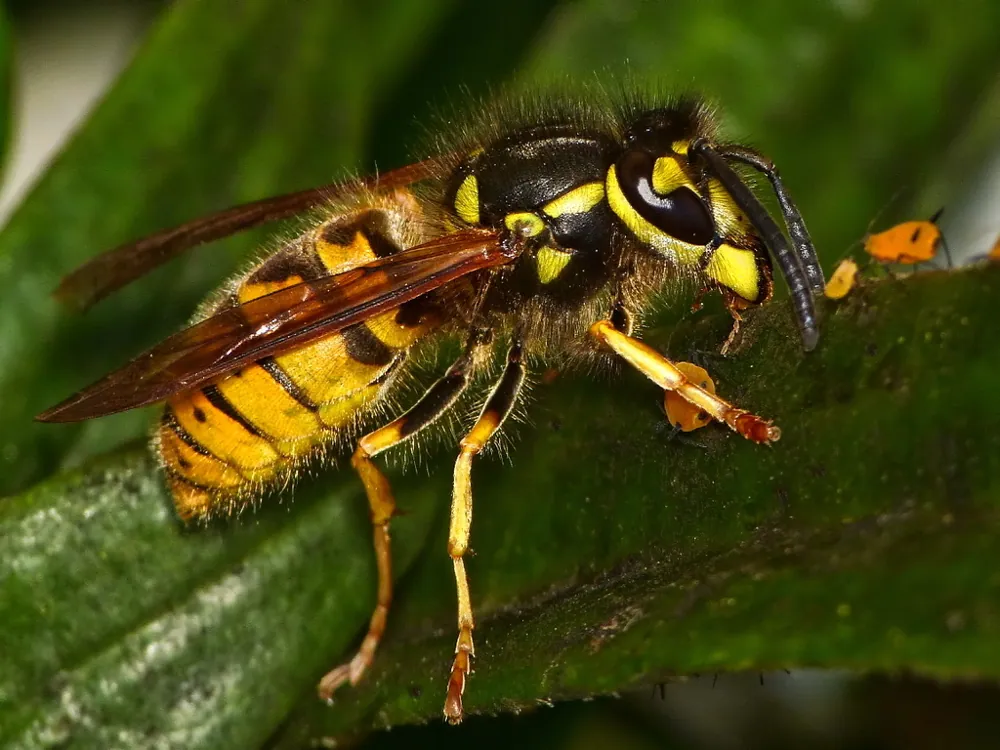
IddiiThe German wasp is a black and yellow social wasp that lives in colonies. It is native to Europe, Northern Africa and temperate Asia, but it has spread to many other parts of the world. Because it competes with local wildlife, it is treated as a pest in most areas outside its native range.1


 Akkaataa itti beekamu
- About 13 mm long, with typical wasp colours of black and yellow1
- Workers have three tiny black dots on the clypeus (the front part of the head, between the eyes and mouthparts)1
- Black marks on the abdomen are highly variable, so they are not a reliable way to identify it1
- Grey paper nests, often in the soil or in attics1
Yeroo baay'ee kan itti wal fakkeessan: The German wasp is very similar to the common wasp (Vespula vulgaris). Unlike the common wasp, it has three tiny black dots on the clypeus, but this only applies to workers. In males, the normally unbroken black mark on the common wasp's clypeus can look broken, which makes it hard to tell the two apart. Members of Vespula are also often confused with the paper wasp Polistes dominula.1
Humna summii
Summiin qeensa iddii (stinger) keessaan ba'a.
Namootaaf hammam balaa qaba?
Balaa namootaaf: Ni dhukkubsaBaay'ee dhukkubsuu danda'a, garuu gonkumaa jechuun ni danda'ama cimaa hin ta'u. Yoo idde
- Qeensa kanniisaa (stinger) haqii baasiitii bakka sana qabbaneessi.
- Yoo namichi hargansuuf rakkate, fuulli ykn qoonqoon isaa dhiite, ykn of wallaaluuf jedhe, kun balaa tasaa alarjii ti: lakkoofsa balaa tasaa bilbili, yoo qalama adrenaaliinii (adrenaline pen) qabaate immoo itti fayyadami.
Yeroo hunda dursa lakkoofsa balaa tasaa kee bilbili (112, 000, 911). Kun qajeelfama gargaarsa jalqabaa waliigalaa ti, gorsa yaalaa miti. Bu'uura gargaarsa jalqabaa
 Nageenyaan turi
- Bineensa bosonaa gonkumaa hin tuqin, hin qabin, hin tuttuqin, xiqqaa ta'us, rafe ykn du'e fakkaatus.
- Iddoo itti kenni. Yoo tokko wajjin wal argite, tasgabbaa'i, suuta duubatti deebi'iitii karaa isaa akka deemu dhiisi.
- Yoo tokko si idde: tasgabbaa'i, sochii malee turi, lakkoofsa balaa tasaa kee (112, 000, 911) bilbili ykn dafii hospitaala ga'i. Maal akka fakkaatu yaadadhu, suuraan ni gargaara.
Si miidhuuf si hin barbaadu. Summii isaa nyaata qabachuuf ykn of eeguuf fayyadama, dhokachuu immoo baay'ee filata. Waa'ee nageenyaa dabalataan
Addunyaa keessaa eessatti?
Hammam guddaa dha?
Dheerinni isaa hammam?
Hammam ulfaata?
 qeensa quba kee irra taa'uu danda'a
 baay'ee salphaa waan ta'eef harka kee irratti hin dhaga'amu
 dirree kubbaa miilaa guutuu sekoondii 16 keessatti barrisee ce'uu danda'a
German wasp SI wajjin yoo wal bira qabamu hammam guddaa dha?
Herrega qofa barsiisaa kee keessatti. Homtuu hin olkaa'amu, eessayyuu hin ergamu.
Hammam ariifata?


Dhugaawwan
German wasps are invasive. They have spread to many continents and are especially successful at colonising new areas.1
They can outcompete many other animals for food, which has caused considerable harm to native wildlife where they have invaded.1
Female bee moths (Aphomia sociella) sometimes lay eggs in German wasp nests. Their larvae feed on the eggs, larvae and pupae, and can destroy large parts of the nest.1
In Australia, nests can grow very large and some survive the winter. In England, none of the nests in the study survive the winter.1
Queens mate with between one and seven males, and workers can lay eggs, although worker policing keeps most of their sons from reaching adulthood.1
Colonies grow rapidly over summer, with a large increase in worker numbers and nest size. In late summer, the colony focuses on producing new queens and males.1
Soba diigaa
Soba: German wasps are paper wasps because they build grey paper nests.
Dhugaa: The name is used by mistake. Strictly speaking, paper wasps belong to the subfamily Polistinae, while German wasps belong to the genus Vespula.1
Ogeeyyii summiitiif
- Maqaa saayinsii
- Vespula germanica
- Garee
- Kanniisa fi hurrii (wasp fi hornet)
- Maatii
- Vespidae2
- Tartiiba
- Hymenoptera
- Ardiiwwan
- Awurooppaa, Eeshiyaa, Afrikaa
- Ilmoolee
- A single queen starts a nest in spring and lays eggs in hexagonal cells, with one wasp developing in each cell through the egg, larva and pupa stages.1
- Balaa namootaaf
- 2 / 5: Ni dhukkubsa3
Dhugaawwan eessaa dhufu
- Vespula germanica (Wikipedia (CC BY-SA 4.0))
- Vespula germanica (iNaturalist): maqaa fi ramaddii.
- Venom Wiki: sadarkaan balaa, guddinni idilee fi tilmaamni ariitii kan keenya. Akkamitti akka hojjennu ilaali: Balaa akkamitti madaalla.
Dhugaan fuula kana irra jiru hundi lakkoofsa madda isaatti si qajeelchu qaba. Yoo waan tokko dogoggorre, dhiifama, nuti jaallattoota bineensotaa ti malee joornaalii saayinsii miti. [email protected] irratti nutti himi, ni sirreessina.
 Iskoorpiyooniin beela'eera! Venom Wiki pirojektii nama tokkoo ti: bilisa, beeksisa fi hordoftuu malee. Gumaachi xiqqaan interneetii irratti akka turu gargaara.Iskoorpiyoonii nyaachisi
Garee wal fakkaataa irraa dabalataan: Kanniisa fi hurrii (wasp fi hornet)
 Asian giant hornetKanniisa fi hurrii (wasp fi hornet)Ni ajjeesuu danda'a
 Common waspKanniisa fi hurrii (wasp fi hornet)Ni dhukkubsa qofa
 European hornetKanniisa fi hurrii (wasp fi hornet)Ni dhukkubsa qofa
 Western honey beeKanniisa fi hurrii (wasp fi hornet)Ni dhukkubsa qofa
 Giant honey beeKanniisa fi hurrii (wasp fi hornet)Doktora barbaada
 Asian hornetKanniisa fi hurrii (wasp fi hornet)Ni dhukkubsa qofa
Akkasumas kan jiraatu: Awurooppaa
 Common European adderBofoota viper fi adderDoktora barbaada
 Spanish flyBineensota summaa'oo birooDoktora barbaadaHin tuqin
 Fire salamanderRaacha summaa'aa, raacha lafaa fi newtNi dhukkubsa qofaHin tuqin
 Blunt-nosed viperBofoota viper fi adderNi ajjeesuu danda'a
 Nose-horned viperBofoota viper fi adderNi ajjeesuu danda'a
 Ottoman viperBofoota viper fi adderNi ajjeesuu danda'a