
 Afrikaa
 Eeshiyaa
 Awurooppaa
 Ameerikaa Kibbaa
 Awustiraaliyaa fi Oshiyaaniyaa
 Antaarkitikaa
 Garba Paasifikii
 Garba Atlaantikii
 Garba Hindii
 Garba Arkitikii
 Galaana Meditiraaniyaa
 Galaana Diimaa
 Galaana Kaariibiyaan
 Galaana Kooraal
 Galaana Chaayinaa Kibbaa
 Galaana Filippiinsii
 Galaana Andamaan
 Galaana Kaabaa
 Galaana Timoor fi Araafuuraa
 Galaana Bengaal
 Galaana Kaaliforniyaa
Thistledown velvet ant
 Iddii
IddiiThe thistledown velvet ant is a mid-sized member of the Dasymutilla genus, a group known as velvet ants. Its females have no wings and live in hot deserts in the south-western United States and northern Mexico. Females can deliver a very painful sting, so it is best to leave them alone.1
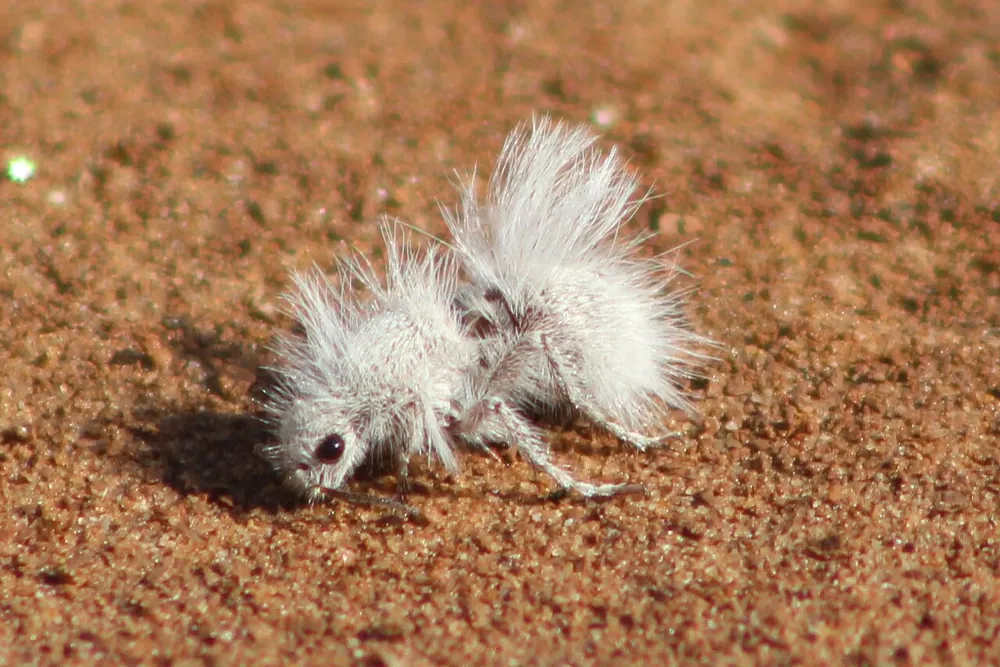
 Akkaataa itti beekamu
- Only the females are wingless.1
- It is mid-sized for a velvet ant, larger than some of the smallest species but smaller than some of the largest.1
- Females are camouflaged. They look like the fruit of the Creosotebush rather than having the bright warning colours seen in many other velvet ants.1
Yeroo baay'ee kan itti wal fakkeessan: Unlike the orange Dasymutilla species found in the same habitat, this species does not use bright orange or warning colours. Its camouflage helps it blend into the desert plants around it.1
Humna summii
Summiin qeensa iddii (stinger) keessaan ba'a.
Namootaaf hammam balaa qaba?
Balaa namootaaf: Ni dhukkubsaBaay'ee dhukkubsuu danda'a, garuu gonkumaa jechuun ni danda'ama cimaa hin ta'u.Females can deliver a very painful sting when threatened. Its sting is more powerful than those of most smaller velvet ants, but weaker than those of most larger ones.1
Yeroo sodaatu maal godha?
Females use their sting to defend themselves when threatened.1
 Yoo idde
- Qeensa kanniisaa (stinger) haqii baasiitii bakka sana qabbaneessi.
- Yoo namichi hargansuuf rakkate, fuulli ykn qoonqoon isaa dhiite, ykn of wallaaluuf jedhe, kun balaa tasaa alarjii ti: lakkoofsa balaa tasaa bilbili, yoo qalama adrenaaliinii (adrenaline pen) qabaate immoo itti fayyadami.
Yeroo hunda dursa lakkoofsa balaa tasaa kee bilbili (112, 000, 911). Kun qajeelfama gargaarsa jalqabaa waliigalaa ti, gorsa yaalaa miti. Bu'uura gargaarsa jalqabaa
 Nageenyaan turi
- Bineensa bosonaa gonkumaa hin tuqin, hin qabin, hin tuttuqin, xiqqaa ta'us, rafe ykn du'e fakkaatus.
- Iddoo itti kenni. Yoo tokko wajjin wal argite, tasgabbaa'i, suuta duubatti deebi'iitii karaa isaa akka deemu dhiisi.
- Yoo tokko si idde: tasgabbaa'i, sochii malee turi, lakkoofsa balaa tasaa kee (112, 000, 911) bilbili ykn dafii hospitaala ga'i. Maal akka fakkaatu yaadadhu, suuraan ni gargaara.
Si miidhuuf si hin barbaadu. Summii isaa nyaata qabachuuf ykn of eeguuf fayyadama, dhokachuu immoo baay'ee filata. Waa'ee nageenyaa dabalataan
Addunyaa keessaa eessatti?
Hammam guddaa dha?
Dheerinni isaa hammam?
 quba kee isa xiqqaa caalaa gabaabaa
Thistledown velvet ant SI wajjin yoo wal bira qabamu hammam guddaa dha?
Herrega qofa barsiisaa kee keessatti. Homtuu hin olkaa'amu, eessayyuu hin ergamu.
Hammam ariifata?


Dhugaawwan
Its females are camouflaged to look like Creosotebush fruit, instead of using the bright warning colours common to other velvet ants.1
Its colouring seems to be mainly an adaptation to hot desert conditions, not a defence against predators.1
Its internal and external body temperatures are lower than those of orange Dasymutilla species living in the same habitat.1
Its sting is stronger than those of most smaller velvet ants, but weaker than those of most larger ones.1
Like other velvet ants, only the wingless females have the sting used for defence.1
Dhugaawwan eessaa dhufu
- Dasymutilla gloriosa (Wikipedia (CC BY-SA 4.0))
- Dasymutilla gloriosa (iNaturalist): maqaa fi ramaddii.
- Venom Wiki: sadarkaan balaa, guddinni idilee fi tilmaamni ariitii kan keenya. Akkamitti akka hojjennu ilaali: Balaa akkamitti madaalla.
Dhugaan fuula kana irra jiru hundi lakkoofsa madda isaatti si qajeelchu qaba. Yoo waan tokko dogoggorre, dhiifama, nuti jaallattoota bineensotaa ti malee joornaalii saayinsii miti. [email protected] irratti nutti himi, ni sirreessina.
 Iskoorpiyooniin beela'eera! Venom Wiki pirojektii nama tokkoo ti: bilisa, beeksisa fi hordoftuu malee. Gumaachi xiqqaan interneetii irratti akka turu gargaara.Iskoorpiyoonii nyaachisi
Garee wal fakkaataa irraa dabalataan: Kanniisa fi hurrii (wasp fi hornet)
 Tarantula hawkKanniisa fi hurrii (wasp fi hornet)Ni dhukkubsa qofa
 Executioner waspKanniisa fi hurrii (wasp fi hornet)Doktora barbaada
 Warrior waspKanniisa fi hurrii (wasp fi hornet)Doktora barbaada
 Bald-faced hornetKanniisa fi hurrii (wasp fi hornet)Ni dhukkubsa qofa
 Cow killer velvet antKanniisa fi hurrii (wasp fi hornet)Ni dhukkubsa qofa
 Eastern cicada killerKanniisa fi hurrii (wasp fi hornet)Miidhaa hin qabu
Akkasumas kan jiraatu: Ameerikaa Kaabaa
 TerciopeloBofoota pit viperNama ajjeesa
 Eastern coral snakeBofa kooraalNi ajjeesuu danda'a
 Eastern diamondback rattlesnakeBofoota rattlesnakeNi ajjeesuu danda'a
 Eyelash viperBofoota pit viperNi ajjeesuu danda'a
 Timber rattlesnakeBofoota rattlesnakeNi ajjeesuu danda'a
 Western diamondback rattlesnakeBofoota rattlesnakeNi ajjeesuu danda'a