
 Afurika
 Aziya
Aziya Uburayi
 Amerika y'Amajyepfo
 Ositaraliya na Oseyaniya
 Antaragitika
 Inyanja ya Pasifika
 Inyanja ya Atalantika
 Inyanja y'Abahinde
 Inyanja ya Arigitika
 Inyanja ya Mediterane
 Inyanja Itukura
 Inyanja ya Karayibe
 Inyanja ya Korali
 Inyanja y'Amajyepfo y'u Bushinwa
 Inyanja ya Filipine
 Inyanja ya Andamani
 Inyanja y'Amajyaruguru
 Inyanja ya Timor na Arafura
 Ikigobe cya Bengali
 Ikigobe cya Kaliforuniya
Many-banded krait
 Iraruma
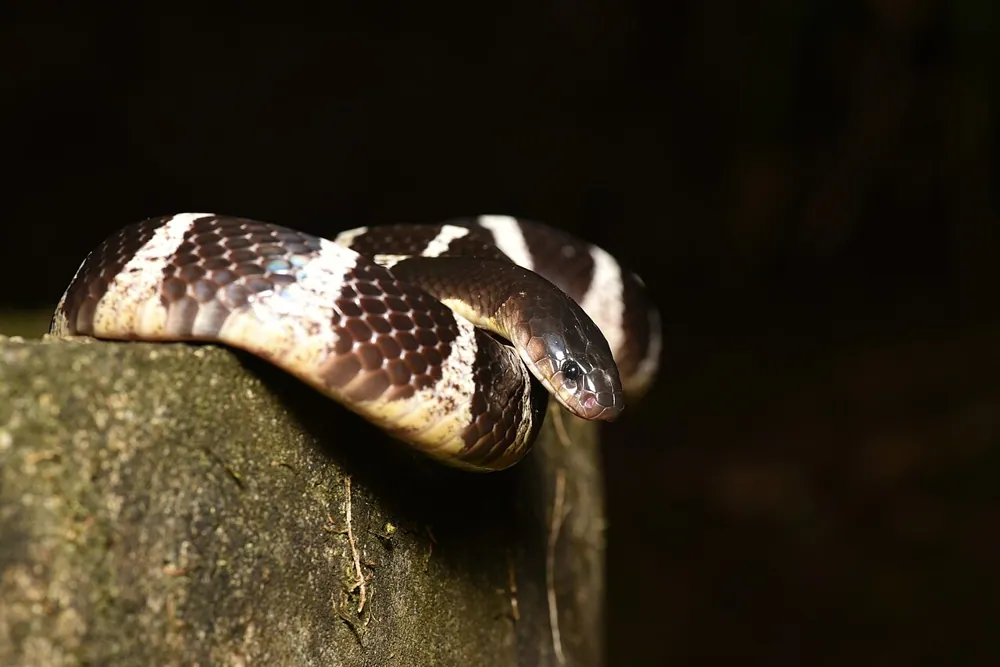
The many-banded krait is an extremely venomous snake found in central and southern China and much of Southeast Asia. It is black or bluish-black with many white bands across its body. It matters because its bite can be fatal, and it is one of the most venomous land snakes in the world.1



 Uko wayimenya
- The body is black to dark bluish-black.1
- It has about 21 to 30 white or creamy white cross bands along its upper body.1
- The short, pointed tail is black with 7 to 11 white cross bands.1
- The head is mostly black, broad and oval, and slightly flat.1
- Young snakes often have whitish blotches on the underside of the head.1
Ikunze kwitiranywa na: The Malayan krait (Bungarus candidus) is easily confused with this species. A 2017 genetic study found that many museum specimens labelled as many-banded kraits in China were actually Malayan kraits.1
Imbaraga z'ubumara
Ubumara busohokera mu menyo yayo y'ubumara cyangwa mu yandi menyo iyo iriye.
Ubumara bwayo bukora iki?
Its venom contains neurotoxins, which attack the nerves and the connections between nerves and muscles. Local effects are usually mild, with slight itching and numbness rather than serious swelling or pain. Symptoms usually start one to six hours after a bite and can include drooping eyelids, double vision, weakness, tongue paralysis, loss of voice and difficulty breathing.1
Iteje akaga kangana iki ku bantu?
Akaga ku bantu: YicaImwe mu nyamaswa ziteje akaga kurusha izindi ku isi.Estimated death rates from untreated bites vary between studies, from 25–35% to 70–100%. In a serious bite, breathing can stop and lead to death. In 2001, a juvenile bit the herpetologist Joe Slowinski in Myanmar and he died 29 hours later.1
Ikora iki iyo ifite ubwoba?
It is generally timid and placid, but it is more defensive at night and thrashes about when handled.1
 Niba iruma
- Umuntu agume atanyeganyega kandi atuje, mukuremo impeta n'ibindi bintu bifashe cyane, kandi mujye ku bitaro vuba: umuti urwanya ubumara (antivenom) ni wo muti.
Buri gihe banza uhamagare nimero y'ubutabazi (112, 000, 911). Izi ni inama rusange z'ubutabazi bw'ibanze, si inama za muganga. Ibanze by'ubutabazi bw'ibanze
 Irinde akaga
- Ntuzigere ukora, ufata cyangwa ushotora inyamaswa yo mu gasozi, nubwo yaba ntoya, kandi nubwo yasa n'isinziriye cyangwa yapfuye.
- Yihe umwanya. Niba uhuye n'imwe, tuza, usubire inyuma buhoro buhoro kandi uyireke yigendere.
- Niba imwe ikurumye: tuza, ntunyeganyege, hamagara nimero y'ubutabazi (112, 000, 911) cyangwa ujye ku bitaro vuba. Ibuka uko yasaga, ifoto irafasha.
Ntigushakisha ngo ikugirire nabi. Ikoresha ubumara bwayo kugira ngo ifate ibyo kurya cyangwa yirinde, kandi ikunda cyane kwihisha. Ibindi ku kwirinda
Ingana gute?
Ireshya ite?
 ireshya n'injangwe zo mu rugo 4 zikurikiranye kuva ku zuru kugeza ku murizo
 ireshya n'imineke 10 ikurikiranye
 yakwiruka metero 100 mu masegonda 49 (umuntu wihuta kurusha abandi akenera 9,6)
Many-banded krait ingana ite ugereranyije NAWE?
Ni imibare gusa ikorerwa muri mudasobwa yawe. Nta kintu kibikwa cyangwa cyoherezwa ahandi.
Yihuta gute?


Ibintu by'ukuri
Its venom is among the most potent of any land snake, based on lab tests on mice dating back to 1943.1
In 2001, a juvenile bite in Myanmar killed Joe Slowinski, which drew worldwide attention to the species.1
The snake that bit Slowinski was first thought to be this species, but it was later classified as a different species.1
It is active from April and retreats into hibernation in November.1
Usenya ibinyoma
Ikinyoma: American soldiers in the Vietnam War called it the "two-step snake", believing its venom could kill a person within two steps.
Ukuri: Its symptoms usually start one to six hours after a bite, and death can take much longer. The two-step belief is wrong, and a bite still needs urgent medical care.1
Ku bahanga mu by'ubumara
- Izina rya siyansi
- Bungarus multicinctus
- Itsinda
- Cobra, mamba na krait
- Umuryango
- Elapidae2
- Itsinda rinini (order)
- Squamata
- Imigabane
- Aziya
- Abana bato
- It lays eggs. Females usually lay 3 to 15 eggs, and up to 20 are possible. The eggs hatch about six weeks later, and the young are about 25 cm long.1
- Igihe ibaho
- hafi imyaka 13,71
- Akaga ku bantu
- 5 / 5: Yica3
Aho ibintu bivugwa bituruka
- Many-banded krait (Wikipedia (CC BY-SA 4.0))
- Bungarus multicinctus (iNaturalist): amazina n'ibyiciro.
- Venom Wiki: urwego rw'akaga, ingano isanzwe n'ikigereranyo cy'umuvuduko ni ibyacu bwite. Reba uko tubibara: Uko tugena akaga.
Buri kintu kivugwa kuri iyi paji gifite nimero yerekana aho cyavuye. Niba twibeshye, tubabarire, turi abakunzi b'inyamaswa, ntituri ikinyamakuru cya siyansi. Tubwire kuri [email protected] tuzabikosora.
 Sikorupiyo irashonje! Venom Wiki ni umushinga w'umuntu umwe: ni ubuntu, nta matangazo kandi nta bikurikirana abantu. Impano ntoya ifasha kugira ngo ikomeze kuboneka kuri interineti.Gaburira sikorupiyo
 Indian cobra
 King cobra
 Caspian cobra
 Common krait
 Malayan krait
 Monocled cobra
 Deathstalker
 Indian saw-scaled viper
 Puff adder
 Impiri ya Russell
 Asian giant hornet
 Komodo dragon