
 Afurika
 Aziya
Aziya Uburayi
 Amerika y'Amajyepfo
 Ositaraliya na Oseyaniya
 Antaragitika
 Inyanja ya Pasifika
 Inyanja ya Atalantika
 Inyanja y'Abahinde
 Inyanja ya Arigitika
 Inyanja ya Mediterane
 Inyanja Itukura
 Inyanja ya Karayibe
 Inyanja ya Korali
 Inyanja y'Amajyepfo y'u Bushinwa
 Inyanja ya Filipine
 Inyanja ya Andamani
 Inyanja y'Amajyaruguru
 Inyanja ya Timor na Arafura
 Ikigobe cya Bengali
 Ikigobe cya Kaliforuniya
Western black widow
 Iraruma
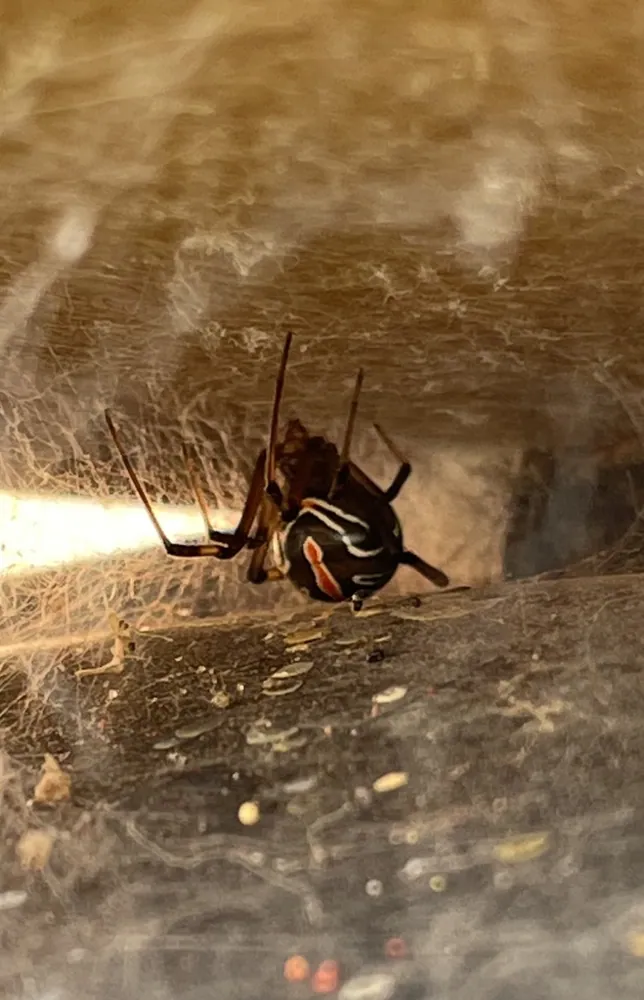
The western black widow is a venomous spider that lives in western North America. The female is black, often with a red hourglass mark on her belly, and her webs are tangled and irregular. Her venom is strong, so it is worth knowing what she looks like.1



 Uko wayimenya
- The female is about 14–16 mm long and black, often with an hourglass-shaped mark on the lower abdomen.1
- The hourglass mark is usually red, but it can be yellow and, very rarely, white.1
- The male is about half the female's length and is generally beige, with lighter striping on the abdomen.1
- Its webs are irregular or tangled, with no obvious overall pattern.1
Ikunze kwitiranywa na: It was once described as a subspecies of Latrodectus mactans and is closely related to the northern species Latrodectus variolus.1
Imbaraga z'ubumara
Ubumara busohokera mu menyo yayo y'ubumara cyangwa mu yandi menyo iyo iriye.
Ubumara bwayo bukora iki?
The female's venom contains a neurotoxin called α-latrotoxin, which attacks the nerves. In humans, its symptoms include pain, nausea, vomiting, goosebumps and localised sweating.1
Iteje akaga kangana iki ku bantu?
Akaga ku bantu: IkomeyeKurumwa na yo bisaba kujya kwa muganga. Abapfa ni bake cyane.Historical reports gave fatality rates between 0.5% and 12%. However, recent studies have not been able to confirm any deaths from the U.S. species of Latrodectus, including zero deaths among 23,409 documented bites from 2000 through 2008.1
Ikora iki iyo ifite ubwoba?
Juveniles and females can fling a sticky ball of silk at predators, which can stop most of them.1
 Niba iruma
- Oza aho yarumye kandi uhashyire agapaki k'urubura kubera ububabare. Shaka ubufasha bwa muganga niba ububabare bukabije, bukwirakwira cyangwa umuntu yumva atameze neza.
Buri gihe banza uhamagare nimero y'ubutabazi (112, 000, 911). Izi ni inama rusange z'ubutabazi bw'ibanze, si inama za muganga. Ibanze by'ubutabazi bw'ibanze
 Irinde akaga
- Ntuzigere ukora, ufata cyangwa ushotora inyamaswa yo mu gasozi, nubwo yaba ntoya, kandi nubwo yasa n'isinziriye cyangwa yapfuye.
- Yihe umwanya. Niba uhuye n'imwe, tuza, usubire inyuma buhoro buhoro kandi uyireke yigendere.
- Niba imwe ikurumye: tuza, ntunyeganyege, hamagara nimero y'ubutabazi (112, 000, 911) cyangwa ujye ku bitaro vuba. Ibuka uko yasaga, ifoto irafasha.
Ntigushakisha ngo ikugirire nabi. Ikoresha ubumara bwayo kugira ngo ifate ibyo kurya cyangwa yirinde, kandi ikunda cyane kwihisha. Ibindi ku kwirinda
Ingana gute?
Ireshya ite?
 ngufi kurusha agahera kawe
Western black widow ingana ite ugereranyije NAWE?
Ni imibare gusa ikorerwa muri mudasobwa yawe. Nta kintu kibikwa cyangwa cyoherezwa ahandi.
Yihuta gute?


Ibintu by'ukuri
When prey hits a gumfoot thread, the thread breaks and creates tension that pulls the line and prey up to the spider.1
This spider is an opportunistic cannibal, and it may eat other members of its own kind when prey is scarce, when it is very hungry, or in self-defence.1
The silk is strongly sticky, and its strength is similar to that of silk from orb-weaving spiders.1
Males can be preferred by females based on the webs, with well-fed females chosen over starved ones.1
Males may mate several times during their relatively short lives.1
Usenya ibinyoma
Ikinyoma: A black widow bite is usually deadly.
Ukuri: Recent studies have not confirmed any deaths from the U.S. species of Latrodectus, including zero deaths among 23,409 documented bites from 2000 through 2008.1
Aho ibintu bivugwa bituruka
- Latrodectus hesperus (Wikipedia (CC BY-SA 4.0))
- Latrodectus hesperus (iNaturalist): amazina n'ibyiciro.
- Venom Wiki: urwego rw'akaga, ingano isanzwe n'ikigereranyo cy'umuvuduko ni ibyacu bwite. Reba uko tubibara: Uko tugena akaga.
Buri kintu kivugwa kuri iyi paji gifite nimero yerekana aho cyavuye. Niba twibeshye, tubabarire, turi abakunzi b'inyamaswa, ntituri ikinyamakuru cya siyansi. Tubwire kuri [email protected] tuzabikosora.
 Sikorupiyo irashonje! Venom Wiki ni umushinga w'umuntu umwe: ni ubuntu, nta matangazo kandi nta bikurikirana abantu. Impano ntoya ifasha kugira ngo ikomeze kuboneka kuri interineti.Gaburira sikorupiyo
 Brown recluse
 Southern black widow
 Northern black widow
 Bold jumping spider
 Golden silk orb-weaver
 Central American wandering spider
 Terciopelo
 Eastern coral snake
 Eastern diamondback rattlesnake
 Eyelash viper
 Timber rattlesnake
 Western diamondback rattlesnake