
 Afurika
 Aziya
Aziya Uburayi
 Amerika y'Amajyepfo
 Ositaraliya na Oseyaniya
 Antaragitika
 Inyanja ya Pasifika
 Inyanja ya Atalantika
 Inyanja y'Abahinde
 Inyanja ya Arigitika
 Inyanja ya Mediterane
 Inyanja Itukura
 Inyanja ya Karayibe
 Inyanja ya Korali
 Inyanja y'Amajyepfo y'u Bushinwa
 Inyanja ya Filipine
 Inyanja ya Andamani
 Inyanja y'Amajyaruguru
 Inyanja ya Timor na Arafura
 Ikigobe cya Bengali
 Ikigobe cya Kaliforuniya
Yellow-spotted monitor
 Iraruma
The yellow-spotted monitor is a large, fast lizard that lives in northern and western Australia and southern New Guinea. It is one of Australia's biggest lizards, and it plays an important part in its ecosystem as a predator. It can give a painful bite if it feels threatened.1



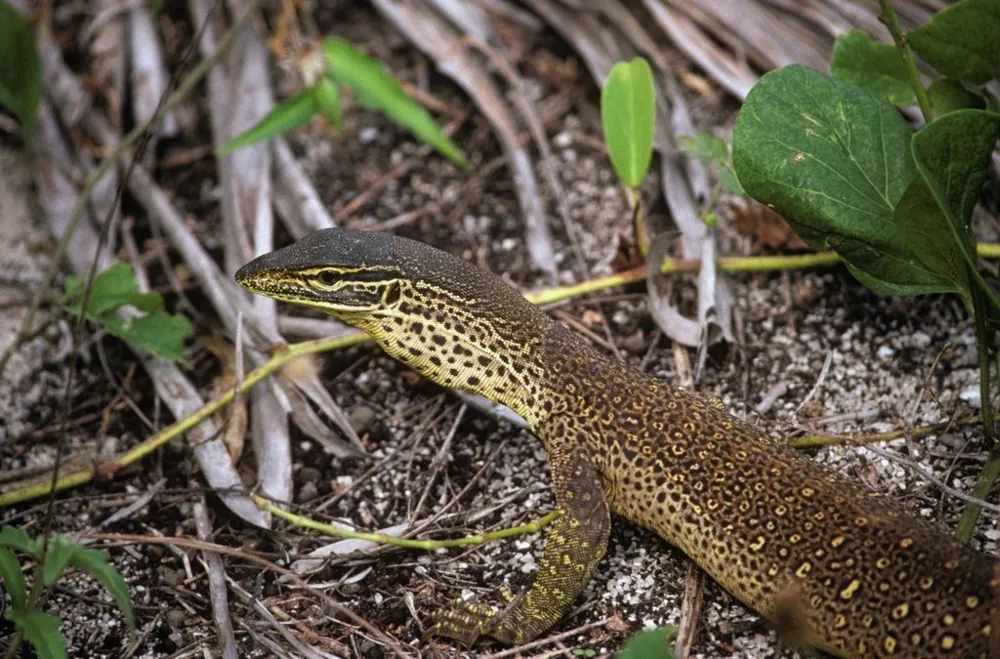
 Uko wayimenya
- Most individuals are yellow, with a brown or dark tan background.1
- Large, dark spots form rows along the back, and they are most distinct in the middle of the back.1
- Bands of colour appear toward the tip of the tail.1
- Adults are large: females average about 90 cm long and males about 120 to 150 cm.1
- Colour varies between individuals and places. The subspecies rubidus is reddish rather than brown.1
Ikunze kwitiranywa na: The sand goanna (Varanus gouldii) somewhat resembles the yellow-spotted monitor.1
Imbaraga z'ubumara
Ubumara busohokera mu menyo yayo y'ubumara cyangwa mu yandi menyo iyo iriye.
Iteje akaga kangana iki ku bantu?
Akaga ku bantu: IrababazaIshobora kubabaza cyane, ariko hafi ya buri gihe nta kibazo gikomeye biteza.Ikora iki iyo ifite ubwoba?
When threatened, it raises itself up on its hind legs and supports itself with its tail, which lets it watch for danger. It can also run up to 100 metres to a tree or burrow.1
 Niba iruma
- Oza igikomere, umuntu agume atuje kandi ushake ubufasha bwa muganga.
Buri gihe banza uhamagare nimero y'ubutabazi (112, 000, 911). Izi ni inama rusange z'ubutabazi bw'ibanze, si inama za muganga. Ibanze by'ubutabazi bw'ibanze
 Irinde akaga
- Ntuzigere ukora, ufata cyangwa ushotora inyamaswa yo mu gasozi, nubwo yaba ntoya, kandi nubwo yasa n'isinziriye cyangwa yapfuye.
- Yihe umwanya. Niba uhuye n'imwe, tuza, usubire inyuma buhoro buhoro kandi uyireke yigendere.
- Niba imwe ikurumye: tuza, ntunyeganyege, hamagara nimero y'ubutabazi (112, 000, 911) cyangwa ujye ku bitaro vuba. Ibuka uko yasaga, ifoto irafasha.
Ntigushakisha ngo ikugirire nabi. Ikoresha ubumara bwayo kugira ngo ifate ibyo kurya cyangwa yirinde, kandi ikunda cyane kwihisha. Ibindi ku kwirinda
Ingana gute?
Ireshya ite?
Iremera ibingana iki?
 ireshya n'injangwe zo mu rugo 3 zikurikiranye kuva ku zuru kugeza ku murizo
 ireshya n'imineke 9 ikurikiranyeiremera hafi nk'injangwe yo mu rugo
 yakwiruka metero 100 mu masegonda 24 (umuntu wihuta kurusha abandi akenera 9,6)
Yellow-spotted monitor ingana ite ugereranyije NAWE?
Ni imibare gusa ikorerwa muri mudasobwa yawe. Nta kintu kibikwa cyangwa cyoherezwa ahandi.
Yihuta gute?

Ibintu by'ukuri
The yellow-spotted monitor digs some of the deepest burrows known for any vertebrate, with an average depth of 2.6 m as of 2015.1
During the dry season, it has been recorded diving underwater to feed on freshwater mussels.1
Argus monitors can mature sexually in less than a year, which is much faster than most other large monitors, which usually take 2 or more years.1
Several individuals may share one interconnected system of burrows, called a warren. One study found at least 6 individuals using the same warren.1
It is the third largest lizard in Australia, after the perentie and the lace monitor.1
Its sense of smell is its sharpest sense, and it flicks its forked tongue to search for food, much as snakes do.1
Aho ibintu bivugwa bituruka
- Yellow-spotted monitor (Wikipedia (CC BY-SA 4.0))
- Varanus panoptes (iNaturalist): amazina n'ibyiciro.
- Venom Wiki: urwego rw'akaga, ingano isanzwe n'ikigereranyo cy'umuvuduko ni ibyacu bwite. Reba uko tubibara: Uko tugena akaga.
Buri kintu kivugwa kuri iyi paji gifite nimero yerekana aho cyavuye. Niba twibeshye, tubabarire, turi abakunzi b'inyamaswa, ntituri ikinyamakuru cya siyansi. Tubwire kuri [email protected] tuzabikosora.
 Sikorupiyo irashonje! Venom Wiki ni umushinga w'umuntu umwe: ni ubuntu, nta matangazo kandi nta bikurikirana abantu. Impano ntoya ifasha kugira ngo ikomeze kuboneka kuri interineti.Gaburira sikorupiyo
Izindi zo mu itsinda rimwe: Imiserebanya ifite ubumara
 Lace monitorImiserebanya ifite ubumaraIrababaza gusa
 PerentieImiserebanya ifite ubumaraIrababaza gusa
 Spiny-tailed monitorImiserebanya ifite ubumaraNtacyo itwaye
 Mitchell's water monitorImiserebanya ifite ubumaraNtacyo itwaye
 Komodo dragonImiserebanya ifite ubumaraIshobora kwica
 Gila monsterImiserebanya ifite ubumaraBisaba muganga
 Coastal taipan
 Common death adder
 Eastern brown snake
 Tayipani yo mu gihugu imbere
 Sydney funnel-web spider
 Inzoka y'ingwe