
 Afrika
 Asia
Asia Yuropu
 Amerika yeKumaodzanyemba
 Australia neOceania
 Antarctica
 Gungwa rePacific
 Gungwa reAtlantic
 Gungwa reIndia
 Gungwa reArctic
 Gungwa reMediterranean
 Gungwa Dzvuku
 Gungwa reCaribbean
 Gungwa reCoral
 Gungwa reChina yeKumaodzanyemba
 Gungwa rePhilippines
 Gungwa reAndaman
 Gungwa reKuchamhembe
 Gungwa reTimor neArafura
 Gungwa reBengal
 Gulf yeCalifornia
South American coral snake
 Inoruma
The South American coral snake is a thin, brightly coloured venomous snake. It lives only in South America, from Argentina to Venezuela. It is nocturnal, so it is most active at night, and its venom is strong enough to be dangerous to people.1



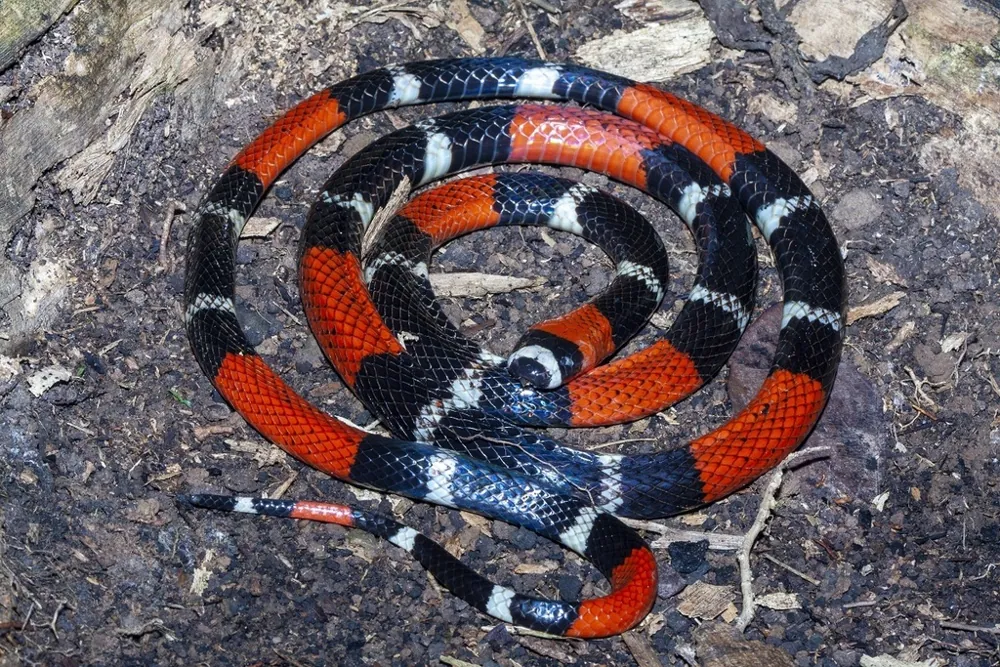
 Maziviro ayo
- The snout is black, followed by a narrow white band in front of the eyes and a wider black band across the eyes.1
- The rest of the head is red, and the body has broad red rings.1
- Between the red rings are 7 to 17 groups of three black and two white rings.1
- The tail has two of these black and white groups.1
- It is thin, and adults are usually 60 to 90 cm long, tail included.1
Simba reuturu
Uturu hunobuda nemeno ayo painoruma.
Uturu hwayo hunoitei?
Its venom is a strong neurotoxin, which attacks the nerves. It acts both before and after the nerve connects to the muscle, and it causes a strong, permanent block of nerve signals to the muscles in vertebrates. A muscle-damaging toxin called lemnitoxin has also been isolated from the venom.1
Ine ngozi yakadii kuvanhu?
Ngozi kuvanhu: Ine ngozi zvikuruInogona kuuraya munhu asina kurapwa.It is not aggressive towards people, but it can bite to defend itself. The estimated lethal dose for an adult human is 5 to 7 mg of venom (dry weight). In laboratory milking, the average venom yield was 8 to 10 mg and the largest was 27 mg.1
Inoitei kana yatya?
It is not aggressive, but it can attack to defend itself when threatened.1
 Kana ikaruma
- Chengeta munhu asingafambe uye akadzikama, uende kuchipatara nokukurumidza, kunyange parumwa pachiita sepadiki: zviratidzo zvinogona kutanga maawa akati kuti gare gare.
Gara uchitanga wafonera nhamba yechimbichimbi (112, 000, 911). Iri izano rakajairika rerubatsiro rwekutanga, kwete zano rechiremba. Zvakakosha zverubatsiro rwekutanga
 Gara wakachengeteka
- Usambobata mhuka yesango, kuedza kuitora kana kuinetsa, kunyange iri diki, uye kunyange ichiita seyakarara kana yakafa.
- Ipa nzvimbo. Kana ukasangana nayo, dzikama, dzokera shure zvishoma nezvishoma uirege iende nenzira yayo.
- Kana imwe ikakuruma: dzikama, gara wakanyarara, fonera nhamba yechimbichimbi (112, 000, 911) kana kuti enda kuchipatara nokukurumidza. Rangarira kuti yaitaridzika sei, mufananidzo unobatsira.
Haisi kukutsvaga. Inoshandisa uturu hwayo kubata chikafu kana kuzvidzivirira, uye inotonyanya kuda kuhwanda. Zvimwe pamusoro pekugara wakachengeteka
Yakakura sei?
Yakareba zvakadii?
 yakareba sekatsi dzepamba 3 kubva pamhuno kusvika kumuswe
 yakareba semabhanana 8 akateedzana
 inogona kumhanya mamita 100 mumasekondi 71 (munhu anomhanyisa kupfuura vose anoda 9.6)
South American coral snake yakakura sei kana yaenzaniswa NEWE?
Masvomhu chete mubrowser yako. Hapana chinochengetwa kana kutumirwa kupi zvako.
Inomhanya zvakadii?


Chokwadi
The venom of this snake is strong enough to cause paralysis, because it blocks nerve signals to the muscles.1
It is one of the few snakes whose diet includes freshwater eels and gymnotiform fishes.1
It is nocturnal and digs in loose soil or leaf litter, so it spends much of its time hidden underground.1
It can live in disturbed land and near human homes, not only in deep forest.1
Kuputsa ngano
Ngano: Coral snakes are aggressive and will attack people.
Chokwadi: This snake is not aggressive towards people. It only bites to defend itself.1
Kwakabva chokwadi
- Micrurus lemniscatus (Wikipedia (CC BY-SA 4.0))
- Micrurus lemniscatus (iNaturalist): mazita nekurongwa kwemhuka.
- Venom Wiki: danho rengozi, saizi yakajairika nekufungidzira kwekumhanya ndezvedu. Ona kuti tinozviwana sei: Matinoyera ngozi.
Chokwadi chimwe nechimwe pane peji rino chine nhamba inoratidza kwachakabva. Kana takakanganisa, ruregerero, tiri vanoda mhuka, kwete magazini yesainzi. Tiudze pa[email protected] tichazvigadzirisa.
 Chinyavada chine nzara! Venom Wiki iprojekiti yemunhu mumwe: yemahara, isina kushambadza uye isina zvinokuteedzera. Chipo chidiki chinobatsira kuti irambe iri paindaneti.Fudza chinyavada
Zvimwe kubva muboka rimwe chete: Nyoka dzecoral
 Central American coral snakeNyoka dzecoralInogona kuuraya
 Amazonian coral snakeNyoka dzecoralInogona kuuraya
 Aquatic coral snakeNyoka dzecoralInogona kuuraya
 Argentinian coral snakeNyoka dzecoralInogona kuuraya
 Caatinga coral snakeNyoka dzecoralInogona kuuraya
 Dumeril's coral snakeNyoka dzecoralInogona kuuraya
 Golden poison frog
 Terciopelo
 Brazilian wandering spider
 Eyelash viper
 Golden lancehead
 South American bushmaster