
 Afrika
 Asia
Asia Yuropu
 Amerika yeKumaodzanyemba
 Australia neOceania
 Antarctica
 Gungwa rePacific
 Gungwa reAtlantic
 Gungwa reIndia
 Gungwa reArctic
 Gungwa reMediterranean
 Gungwa Dzvuku
 Gungwa reCaribbean
 Gungwa reCoral
 Gungwa reChina yeKumaodzanyemba
 Gungwa rePhilippines
 Gungwa reAndaman
 Gungwa reKuchamhembe
 Gungwa reTimor neArafura
 Gungwa reBengal
 Gulf yeCalifornia
Golden poison frog
 Chepfu muganda rayoInodya: ZvipukananaIne chepfu, haina uturu hwekuruma kana kubaya
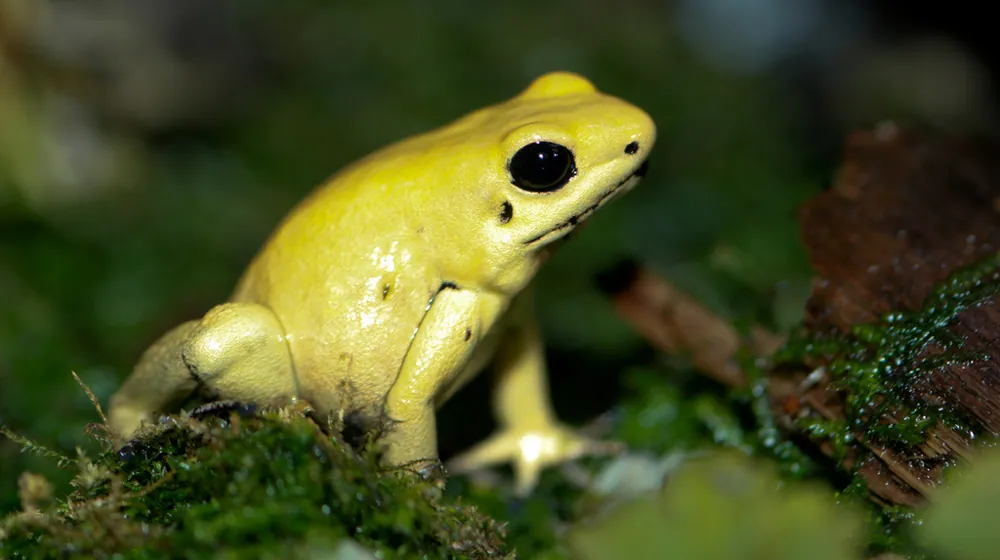
The golden poison frog is a small, bright frog from the rainforests of Colombia. It is considered the most poisonous animal species on Earth, even though it is small. Its bright colours warn predators to stay away.1


 Maziviro ayo
- Adults are brightly coloured, in yellow, mint green, orange or golden yellow forms.1
- Juveniles are mostly black with two golden-yellow stripes along their backs.1
- Juveniles become fully coloured at about 18 weeks of age.1
- It is the largest species in the poison dart frog family.1
- Females are typically larger than males.1
Simba rechepfu
Ganda rayo rine chepfu. Ine ngozi kubata, kunanzva kana kudya.
Chepfu yayo inoitei?
The frog's skin glands produce batrachotoxin, a very strong alkaloid poison. It affects the sodium channels of nerve cells, leaving muscles stuck in a contracted state. This can lead to paralysis, heart fibrillation, heart failure and death.1
Ine ngozi yakadii kuvanhu?
Ngozi kuvanhu: InourayaImwe yemhuka dzine ngozi zvikuru pasi rose.An average wild frog is estimated to carry about one milligram of poison, enough to kill 10 to 20 humans. A predator usually has to try to eat the frog to be poisoned, but contact with the skin is also dangerous. Captive-bred frogs are not toxic.1
Inoitei kana yatya?
Its bright colours warn predators of its toxicity, a pattern called aposematic coloration.1
 Kana munhu akaibata kana kuidya
- Kana munhu akabata imwe: geza maoko zvakanaka uye usabata maziso kana muromo. Kana mwana kana chipfuwo chakananzva kana kudya imwe: fonera nzvimbo yeruzivo rwechepfu kana nhamba yechimbichimbi.
Gara uchitanga wafonera nhamba yechimbichimbi (112, 000, 911). Iri izano rakajairika rerubatsiro rwekutanga, kwete zano rechiremba. Zvakakosha zverubatsiro rwekutanga
 Gara wakachengeteka
- Usambobata mhuka yesango, kuedza kuitora kana kuinetsa, kunyange iri diki, uye kunyange ichiita seyakarara kana yakafa.
- Ipa nzvimbo. Kana ukasangana nayo, dzikama, dzokera shure zvishoma nezvishoma uirege iende nenzira yayo.
- Kana wakaibata kana kuidya: usakwesha maziso kana muromo wako, geza maoko ako uye wana rubatsiro rwechiremba.
Haisi kukutsvaga. Chepfu yayo iripo chete kuti pasava nechinhu chinoidya. Zvimwe pamusoro pekugara wakachengeteka
Yakakura sei?
Yakareba zvakadii?
Inorema zvakadii?

 yakareba sezvidhinha zvematoyi 2 zvakateedzana
 inogona kumhanya mamita 100 mumasekondi 90 (munhu anomhanyisa kupfuura vose anoda 9.6)
Golden poison frog yakakura sei kana yaenzaniswa NEWE?
Masvomhu chete mubrowser yako. Hapana chinochengetwa kana kutumirwa kupi zvako.
Inomhanya zvakadii?


Chokwadi
Local indigenous peoples, such as the Emberá and Cofán, use the frog's poison on the tips of hunting darts and arrows. The poison stays deadly for two years or longer.1
The frog gets its toxicity from its diet. Frogs fed commercial feeder insects in captivity lose their toxicity over time.1
Scientists think a small beetle from the family Melyridae may be a key prey item that supplies the poison.1
The Leimadophis epinephelus snake has shown resistance to several frog toxins and has been seen eating juvenile frogs without harm.1
The frog's colour varies. The yellow form gives it its common name, but the species also has mint green, orange and orange blackfoot forms.1
Kuputsa ngano
Ngano: All golden poison frogs are always poisonous.
Chokwadi: The frog only becomes toxic when it eats the right prey in the wild. Captive-bred frogs raised without their natural food are non-toxic.1
Kune nyanzvi dzeuturu
- Zita resainzi
- Phyllobates terribilis
- Boka
- Matatya ane chepfu, matoad nemanewt
- Mhuri
- Dendrobatidae2
- Odha
- Anura
- Makondinendi
- Amerika yeKumaodzanyemba
- Vacheche
- The eggs are laid on the ground, hidden under leaf litter. Tadpoles stick to the mucus on the parent's back, and the parent carries them to water pools in the canopy.1
- Iri kurarama sei musango
- Endangered1
- Ngozi kuvanhu
- 5 / 5: Inouraya3
Kwakabva chokwadi
- Golden poison frog (Wikipedia (CC BY-SA 4.0))
- Phyllobates terribilis (iNaturalist): mazita nekurongwa kwemhuka.
- Venom Wiki: danho rengozi, saizi yakajairika nekufungidzira kwekumhanya ndezvedu. Ona kuti tinozviwana sei: Matinoyera ngozi.
Chokwadi chimwe nechimwe pane peji rino chine nhamba inoratidza kwachakabva. Kana takakanganisa, ruregerero, tiri vanoda mhuka, kwete magazini yesainzi. Tiudze pa[email protected] tichazvigadzirisa.
 Chinyavada chine nzara! Venom Wiki iprojekiti yemunhu mumwe: yemahara, isina kushambadza uye isina zvinokuteedzera. Chipo chidiki chinobatsira kuti irambe iri paindaneti.Fudza chinyavada
Zvimwe kubva muboka rimwe chete: Matatya ane chepfu, matoad nemanewt
 Cane toadMatatya ane chepfu, matoad nemanewtInoda chirembaUsabata
 Dyeing poison dart frogMatatya ane chepfu, matoad nemanewtInongorwadzaUsabata
 Black-legged poison frogMatatya ane chepfu, matoad nemanewtInogona kuurayaUsabata
 Bruno's casque-headed frogMatatya ane chepfu, matoad nemanewtInoda chirembaUsabata
 Harlequin poison frogMatatya ane chepfu, matoad nemanewtInoda chirembaUsabata
 Giant leaf frogMatatya ane chepfu, matoad nemanewtInongorwadzaUsabata
 Terciopelo
 Brazilian wandering spider
 Eyelash viper
 Golden lancehead
 South American bushmaster
 Peruvian giant centipede