
 Afrika
 Asia
Asia Yuropa
 Amerika Borwa
 Australia le Oceania
 Antarctica
 Lewatle la Pacific
 Lewatle la Atlantic
 Lewatle la India
 Lewatle la Arctic
 Lewatle la Mediterranean
 Lewatle le Lefubedu
 Lewatle la Caribbean
 Lewatle la Coral
 Lewatle la China Borwa
 Lewatle la Philippine
 Lewatle la Andaman
 Lewatle la Leboya
 Lewatle la Timor le Arafura
 Kgwohlo ya Bengal
 Kgwohlo ya California
Armadillo wasp
 Ho hlaba
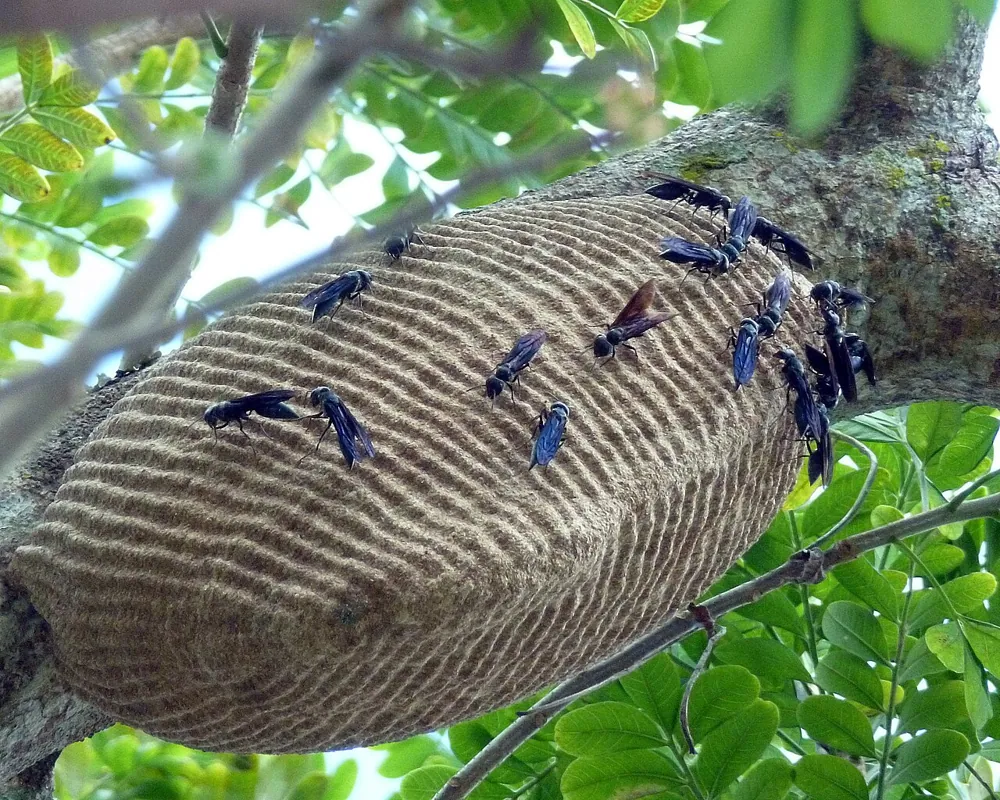
The armadillo wasp is a social wasp with a metallic blue-black body. It builds its nests on tree trunks in tropical South America. It is known for its painful sting, and it also visits flowers and helps pollinate plants.1


 Ho e tseba jwang
- Medium-sized wasp with a blueish-black body1
- Body can look metallic in certain light1
- Dark, almost black wings1
- Head has a projecting vertex (a raised ridge on the top of the head)1
- Less dense small markings (punctation) on the first abdominal segment than S. chalibea and S. virginea1
Hangata e ferekanngwa le: Other Synoeca wasps, especially its sister species S. cyanea and S. septentrionalis, which also have less punctation on the first abdominal segment. S. chalibea and S. virginea have denser punctation on that segment, so this is one way to tell them apart.1
Matla a chefo
Chefo e tswa ka lemao le hlabang.
Chefo ya yona (eo e e kenyang ka ho loma kapa ho hlaba) e etsang?
Its sting injects serotonin, a chemical also known as a neurotransmitter. Serotonin is a vasoconstrictor, meaning it narrows blood vessels, which could potentially be lethal to small animals. In people, it causes severe pain.1
E kotsi hakae ho batho?
Kotsi ho batho: E tebilengHo hlajwa ho hloka ngaka. Lefu le etsahala ka seoelo haholo.Its sting is painful. The wasp only stings in defence, not to attack. Stings can leave the wasp's barbed stinger in the skin, and the wasp dies afterwards.1
E etsang ha e tshohile?
When a colony is threatened, workers perform buzzing runs, shaking from side to side and contacting other members, which warns the colony to swarm. Individual wasps may also sting, and the stinger stays in the victim.1
 Haeba e hlaba
- Kgwaratla lemao la notshi o le ntshe mme o pholise sebaka seo.
- Haeba motho a hema ka thata, sefahleho kapa qoqotho di ruruha, kapa a ikutlwa a tla idibala, ke tshohanyetso ya aletjhi (allergy): letsetsa nomoro ya tshohanyetso mme o sebedise pene ya hae ya adrenaline (adrenaline auto-injector) haeba a na le yona.
Kamehla letsetsa nomoro ya tshohanyetso pele (112, 000, 911). Ena ke tataiso e akaretsang ya thuso ya pele, hase keletso ya bongaka. Metheo ya thuso ya pele
 Dula o bolokehile
- O se ke wa ama, wa tshwara kapa wa tena phoofolo ya naheng, leha e le e nyenyane, le leha e shebahala e robetse kapa e shwele.
- E fe sebaka. Ha o kopana le yona, dula o kgutsitse, kgutlela morao butle mme o e tlohele e tsamaye ka tsela ya yona.
- Haeba e nngwe e o hlaba: dula o kgutsitse, o se ke wa sisinyeha, letsetsa nomoro ya tshohanyetso (112, 000, 911) kapa o ye sepetlele kapele. Hopola hore e ne e shebahala jwang, foto e a thusa.
Ha e o batle. E sebedisa chefo ya yona ho tshwara dijo kapa ho itshireletsa, mme e kgetha ho ipata. Ho eketsehileng ka ho dula o bolokehile
Hokae lefatsheng?
E kgolo hakae?
E telele hakae?
 e telele jwaloka klipi ya pampiri
 e ka fofa ho tshela lebala lohle la bolo ya maoto ka metsotswana e 14
Armadillo wasp e kgolo hakae ha e bapiswa le WENA?
Ke dipalo feela ka hara sebatli sa hao. Ha ho letho le bolokwang kapa le romelwang kae kapa kae.
E potlaka hakae?


Dintlha
When the wasp stings, its barbed stinger stays in the victim, and the wasp dies. This is called sting autotomy.1
The sting also releases alarm pheromones, which mark the target as a threat for the colony to deal with if it returns.1
Some older workers, over 21 days old, may eat large larvae and pupae before leaving the nest. This is called brood cannibalism.1
Queens are chosen through ritual dominance displays, in which potential queens face off, sometimes bending their abdomens.1
Colonies swarm together as a group. Scouts lay down scent trails so the other wasps can follow them to a new nest site.1
Scouts release scent from a special gland called the Richards' gland while they drag their body along the trail.1
Moo dintlha di tswang teng
- Synoeca surinama (Wikipedia (CC BY-SA 4.0))
- Synoeca surinama (iNaturalist): mabitso le tlhophiso.
- Venom Wiki: boemo ba kotsi, boholo bo tlwaelehileng le kakanyo ya lebelo ke tsa rona. Bona kamoo re di balang ka teng: Kamoo re lekanyang kotsi ka teng.
Taba e nngwe le e nngwe leqepheng lena e na le nomoro e bontshang mohlodi wa yona. Haeba re entse phoso, re kopa tshwarelo, re barati ba diphoofolo, hase makasine wa saense. Re bolelle ho [email protected] mme re tla e lokisa.
 Phepheng e lapile! Venom Wiki ke projeke ya motho a le mong: ke mahala, ha e na dipapatso ebile ha e na di-tracker. Thuso e nyenyane ya tjhelete e e boloka e ntse e le inthaneteng.Fepa phepheng
Tse ding tsa sehlopha se le seng: Dinotshi, di-wasp le di-hornet
 Tarantula hawkDinotshi, di-wasp le di-hornetE utlwisa bohloko feela
 Executioner waspDinotshi, di-wasp le di-hornetE hloka ngaka
 Warrior waspDinotshi, di-wasp le di-hornetE hloka ngaka
 Giant tarantula hawkDinotshi, di-wasp le di-hornetE utlwisa bohloko feela
 Paulista waspDinotshi, di-wasp le di-hornetE utlwisa bohloko feela
 Red paper waspDinotshi, di-wasp le di-hornetE utlwisa bohloko feela
 Golden poison frog
 Terciopelo
 Brazilian wandering spider
 Eyelash viper
 Golden lancehead
 South American bushmaster