
 Afrika
 Asia
Asia Yuropa
 Amerika Borwa
 Australia le Oceania
 Antarctica
 Lewatle la Pacific
 Lewatle la Atlantic
 Lewatle la India
 Lewatle la Arctic
 Lewatle la Mediterranean
 Lewatle le Lefubedu
 Lewatle la Caribbean
 Lewatle la Coral
 Lewatle la China Borwa
 Lewatle la Philippine
 Lewatle la Andaman
 Lewatle la Leboya
 Lewatle la Timor le Arafura
 Kgwohlo ya Bengal
 Kgwohlo ya California
Asp viper
 Ho loma
The asp viper is a venomous snake of south-western Europe. It lives in warm, sunny places with dry soil, often in hills and rocky areas. Its bite can be more severe than that of the European adder, so it is important to know what it looks like.1

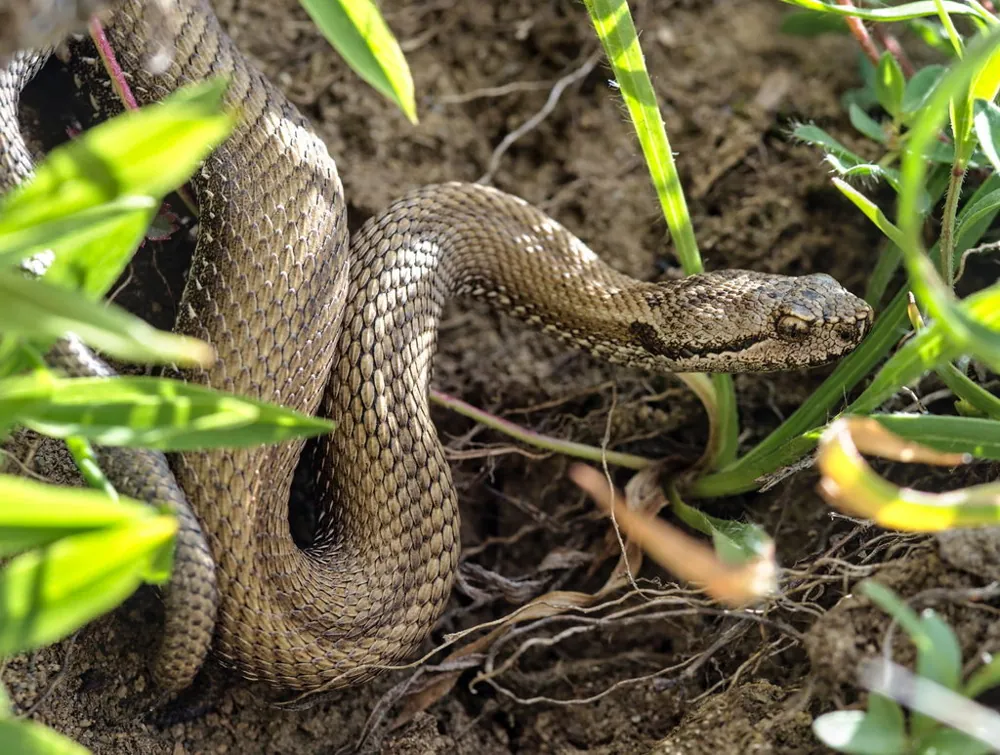
 Ho e tseba jwang
- Average total length is 60–65 cm. Males can reach 85 cm, while females are rarely longer than 75 cm.1
- The head is broad and triangular, and it is clearly separate from the neck.1
- The tip of the snout is slightly but distinctly turned up.1
- The tail is very short, and males are a little slimmer than females.1
- The pattern on the back varies a lot. It rarely forms a clear zigzag, unlike the European adder.1
Hangata e ferekanngwa le: The European adder (Vipera berus) is a close relative. The asp's back pattern rarely forms a clear zigzag, as the adder's often does. Bites from the asp can be more severe than those from the adder.1
Matla a chefo
Chefo e tswa ka meno a yona a chefo (fangs) kapa ka meno a mang ha e loma.
Chefo ya yona (eo e e kenyang ka ho loma kapa ho hlaba) e etsang?
Its venom causes rapidly spreading, severe pain, followed by swelling and skin discolouration. Severe bleeding and tissue death can happen within a few hours. Vision may be badly affected, and in some cases victims developed breathing and swallowing difficulties and paralysis of the bitten limb.1
E kotsi hakae ho batho?
Kotsi ho batho: E tebilengHo longwa ho hloka ngaka. Lefu le etsahala ka seoelo haholo.About 4% of untreated bites are fatal. In Italy, this species causes 90% of snakebite cases and is the only snake in Italian mountains that can be potentially lethal. Its bites can be more severe than those of the European adder.1
 Haeba e loma
- Boloka motho a sa sisinyehe ebile a kgutsitse, boloka setho se lomilweng se lekana le bophahamo ba pelo, tlosa mesale le dintho tse tiileng, mme o mo ise sepetlele kapele.
Kamehla letsetsa nomoro ya tshohanyetso pele (112, 000, 911). Ena ke tataiso e akaretsang ya thuso ya pele, hase keletso ya bongaka. Metheo ya thuso ya pele
 Dula o bolokehile
- O se ke wa ama, wa tshwara kapa wa tena phoofolo ya naheng, leha e le e nyenyane, le leha e shebahala e robetse kapa e shwele.
- E fe sebaka. Ha o kopana le yona, dula o kgutsitse, kgutlela morao butle mme o e tlohele e tsamaye ka tsela ya yona.
- Haeba e nngwe e o loma: dula o kgutsitse, o se ke wa sisinyeha, letsetsa nomoro ya tshohanyetso (112, 000, 911) kapa o ye sepetlele kapele. Hopola hore e ne e shebahala jwang, foto e a thusa.
Ha e o batle. E sebedisa chefo ya yona ho tshwara dijo kapa ho itshireletsa, mme e kgetha ho ipata. Ho eketsehileng ka ho dula o bolokehile
Hokae lefatsheng?
E kgolo hakae?
E telele hakae?
 e telele jwaloka dikatse tsa lapeng tse 1,5 ho tloha nkong ho isa mohatleng
 e telele jwaloka dibanana tse 5 tse latellanang
 e ka matha metara e 100 ka metsotswana e 110 (motho ya potlakang ka ho fetisisa o hloka 9,6)
Asp viper e kgolo hakae ha e bapiswa le WENA?
Ke dipalo feela ka hara sebatli sa hao. Ha ho letho le bolokwang kapa le romelwang kae kapa kae.
E potlaka hakae?


Dintlha
Ancient writers named the snake that supposedly killed Queen Cleopatra as an asp. Experts think a cobra would have been too big, over 5 feet long, to smuggle in a basket.1
In the past, the word "asp" was used to mean any venomous snake.1
In 2006, a number of these vipers were found in a wooded area near Poortugaal in the Netherlands. The species is not native there, so it was probably released or escaped.1
Asp vipers have been found at over 2,100 m above sea level in the Pyrenees, even though they are not strongly linked to high altitudes.1
The venom yield is relatively low. One study recorded a daily extraction of 9–10 mg.1
Ho senya ditshomo
Tshomo: Queen Cleopatra was killed by a cobra.
Nnete: Ancient sources named the snake an asp. Experts think a cobra would have been too big to smuggle in a basket.1
Moo dintlha di tswang teng
- Vipera aspis (Wikipedia (CC BY-SA 4.0))
- Vipera aspis (iNaturalist): mabitso le tlhophiso.
- Venom Wiki: boemo ba kotsi, boholo bo tlwaelehileng le kakanyo ya lebelo ke tsa rona. Bona kamoo re di balang ka teng: Kamoo re lekanyang kotsi ka teng.
Taba e nngwe le e nngwe leqepheng lena e na le nomoro e bontshang mohlodi wa yona. Haeba re entse phoso, re kopa tshwarelo, re barati ba diphoofolo, hase makasine wa saense. Re bolelle ho [email protected] mme re tla e lokisa.
 Phepheng e lapile! Venom Wiki ke projeke ya motho a le mong: ke mahala, ha e na dipapatso ebile ha e na di-tracker. Thuso e nyenyane ya tjhelete e e boloka e ntse e le inthaneteng.Fepa phepheng
Tse ding tsa sehlopha se le seng: Di-viper le di-adder
 Common European adder
 Blunt-nosed viper
 Nose-horned viper
 Ottoman viper
 Lataste's viper
 Meadow viper
E boetse e phela: Yuropa
 Spanish flyDiphoofolo tse ding tse chefangE hloka ngakaO se ke wa ama
 Common waspDinotshi, di-wasp le di-hornetE utlwisa bohloko feela
 European hornetDinotshi, di-wasp le di-hornetE utlwisa bohloko feela
 Fire salamanderDihoho tse chefang, mampotsana le di-newtE utlwisa bohloko feelaO se ke wa ama
 Western honey beeDinotshi, di-wasp le di-hornetE utlwisa bohloko feela
 Mediterranean black widowDikgoE hloka ngaka