
 Afrika
 Asia
Asia Yuropa
 Amerika Borwa
 Australia le Oceania
 Antarctica
 Lewatle la Pacific
 Lewatle la Atlantic
 Lewatle la India
 Lewatle la Arctic
 Lewatle la Mediterranean
 Lewatle le Lefubedu
 Lewatle la Caribbean
 Lewatle la Coral
 Lewatle la China Borwa
 Lewatle la Philippine
 Lewatle la Andaman
 Lewatle la Leboya
 Lewatle la Timor le Arafura
 Kgwohlo ya Bengal
 Kgwohlo ya California
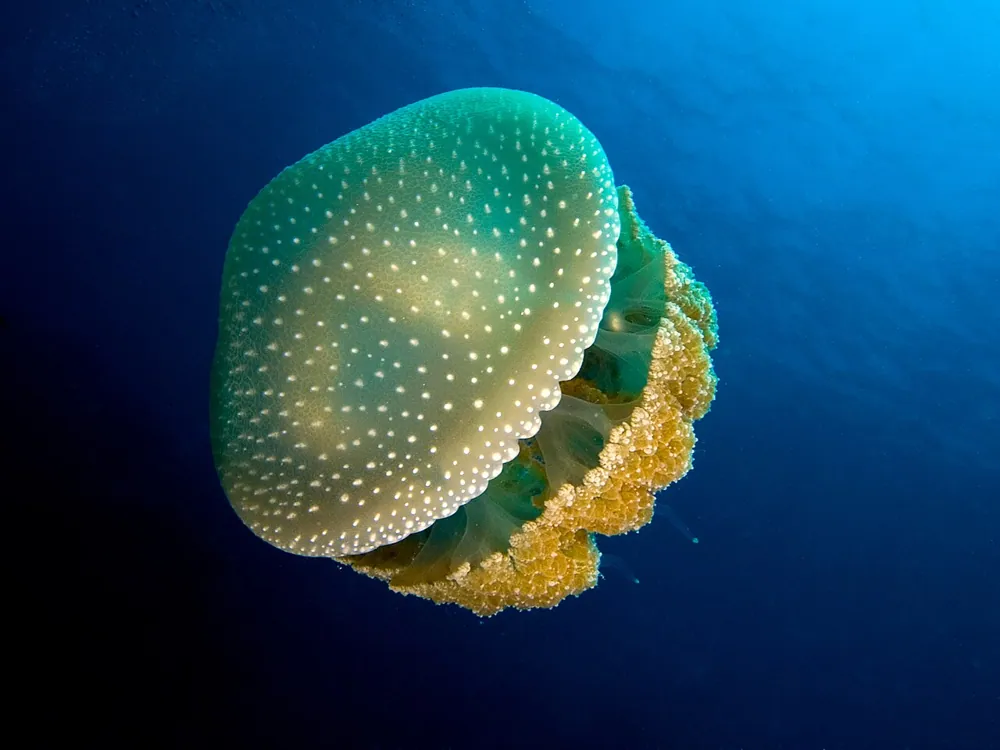
Australian spotted jellyfish
 Di-tentacle tse hlabangE ja: Dijo tse nyenyane tsa lewatle
The Australian spotted jellyfish is a jellyfish with a bell up to 50 cm wide. It is native to the western Pacific, from Australia to Japan, but has spread to many other seas. Its sting is mild and it is not considered a threat to people, but large groups can cause problems for fishing and local sea life.1

 Ho e tseba jwang
Matla a chefo
Dikete tsa disele tse nyenyane tse hlabang di thunya ha ho na le se di amang.
Chefo ya yona (eo e e kenyang ka ho loma kapa ho hlaba) e etsang?
It has only a mild venom. The venom is not strong enough to kill its prey, which is why it catches food by filtering rather than by stunning it.1
E kotsi hakae ho batho?
Kotsi ho batho: E bobebeJwaloka ho hlajwa ke notshi kapa ho fetang moo. Ha e na kotsi ho batho.It is not considered a threat to humans, and its sting is mild or hard to notice. It does cause harm to fishing industries, where it eats fish, crab and shrimp eggs and larvae and clogs nets.1
 Haeba e hlaba
- The sting can be treated with a dilute acid, usually white or cider vinegar.1
- Tswa metsing mme o tlose di-tentacle tsohle (ka ditlelafo kapa ka lesela).
- Bakeng sa box jellyfish tsa tropike: tshela asene (vinegar) moo e hlabileng teng bonyane metsotswana e 30, bitsa thuso mme o itokisetse ho etsa CPR. Bakeng sa di-bluebottle le tse ding tse ngata: hlatswa ka metsi a lewatle, ebe ka metsi a tjhesang bakeng sa bohloko.
Kamehla letsetsa nomoro ya tshohanyetso pele (112, 000, 911). Ena ke tataiso e akaretsang ya thuso ya pele, hase keletso ya bongaka. Metheo ya thuso ya pele
 Dula o bolokehile
- O se ke wa ama, wa tshwara kapa wa tena phoofolo ya naheng, leha e le e nyenyane, le leha e shebahala e robetse kapa e shwele.
- E fe sebaka. Ha o kopana le yona, dula o kgutsitse, kgutlela morao butle mme o e tlohele e tsamaye ka tsela ya yona.
- Haeba e nngwe e o hlaba: dula o kgutsitse, o se ke wa sisinyeha, letsetsa nomoro ya tshohanyetso (112, 000, 911) kapa o ye sepetlele kapele. Hopola hore e ne e shebahala jwang, foto e a thusa.
Ha e o batle. E sebedisa chefo ya yona ho tshwara dijo kapa ho itshireletsa, mme e kgetha ho ipata. Ho eketsehileng ka ho dula o bolokehile
Hokae lefatsheng?
E kgolo hakae?
E telele hakae?
 e telele jwaloka dibanana tse 3 tse latellanang
 e telele jwaloka diboloko tsa ho bapala tse 16 moleng
 e ka sesa bolelele ba letangwane le leholo la ho sesa (50 m) ka metsotswana e 150
Australian spotted jellyfish e kgolo hakae ha e bapiswa le WENA?
Ke dipalo feela ka hara sebatli sa hao. Ha ho letho le bolokwang kapa le romelwang kae kapa kae.
E potlaka hakae?

_edit.jpg)
Dintlha
Each jellyfish can filter as much as 50,000 litres of seawater per day.1
One individual found on Sunset Beach, North Carolina, in October 2007 measured 74 cm wide, perhaps the largest ever recorded.1
Large swarms can clog fishing nets, damage boat intakes and sometimes force fishing areas to close.1
Its polyps can multiply by dividing into other polyps, which makes a larger group than the one the mother started with.1
Its polyp stage can last up to five years, and its adult stage up to two years.1
In the Gulf of Mexico, medusae grow unusually large, reaching more than 60 cm across.1
Ho senya ditshomo
Tshomo: It is a dangerous jellyfish that is a serious threat to people.
Nnete: It has only a mild venom and is not considered a threat to humans. Its main harm is to fishing and the local ecosystem, where it eats large amounts of zooplankton.1
Bakeng sa ditsebi tsa chefo
- Lebitso la saense
- Phyllorhiza punctata
- Sehlopha
- Di-jellyfish le diphoofolo tsa lewatle tse hlabang
- Lelapa
- Mastigiidae2
- Tatelano
- Rhizostomeae
- Dikontinente
- Lewatle la Pacific, Lewatle la India, Lewatle la Coral, Lewatle la Atlantic, Lewatle la Caribbean, Kgwohlo ya Mexico, Lewatle la Timor le Arafura, Mawatle
- Masea
- Males release sperm into the water, and the female gathers it into her mouth, where she holds the fertilised eggs. The larvae settle on the seabed and grow into polyps, which reproduce by cloning themselves.1
- Kotsi ho batho
- 1 / 5: E bobebe3
Moo dintlha di tswang teng
- Phyllorhiza punctata (Wikipedia (CC BY-SA 4.0))
- Phyllorhiza punctata (iNaturalist): mabitso le tlhophiso.
- Venom Wiki: boemo ba kotsi, boholo bo tlwaelehileng le kakanyo ya lebelo ke tsa rona. Bona kamoo re di balang ka teng: Kamoo re lekanyang kotsi ka teng.
Taba e nngwe le e nngwe leqepheng lena e na le nomoro e bontshang mohlodi wa yona. Haeba re entse phoso, re kopa tshwarelo, re barati ba diphoofolo, hase makasine wa saense. Re bolelle ho [email protected] mme re tla e lokisa.
 Phepheng e lapile! Venom Wiki ke projeke ya motho a le mong: ke mahala, ha e na dipapatso ebile ha e na di-tracker. Thuso e nyenyane ya tjhelete e e boloka e ntse e le inthaneteng.Fepa phepheng
Tse ding tsa sehlopha se le seng: Di-jellyfish le diphoofolo tsa lewatle tse hlabang
 Australian box jellyfishDi-jellyfish le diphoofolo tsa lewatle tse hlabangE a bolayaO se ke wa ama
 Irukandji jellyfishDi-jellyfish le diphoofolo tsa lewatle tse hlabangE ka bolayaO se ke wa ama
 Portuguese man o' warDi-jellyfish le diphoofolo tsa lewatle tse hlabangE hloka ngakaO se ke wa ama
 Lion's mane jellyfishDi-jellyfish le diphoofolo tsa lewatle tse hlabangE utlwisa bohloko feelaO se ke wa ama
 Moon jellyfishDi-jellyfish le diphoofolo tsa lewatle tse hlabangHa e na kotsi
 Common kingslayerDi-jellyfish le diphoofolo tsa lewatle tse hlabangE ka bolayaO se ke wa ama
E boetse e phela: Lewatle la Pacific
 Geography coneDikgofu tsa cone le di-octopusE a bolaya
 Greater blue-ringed octopusDikgofu tsa cone le di-octopusE a bolaya
 Japanese pufferfishDiphoofolo tse ding tse chefangE a bolaya
 Southern blue-ringed octopusDikgofu tsa cone le di-octopusE a bolaya
 Hawksbill sea turtleDiphoofolo tse ding tse chefangE ka bolaya
 Reef stonefishDitlhapi tse nang le chefoE ka bolayaO se ke wa ama