
 Afrika
 Asia
Asia Yuropa
 Amerika Borwa
 Australia le Oceania
 Antarctica
 Lewatle la Pacific
 Lewatle la Atlantic
 Lewatle la India
 Lewatle la Arctic
 Lewatle la Mediterranean
 Lewatle le Lefubedu
 Lewatle la Caribbean
 Lewatle la Coral
 Lewatle la China Borwa
 Lewatle la Philippine
 Lewatle la Andaman
 Lewatle la Leboya
 Lewatle la Timor le Arafura
 Kgwohlo ya Bengal
 Kgwohlo ya California
Bold jumping spider
 Ho loma
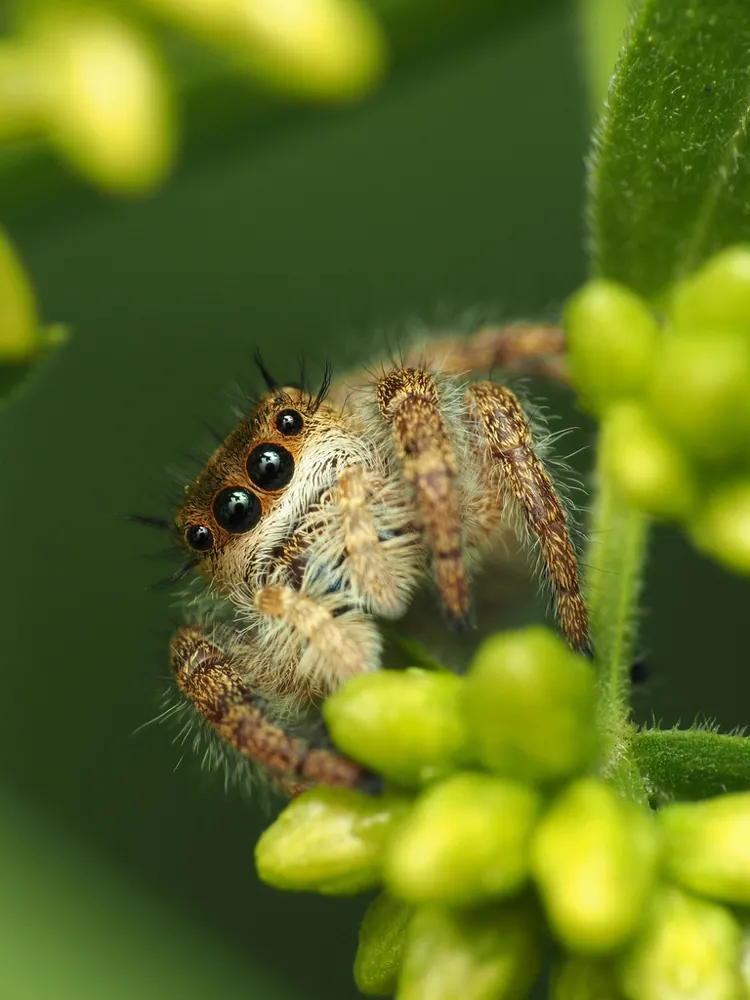
The bold jumping spider is a small spider that hunts by sight, leaping onto its prey instead of catching it in a web. It is common across North America and is often found near people, in gardens, fields and on fence posts. It matters because it eats many crop pests.1


 Ho e tseba jwang
- A large, usually triangular white spot in the centre of the abdomen, with two smaller spots below it.1
- Iridescent green chelicerae (the front mouthparts).1
- White banding with fringes on the legs and pedipalps, which is more prominent in males.1
- Males have more striking markings than females and tufts of hair over their eyes.1
- Large forward-facing eyes, as with all jumping spiders.1
Hangata e ferekanngwa le: Phidippus regius has a similar abdominal pattern and lives in the same area of the southeastern United States. In the bold jumper the pale spots near the rear are more linear, while in P. regius they are more oval. The bold jumper also has pairs of matte black patches on its abdomen, which P. regius lacks.1
Matla a chefo
Chefo e tswa ka meno a yona a chefo (fangs) kapa ka meno a mang ha e loma.
Chefo ya yona (eo e e kenyang ka ho loma kapa ho hlaba) e etsang?
Bold jumpers use venom to immobilise their prey after biting it with their fangs.1
E kotsi hakae ho batho?
Kotsi ho batho: E bobebeJwaloka ho hlajwa ke notshi kapa ho fetang moo. Ha e na kotsi ho batho.Bites from this spider are rare. A bite may happen if the spider feels threatened or is mishandled. If it is handled, it generally does not bite.1
E etsang ha e tshohile?
When threatened, they flee by jumping down and away or by hiding in small crevices.1
 Haeba e loma
- Hlatswa moo e lomileng teng mme o bee pakete ya leqhwa hodima teng bakeng sa bohloko. Fumana thuso ya bongaka haeba bohloko bo le matla, bo phatlalla kapa motho a ikutlwa a kula.
Kamehla letsetsa nomoro ya tshohanyetso pele (112, 000, 911). Ena ke tataiso e akaretsang ya thuso ya pele, hase keletso ya bongaka. Metheo ya thuso ya pele
 Dula o bolokehile
- O se ke wa ama, wa tshwara kapa wa tena phoofolo ya naheng, leha e le e nyenyane, le leha e shebahala e robetse kapa e shwele.
- E fe sebaka. Ha o kopana le yona, dula o kgutsitse, kgutlela morao butle mme o e tlohele e tsamaye ka tsela ya yona.
- Haeba e nngwe e o loma: dula o kgutsitse, o se ke wa sisinyeha, letsetsa nomoro ya tshohanyetso (112, 000, 911) kapa o ye sepetlele kapele. Hopola hore e ne e shebahala jwang, foto e a thusa.
Ha e o batle. E sebedisa chefo ya yona ho tshwara dijo kapa ho itshireletsa, mme e kgetha ho ipata. Ho eketsehileng ka ho dula o bolokehile
Hokae lefatsheng?
E kgolo hakae?
E telele hakae?
 e kgutshwane ho feta monwana wa hao o monyenyane
Bold jumping spider e kgolo hakae ha e bapiswa le WENA?
Ke dipalo feela ka hara sebatli sa hao. Ha ho letho le bolokwang kapa le romelwang kae kapa kae.
E potlaka hakae?


Dintlha
Bold jumpers have some of the best eyesight of any spider. Their vision is widely regarded as the best among all spiders.1
Their four pairs of eyes give them nearly 360° of visual coverage around the head.1
Bold jumpers sometimes invade the webs of other spiders to steal insects that have been caught, or to attack the spiders themselves.1
Bold jumpers can change their behaviour after watching other spiders, which is rare among spiders.1
Females choose mates by watching the male's leg and body movements during his courtship dance.1
Spiderlings often spread to new places by ballooning, a way of travelling on silk threads in the wind.1
Ho senya ditshomo
Tshomo: Like most spiders, jumping spiders catch their prey in webs.
Nnete: Bold jumpers do not build webs to catch prey. They hunt actively by sight and leap onto their victims.1
Bakeng sa ditsebi tsa chefo
Moo dintlha di tswang teng
- Phidippus audax (Wikipedia (CC BY-SA 4.0))
- Phidippus audax (iNaturalist): mabitso le tlhophiso.
- Venom Wiki: boemo ba kotsi, boholo bo tlwaelehileng le kakanyo ya lebelo ke tsa rona. Bona kamoo re di balang ka teng: Kamoo re lekanyang kotsi ka teng.
Taba e nngwe le e nngwe leqepheng lena e na le nomoro e bontshang mohlodi wa yona. Haeba re entse phoso, re kopa tshwarelo, re barati ba diphoofolo, hase makasine wa saense. Re bolelle ho [email protected] mme re tla e lokisa.
 Phepheng e lapile! Venom Wiki ke projeke ya motho a le mong: ke mahala, ha e na dipapatso ebile ha e na di-tracker. Thuso e nyenyane ya tjhelete e e boloka e ntse e le inthaneteng.Fepa phepheng
 Brown recluse
 Southern black widow
 Northern black widow
 Western black widow
 Golden silk orb-weaver
 Central American wandering spider
 Terciopelo
 Eastern coral snake
 Eastern diamondback rattlesnake
 Eyelash viper
 Timber rattlesnake
 Western diamondback rattlesnake