
 Afrika
 Asia
Asia Yuropa
 Amerika Borwa
 Australia le Oceania
 Antarctica
 Lewatle la Pacific
 Lewatle la Atlantic
 Lewatle la India
 Lewatle la Arctic
 Lewatle la Mediterranean
 Lewatle le Lefubedu
 Lewatle la Caribbean
 Lewatle la Coral
 Lewatle la China Borwa
 Lewatle la Philippine
 Lewatle la Andaman
 Lewatle la Leboya
 Lewatle la Timor le Arafura
 Kgwohlo ya Bengal
 Kgwohlo ya California
Western black widow
 Ho loma
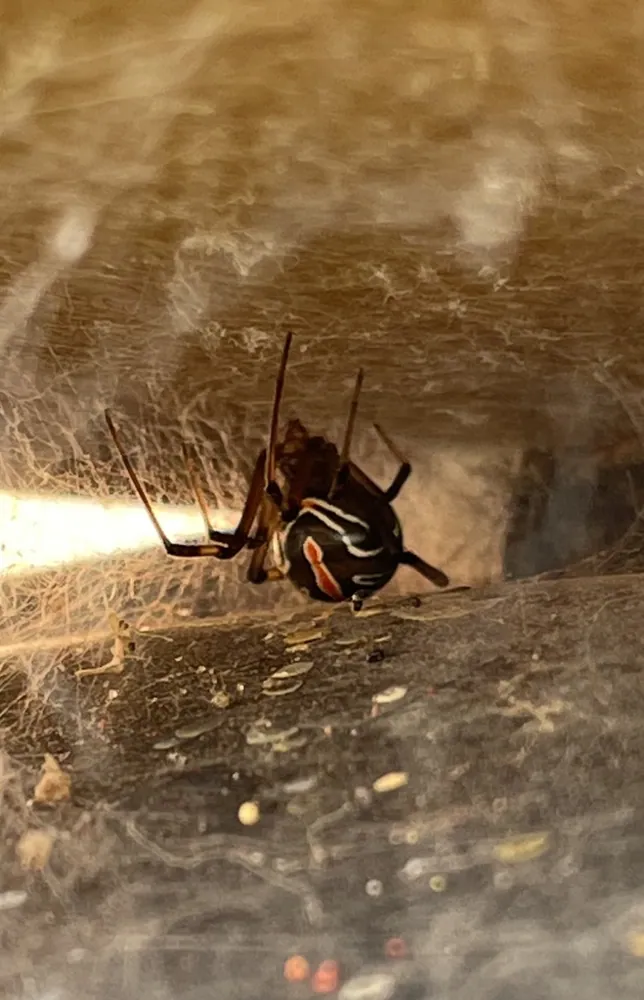
The western black widow is a venomous spider that lives in western North America. The female is black, often with a red hourglass mark on her belly, and her webs are tangled and irregular. Her venom is strong, so it is worth knowing what she looks like.1



 Ho e tseba jwang
- The female is about 14–16 mm long and black, often with an hourglass-shaped mark on the lower abdomen.1
- The hourglass mark is usually red, but it can be yellow and, very rarely, white.1
- The male is about half the female's length and is generally beige, with lighter striping on the abdomen.1
- Its webs are irregular or tangled, with no obvious overall pattern.1
Hangata e ferekanngwa le: It was once described as a subspecies of Latrodectus mactans and is closely related to the northern species Latrodectus variolus.1
Matla a chefo
Chefo e tswa ka meno a yona a chefo (fangs) kapa ka meno a mang ha e loma.
Chefo ya yona (eo e e kenyang ka ho loma kapa ho hlaba) e etsang?
The female's venom contains a neurotoxin called α-latrotoxin, which attacks the nerves. In humans, its symptoms include pain, nausea, vomiting, goosebumps and localised sweating.1
E kotsi hakae ho batho?
Kotsi ho batho: E tebilengHo longwa ho hloka ngaka. Lefu le etsahala ka seoelo haholo.Historical reports gave fatality rates between 0.5% and 12%. However, recent studies have not been able to confirm any deaths from the U.S. species of Latrodectus, including zero deaths among 23,409 documented bites from 2000 through 2008.1
E etsang ha e tshohile?
Juveniles and females can fling a sticky ball of silk at predators, which can stop most of them.1
 Haeba e loma
- Hlatswa moo e lomileng teng mme o bee pakete ya leqhwa hodima teng bakeng sa bohloko. Fumana thuso ya bongaka haeba bohloko bo le matla, bo phatlalla kapa motho a ikutlwa a kula.
Kamehla letsetsa nomoro ya tshohanyetso pele (112, 000, 911). Ena ke tataiso e akaretsang ya thuso ya pele, hase keletso ya bongaka. Metheo ya thuso ya pele
 Dula o bolokehile
- O se ke wa ama, wa tshwara kapa wa tena phoofolo ya naheng, leha e le e nyenyane, le leha e shebahala e robetse kapa e shwele.
- E fe sebaka. Ha o kopana le yona, dula o kgutsitse, kgutlela morao butle mme o e tlohele e tsamaye ka tsela ya yona.
- Haeba e nngwe e o loma: dula o kgutsitse, o se ke wa sisinyeha, letsetsa nomoro ya tshohanyetso (112, 000, 911) kapa o ye sepetlele kapele. Hopola hore e ne e shebahala jwang, foto e a thusa.
Ha e o batle. E sebedisa chefo ya yona ho tshwara dijo kapa ho itshireletsa, mme e kgetha ho ipata. Ho eketsehileng ka ho dula o bolokehile
Hokae lefatsheng?
E kgolo hakae?
E telele hakae?
 e kgutshwane ho feta monwana wa hao o monyenyane
Western black widow e kgolo hakae ha e bapiswa le WENA?
Ke dipalo feela ka hara sebatli sa hao. Ha ho letho le bolokwang kapa le romelwang kae kapa kae.
E potlaka hakae?


Dintlha
When prey hits a gumfoot thread, the thread breaks and creates tension that pulls the line and prey up to the spider.1
This spider is an opportunistic cannibal, and it may eat other members of its own kind when prey is scarce, when it is very hungry, or in self-defence.1
The silk is strongly sticky, and its strength is similar to that of silk from orb-weaving spiders.1
Males can be preferred by females based on the webs, with well-fed females chosen over starved ones.1
Males may mate several times during their relatively short lives.1
Ho senya ditshomo
Tshomo: A black widow bite is usually deadly.
Nnete: Recent studies have not confirmed any deaths from the U.S. species of Latrodectus, including zero deaths among 23,409 documented bites from 2000 through 2008.1
Moo dintlha di tswang teng
- Latrodectus hesperus (Wikipedia (CC BY-SA 4.0))
- Latrodectus hesperus (iNaturalist): mabitso le tlhophiso.
- Venom Wiki: boemo ba kotsi, boholo bo tlwaelehileng le kakanyo ya lebelo ke tsa rona. Bona kamoo re di balang ka teng: Kamoo re lekanyang kotsi ka teng.
Taba e nngwe le e nngwe leqepheng lena e na le nomoro e bontshang mohlodi wa yona. Haeba re entse phoso, re kopa tshwarelo, re barati ba diphoofolo, hase makasine wa saense. Re bolelle ho [email protected] mme re tla e lokisa.
 Phepheng e lapile! Venom Wiki ke projeke ya motho a le mong: ke mahala, ha e na dipapatso ebile ha e na di-tracker. Thuso e nyenyane ya tjhelete e e boloka e ntse e le inthaneteng.Fepa phepheng
 Brown recluse
 Southern black widow
 Northern black widow
 Bold jumping spider
 Golden silk orb-weaver
 Central American wandering spider
 Terciopelo
 Eastern coral snake
 Eastern diamondback rattlesnake
 Eyelash viper
 Timber rattlesnake
 Western diamondback rattlesnake