
 Afrika
 Asia
Asia Yuropa
 Amerika Borwa
 Australia le Oceania
 Antarctica
 Lewatle la Pacific
 Lewatle la Atlantic
 Lewatle la India
 Lewatle la Arctic
 Lewatle la Mediterranean
 Lewatle le Lefubedu
 Lewatle la Caribbean
 Lewatle la Coral
 Lewatle la China Borwa
 Lewatle la Philippine
 Lewatle la Andaman
 Lewatle la Leboya
 Lewatle la Timor le Arafura
 Kgwohlo ya Bengal
 Kgwohlo ya California
Southern black widow
 Ho loma
The southern black widow is a venomous spider that lives in North America. Mature females are shiny black with a red hourglass mark on their underside. Its bite can cause pain and other symptoms, but it is rarely fatal to healthy people.1


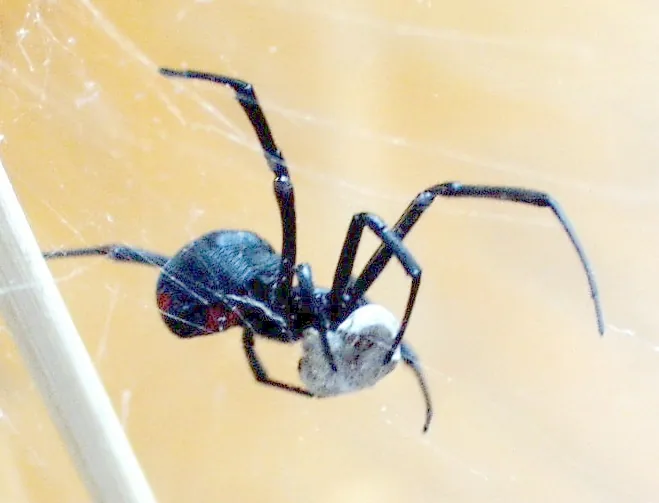
 Ho e tseba jwang
- Mature females are shiny black, with a red hourglass-shaped mark on the underside of a very rounded abdomen.1
- Many females have an orange or red patch on the top of the abdomen, just above the spinnerets.1
- Mature females have a body length of 8–13 mm, not counting the legs. Males are 3–6 mm.1
- Juveniles look very different. They have a grey to black abdomen with white stripes across it, spotted with yellow and orange.1
- Males are either purple, or look more like the juveniles.1
Hangata e ferekanngwa le: It is often confused with the false widows (genus Steatoda) and with the closely related northern (L. variolus) and western (L. hesperus) black widows.1
Matla a chefo
Chefo e tswa ka meno a yona a chefo (fangs) kapa ka meno a mang ha e loma.
Chefo ya yona (eo e e kenyang ka ho loma kapa ho hlaba) e etsang?
The venom contains alpha-latrotoxin, a neurotoxic venom that attacks the nerves. It causes pain and other symptoms, which are collectively called latrodectism.1
E kotsi hakae ho batho?
Kotsi ho batho: E tebilengHo longwa ho hloka ngaka. Lefu le etsahala ka seoelo haholo.Deaths in healthy adults are exceedingly rare. No deaths were reported among 23,409 documented Latrodectus bites in the US from 2000 to 2008, though about 2,000 bites happen each year. Only mature females can bite people.1
 Ditaba tse monate: dingaka di na le moriana (antivenom) kapa kalafo bakeng sa sena.1
 Haeba e loma
- Hlatswa moo e lomileng teng mme o bee pakete ya leqhwa hodima teng bakeng sa bohloko. Fumana thuso ya bongaka haeba bohloko bo le matla, bo phatlalla kapa motho a ikutlwa a kula.
Kamehla letsetsa nomoro ya tshohanyetso pele (112, 000, 911). Ena ke tataiso e akaretsang ya thuso ya pele, hase keletso ya bongaka. Metheo ya thuso ya pele
 Dula o bolokehile
- O se ke wa ama, wa tshwara kapa wa tena phoofolo ya naheng, leha e le e nyenyane, le leha e shebahala e robetse kapa e shwele.
- E fe sebaka. Ha o kopana le yona, dula o kgutsitse, kgutlela morao butle mme o e tlohele e tsamaye ka tsela ya yona.
- Haeba e nngwe e o loma: dula o kgutsitse, o se ke wa sisinyeha, letsetsa nomoro ya tshohanyetso (112, 000, 911) kapa o ye sepetlele kapele. Hopola hore e ne e shebahala jwang, foto e a thusa.
Ha e o batle. E sebedisa chefo ya yona ho tshwara dijo kapa ho itshireletsa, mme e kgetha ho ipata. Ho eketsehileng ka ho dula o bolokehile
Hokae lefatsheng?
E kgolo hakae?
E telele hakae?
 e nyenyane hoo e ka dulang lenalong la hao
Southern black widow e kgolo hakae ha e bapiswa le WENA?
Ke dipalo feela ka hara sebatli sa hao. Ha ho letho le bolokwang kapa le romelwang kae kapa kae.
E potlaka hakae?


Dintlha
In 1933, Allan Blair let himself be bitten by one of these spiders to study its venom in humans and to convince sceptics that it could be dangerous.1
Females will occasionally eat their mates after reproduction.1
Only mature females can bite people. Their hollow, needle-like mouthparts are about 1 mm long, which is long enough to inject venom into people.1
The brown widow (Latrodectus geometricus) competes with black widows for territory. In areas where they share space, it can displace them.1
Males live only about three to four months, while females can live for up to three years.1
Ho senya ditshomo
Tshomo: A black widow bite is usually fatal.
Nnete: Black widow bites are rarely fatal to healthy people. No deaths from the US species were reported among 23,409 documented bites from 2000 to 2008.1
Bakeng sa ditsebi tsa chefo
- Lebitso la saense
- Latrodectus mactans
- Sehlopha
- Dikgo
- Lelapa
- Theridiidae2
- Tatelano
- Araneae
- Dikontinente
- Amerika Leboya
- Masea
- A female can produce four to nine egg sacs in one summer, each holding about 100–400 eggs, which she guards in a silken container.1
- Nako ya bophelo
- e ka bang dilemo tse 31
- Kotsi ho batho
- 3 / 5: E tebileng3
Moo dintlha di tswang teng
- Latrodectus mactans (Wikipedia (CC BY-SA 4.0))
- Latrodectus mactans (iNaturalist): mabitso le tlhophiso.
- Venom Wiki: boemo ba kotsi, boholo bo tlwaelehileng le kakanyo ya lebelo ke tsa rona. Bona kamoo re di balang ka teng: Kamoo re lekanyang kotsi ka teng.
Taba e nngwe le e nngwe leqepheng lena e na le nomoro e bontshang mohlodi wa yona. Haeba re entse phoso, re kopa tshwarelo, re barati ba diphoofolo, hase makasine wa saense. Re bolelle ho [email protected] mme re tla e lokisa.
 Phepheng e lapile! Venom Wiki ke projeke ya motho a le mong: ke mahala, ha e na dipapatso ebile ha e na di-tracker. Thuso e nyenyane ya tjhelete e e boloka e ntse e le inthaneteng.Fepa phepheng
 Brown recluse
 Northern black widow
 Western black widow
 Bold jumping spider
 Golden silk orb-weaver
 Central American wandering spider
 Terciopelo
 Eastern coral snake
 Eastern diamondback rattlesnake
 Eyelash viper
 Timber rattlesnake
 Western diamondback rattlesnake