
 Afrika
 Asia
Asia Yuropa
 Amerika Borwa
 Australia le Oceania
 Antarctica
 Lewatle la Pacific
 Lewatle la Atlantic
 Lewatle la India
 Lewatle la Arctic
 Lewatle la Mediterranean
 Lewatle le Lefubedu
 Lewatle la Caribbean
 Lewatle la Coral
 Lewatle la China Borwa
 Lewatle la Philippine
 Lewatle la Andaman
 Lewatle la Leboya
 Lewatle la Timor le Arafura
 Kgwohlo ya Bengal
 Kgwohlo ya California
Branching fire coral
 Ho hlaba
Branching fire coral is not a true coral, even though it looks like one. It is a relative of jellyfish that lives on shallow tropical reefs in the western Atlantic and can sting people who touch it. It is an important part of the reef community.1

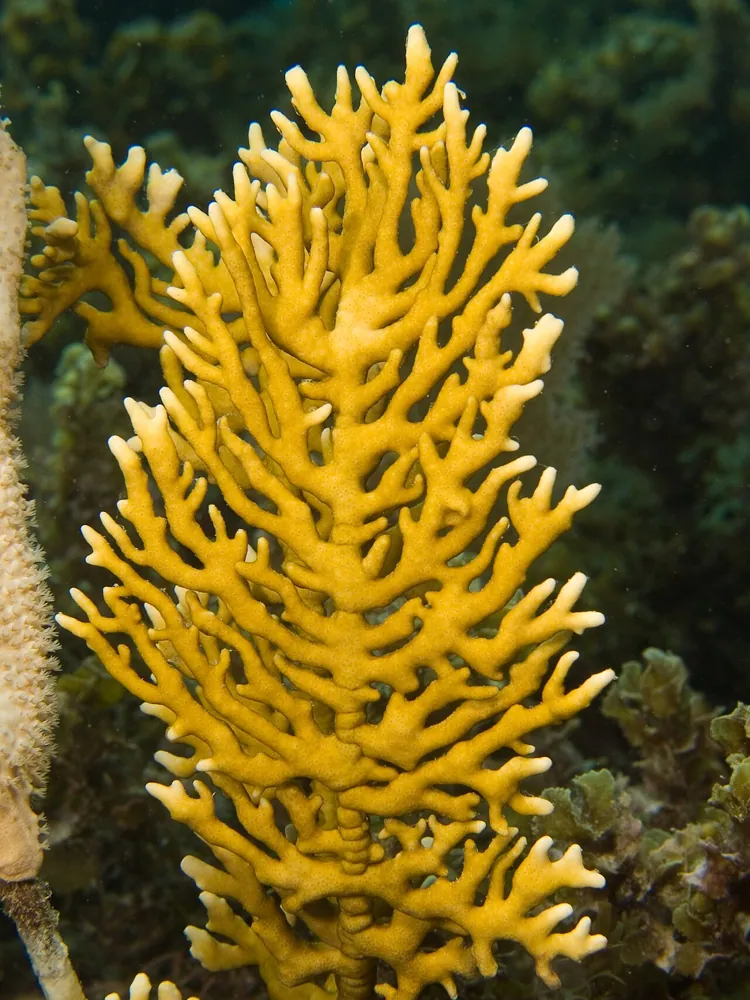
 Ho e tseba jwang
Matla a chefo
Chefo e tswa ka lemao le hlabang.
Chefo ya yona (eo e e kenyang ka ho loma kapa ho hlaba) e etsang?
Its sting injects a water-soluble protein venom. The venom causes a painful burning sensation, skin eruptions, blisters and scarring.1
E kotsi hakae ho batho?
Kotsi ho batho: E bohlokoE ka utlwisa bohloko haholo, empa hoo e batlang e le kamehla ha e kotsi haholo.It can cause painful stings to unwary divers. Its cells are strong enough to sting human skin.1
 Haeba e hlaba
- Tswa metsing mme o tlose di-tentacle tsohle (ka ditlelafo kapa ka lesela).
- Bakeng sa box jellyfish tsa tropike: tshela asene (vinegar) moo e hlabileng teng bonyane metsotswana e 30, bitsa thuso mme o itokisetse ho etsa CPR. Bakeng sa di-bluebottle le tse ding tse ngata: hlatswa ka metsi a lewatle, ebe ka metsi a tjhesang bakeng sa bohloko.
Kamehla letsetsa nomoro ya tshohanyetso pele (112, 000, 911). Ena ke tataiso e akaretsang ya thuso ya pele, hase keletso ya bongaka. Metheo ya thuso ya pele
 Dula o bolokehile
- O se ke wa ama, wa tshwara kapa wa tena phoofolo ya naheng, leha e le e nyenyane, le leha e shebahala e robetse kapa e shwele.
- E fe sebaka. Ha o kopana le yona, dula o kgutsitse, kgutlela morao butle mme o e tlohele e tsamaye ka tsela ya yona.
- Haeba e nngwe e o hlaba: dula o kgutsitse, o se ke wa sisinyeha, letsetsa nomoro ya tshohanyetso (112, 000, 911) kapa o ye sepetlele kapele. Hopola hore e ne e shebahala jwang, foto e a thusa.
Ha e o batle. E sebedisa chefo ya yona ho tshwara dijo kapa ho itshireletsa, mme e kgetha ho ipata. Ho eketsehileng ka ho dula o bolokehile
Hokae lefatsheng?
E kgolo hakae?
E telele hakae?
 e telele jwaloka dibanana tse 3 tse latellanang
 e telele jwaloka diboloko tsa ho bapala tse 16 moleng
 e dieha ho feta kgofu ya serapeng
Branching fire coral e kgolo hakae ha e bapiswa le WENA?
Ke dipalo feela ka hara sebatli sa hao. Ha ho letho le bolokwang kapa le romelwang kae kapa kae.
E potlaka hakae?

.jpg)
Dintlha
When it grows near a sea fan, it grows special 'attack' branches that wrap around and smother the fan.1
It is not a true coral. It belongs to the class Hydrozoa and is more closely related to jellyfish than to stony corals.1
Small fish and shrimp shelter among its branches and seem unaffected by its venom.1
It is one of the first corals to bleach in warm water, but it recovers from damage faster than most other corals.1
About 75% of its energy comes from microscopic algae living in its tissues.1
Ho senya ditshomo
Tshomo: It is a true coral like the stony corals that build reefs.
Nnete: It is not a true coral. It is a hydrozoan, more closely related to jellyfish.1
Bakeng sa ditsebi tsa chefo
- Lebitso la saense
- Millepora alcicornis
- Sehlopha
- Di-jellyfish le diphoofolo tsa lewatle tse hlabang
- Lelapa
- Milleporidae2
- Tatelano
- Anthoathecata
- Dikontinente
- Lewatle la Atlantic, Lewatle la Caribbean, Kgwohlo ya Mexico, Mawatle
- Masea
- It reproduces by fragments breaking off and growing into new colonies, and by budding short-lived, jellyfish-like medusae that release larvae.1
- Kotsi ho batho
- 2 / 5: E bohloko3
Moo dintlha di tswang teng
- Millepora alcicornis (Wikipedia (CC BY-SA 4.0))
- Millepora alcicornis (iNaturalist): mabitso le tlhophiso.
- Venom Wiki: boemo ba kotsi, boholo bo tlwaelehileng le kakanyo ya lebelo ke tsa rona. Bona kamoo re di balang ka teng: Kamoo re lekanyang kotsi ka teng.
Taba e nngwe le e nngwe leqepheng lena e na le nomoro e bontshang mohlodi wa yona. Haeba re entse phoso, re kopa tshwarelo, re barati ba diphoofolo, hase makasine wa saense. Re bolelle ho [email protected] mme re tla e lokisa.
 Phepheng e lapile! Venom Wiki ke projeke ya motho a le mong: ke mahala, ha e na dipapatso ebile ha e na di-tracker. Thuso e nyenyane ya tjhelete e e boloka e ntse e le inthaneteng.Fepa phepheng
Tse ding tsa sehlopha se le seng: Di-jellyfish le diphoofolo tsa lewatle tse hlabang
 Australian box jellyfishDi-jellyfish le diphoofolo tsa lewatle tse hlabangE a bolayaO se ke wa ama
 Irukandji jellyfishDi-jellyfish le diphoofolo tsa lewatle tse hlabangE ka bolayaO se ke wa ama
 Portuguese man o' warDi-jellyfish le diphoofolo tsa lewatle tse hlabangE hloka ngakaO se ke wa ama
 Lion's mane jellyfishDi-jellyfish le diphoofolo tsa lewatle tse hlabangE utlwisa bohloko feelaO se ke wa ama
 Moon jellyfishDi-jellyfish le diphoofolo tsa lewatle tse hlabangHa e na kotsi
 Common kingslayerDi-jellyfish le diphoofolo tsa lewatle tse hlabangE ka bolayaO se ke wa ama
E boetse e phela: Lewatle la Atlantic
 Hawksbill sea turtleDiphoofolo tse ding tse chefangE ka bolaya
 Blue sea dragonDikgofu tsa cone le di-octopusE utlwisa bohloko feela
 Greenland sharkDiphoofolo tse ding tse chefangE utlwisa bohloko feela
 Common octopusDikgofu tsa cone le di-octopusHa e na kotsi
 Common stingrayDitlhapi tse nang le chefoE hloka ngaka
 Greater weeverDitlhapi tse nang le chefoE hloka ngakaO se ke wa ama