
 Afrika
 Asia
Asia Yuropa
 Amerika Borwa
 Australia le Oceania
 Antarctica
 Lewatle la Pacific
 Lewatle la Atlantic
 Lewatle la India
 Lewatle la Arctic
 Lewatle la Mediterranean
 Lewatle le Lefubedu
 Lewatle la Caribbean
 Lewatle la Coral
 Lewatle la China Borwa
 Lewatle la Philippine
 Lewatle la Andaman
 Lewatle la Leboya
 Lewatle la Timor le Arafura
 Kgwohlo ya Bengal
 Kgwohlo ya California
Indian cobra
 Ho loma
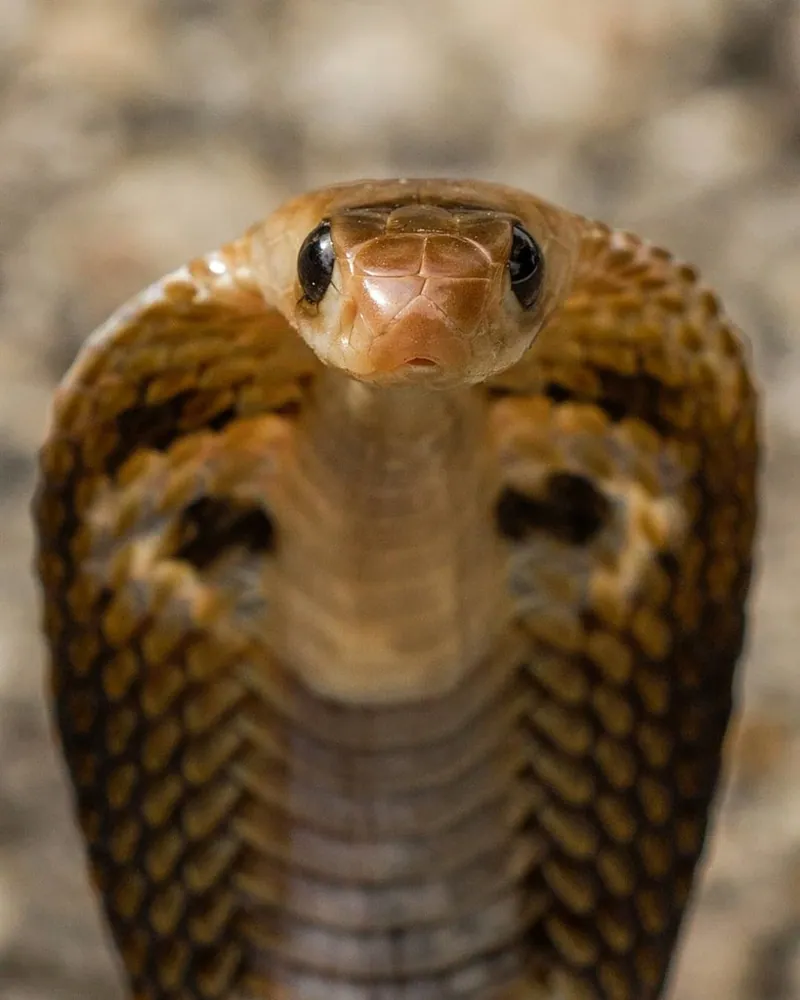
The Indian cobra is a heavy-bodied venomous snake that lives across the Indian subcontinent. It is famous for the large hood it spreads when threatened. It is one of the four snakes responsible for the most snakebites in India and Sri Lanka, so knowing how to recognise it matters.1



 Ho e tseba jwang
- A relatively large hood, which it expands when threatened.1
- Many individuals have a hood mark on the back of the hood: two round eye-like patterns joined by a curved line, looking like a pair of spectacles.1
- Colour varies widely. The underside can be grey, yellow, tan, brown, reddish or black, and many adults have salt-and-pepper speckles on the upper scales.1
- Adults in southern Pakistan are often uniformly black on top, with a light underside.1
Hangata e ferekanngwa le: The Oriental rat snake is often mistaken for this cobra, but it is much longer and has a more ridged-looking body. The monocled cobra has an O-shaped pattern on the back of its hood, while the Indian cobra has a spectacles-shaped pattern. The Caspian cobra can be confused with it where they share range in Pakistan and Afghanistan, but it is never fully black.1
Matla a chefo
Chefo e tswa ka meno a yona a chefo (fangs) kapa ka meno a mang ha e loma.
Chefo ya yona (eo e e kenyang ka ho loma kapa ho hlaba) e etsang?
Its venom mainly contains a powerful neurotoxin, which attacks the nerves, and a cardiotoxin, which harms the heart. The neurotoxin paralyses muscles, and severe bites can lead to respiratory failure (breathing failure) or cardiac arrest (the heart stopping). Symptoms may appear between 15 minutes and two hours after a bite. Early signs include severe local pain and swelling that spreads up the limb, followed by darkening and blistering of the skin, as well as headache, nausea, vomiting, dizziness and drowsiness.1
E kotsi hakae ho batho?
Kotsi ho batho: E a bolayaE nngwe ya diphoofolo tse kotsi ka ho fetisisa lefatsheng.It is responsible for many snakebites and most snakebite cases in Bangladesh. In one study, untreated bite victims had a mortality rate of about 20–30%. In another study of patients who received prompt medical treatment, the rate was 9%. The amount of venom delivered varies from bite to bite.1
 Ditaba tse monate: dingaka di na le moriana (antivenom) kapa kalafo bakeng sa sena.1
E etsang ha e tshohile?
When threatened, it spreads its large hood.1
 Haeba e loma
- Prompt medical treatment and antivenom reduce deaths from this snake's bites. Polyvalent serum, an antivenom that works against several snake species, is available for treating these bites.1
- Boloka motho a sa sisinyehe ebile a kgutsitse, tlosa mesale le dintho tse tiileng, mme o mo ise sepetlele kapele: antivenom ke yona kalafo.
Kamehla letsetsa nomoro ya tshohanyetso pele (112, 000, 911). Ena ke tataiso e akaretsang ya thuso ya pele, hase keletso ya bongaka. Metheo ya thuso ya pele
 Dula o bolokehile
- O se ke wa ama, wa tshwara kapa wa tena phoofolo ya naheng, leha e le e nyenyane, le leha e shebahala e robetse kapa e shwele.
- E fe sebaka. Ha o kopana le yona, dula o kgutsitse, kgutlela morao butle mme o e tlohele e tsamaye ka tsela ya yona.
- Haeba e nngwe e o loma: dula o kgutsitse, o se ke wa sisinyeha, letsetsa nomoro ya tshohanyetso (112, 000, 911) kapa o ye sepetlele kapele. Hopola hore e ne e shebahala jwang, foto e a thusa.
Ha e o batle. E sebedisa chefo ya yona ho tshwara dijo kapa ho itshireletsa, mme e kgetha ho ipata. Ho eketsehileng ka ho dula o bolokehile
Hokae lefatsheng?
E kgolo hakae?
E telele hakae?
 e telele jwaloka dikatse tsa lapeng tse 4 ho tloha nkong ho isa mohatleng
 e telele jwaloka dibanana tse 12 tse latellanang
 e ka matha metara e 100 ka metsotswana e 46 (motho ya potlakang ka ho fetisisa o hloka 9,6)
Indian cobra e kgolo hakae ha e bapiswa le WENA?
Ke dipalo feela ka hara sebatli sa hao. Ha ho letho le bolokwang kapa le romelwang kae kapa kae.
E potlaka hakae?


Dintlha
Its venom is used as an intoxicant in India. Snake charmers have been paid to provide bites from their snakes, and the effects include loss of consciousness, euphoria and sedation.1
Hatchlings are independent from birth and have fully working venom glands, so even young snakes can deliver venom.1
It is revered in Hindu mythology and culture, and is often seen with snake charmers.1
It is protected under the Indian Wildlife Protection Act (1972).1
Moo dintlha di tswang teng
- Indian cobra (Wikipedia (CC BY-SA 4.0))
- Naja naja (iNaturalist): mabitso le tlhophiso.
- Venom Wiki: boemo ba kotsi, boholo bo tlwaelehileng le kakanyo ya lebelo ke tsa rona. Bona kamoo re di balang ka teng: Kamoo re lekanyang kotsi ka teng.
Taba e nngwe le e nngwe leqepheng lena e na le nomoro e bontshang mohlodi wa yona. Haeba re entse phoso, re kopa tshwarelo, re barati ba diphoofolo, hase makasine wa saense. Re bolelle ho [email protected] mme re tla e lokisa.
 Phepheng e lapile! Venom Wiki ke projeke ya motho a le mong: ke mahala, ha e na dipapatso ebile ha e na di-tracker. Thuso e nyenyane ya tjhelete e e boloka e ntse e le inthaneteng.Fepa phepheng
Tse ding tsa sehlopha se le seng: Di-cobra, di-mamba le di-krait
 King cobraDi-cobra, di-mamba le di-kraitE a bolaya
 Caspian cobraDi-cobra, di-mamba le di-kraitE a bolaya
 Common kraitDi-cobra, di-mamba le di-kraitE a bolaya
 Malayan kraitDi-cobra, di-mamba le di-kraitE a bolaya
 Many-banded kraitDi-cobra, di-mamba le di-kraitE a bolaya
 Monocled cobraDi-cobra, di-mamba le di-kraitE a bolaya
 Deathstalker
 Indian saw-scaled viper
 Puff adder
 Noha ea Russell
 Asian giant hornet
 Komodo dragon