
 Afrika
 Asia
Asia Yuropa
 Amerika Borwa
 Australia le Oceania
 Antarctica
 Lewatle la Pacific
 Lewatle la Atlantic
 Lewatle la India
 Lewatle la Arctic
 Lewatle la Mediterranean
 Lewatle le Lefubedu
 Lewatle la Caribbean
 Lewatle la Coral
 Lewatle la China Borwa
 Lewatle la Philippine
 Lewatle la Andaman
 Lewatle la Leboya
 Lewatle la Timor le Arafura
 Kgwohlo ya Bengal
 Kgwohlo ya California
Puff adder
 Ho loma
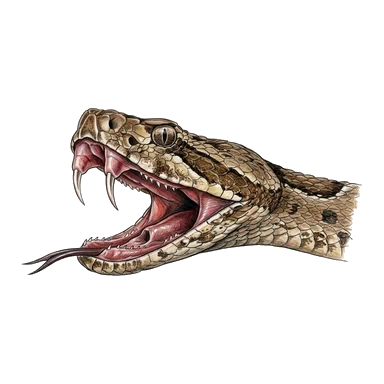
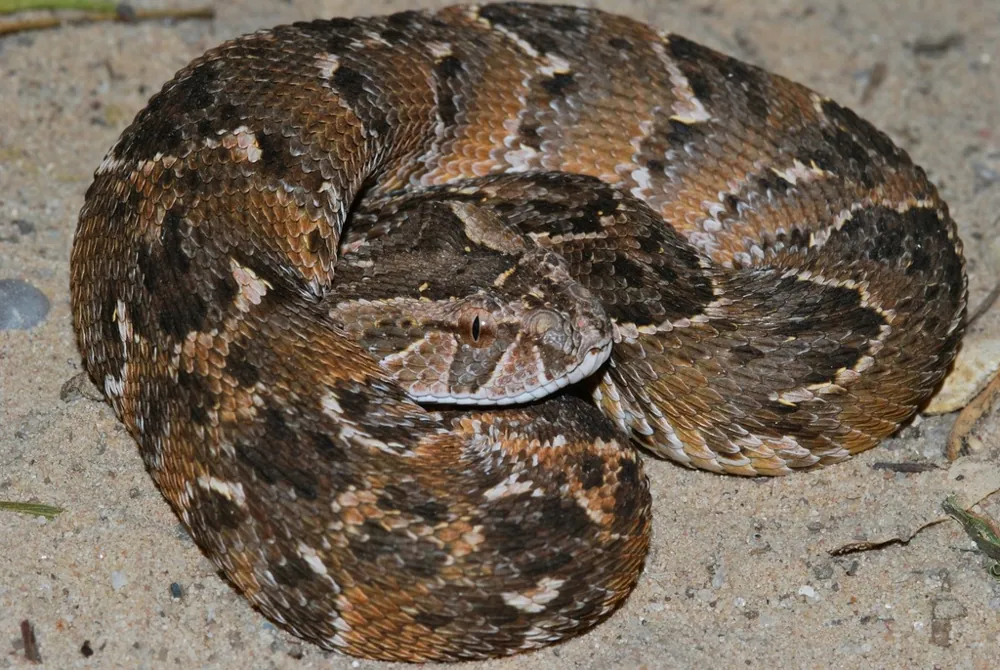
The puff adder is a large, stout viper that lives across most of Africa and parts of the Arabian Peninsula. It is one of the most dangerous snakes in Africa because it lives in places where many people live and work, and it has very potent venom. Its camouflage hides it well, so it is easy to step near without seeing it.1
 Ho e tseba jwang
- Stout, heavy body. Usually about 1.0 m long including the tail.1
- Two dark bands across the top of the head, and two dark bars running from each eye down the sides of the head.1
- Back is straw yellow, light brown, orange or reddish brown, with 18–22 dark brown to black chevron-shaped bands running down the back and tail.1
- In some populations, the body is heavily flecked with brown and black, giving a dusty-brown or blackish look.1
- Males from highland East Africa and the Western Cape of South Africa often have a striking yellow-and-black pattern.1
Matla a chefo
Chefo e tswa ka meno a yona a chefo (fangs) kapa ka meno a mang ha e loma.
Chefo ya yona (eo e e kenyang ka ho loma kapa ho hlaba) e etsang?
Its venom is cytotoxic, which means it destroys body tissue. Bites cause severe pain, swelling, bleeding under the skin and, in serious cases, tissue death that can spread and lead to gangrene. Other symptoms include shock, nausea, vomiting, dizziness and periods of semi-consciousness. Death can occur in about 25 hours from a dose of around 100 mg, and deaths usually come 2–4 days after a bite from complications.1
E kotsi hakae ho batho?
Kotsi ho batho: E a bolayaE nngwe ya diphoofolo tse kotsi ka ho fetisisa lefatsheng.It is responsible for more snakebite deaths in Africa than any other African snake. This is due to its wide range, common presence near people, large size, potent venom and aggressive temperament. Deaths are uncommon in untreated cases, but severe bites can be fatal, with one report giving a 52% mortality rate. Most deaths are linked to poor medical care.1
E etsang ha e tshohile?
When disturbed, it hisses loudly and continuously, coils tightly with the front of its body in a taut S shape, and may back away towards cover before striking suddenly and fast.1
 Haeba e loma
- Boloka motho a sa sisinyehe ebile a kgutsitse, boloka setho se lomilweng se lekana le bophahamo ba pelo, tlosa mesale le dintho tse tiileng, mme o mo ise sepetlele kapele.
Kamehla letsetsa nomoro ya tshohanyetso pele (112, 000, 911). Ena ke tataiso e akaretsang ya thuso ya pele, hase keletso ya bongaka. Metheo ya thuso ya pele
 Dula o bolokehile
- O se ke wa ama, wa tshwara kapa wa tena phoofolo ya naheng, leha e le e nyenyane, le leha e shebahala e robetse kapa e shwele.
- E fe sebaka. Ha o kopana le yona, dula o kgutsitse, kgutlela morao butle mme o e tlohele e tsamaye ka tsela ya yona.
- Haeba e nngwe e o loma: dula o kgutsitse, o se ke wa sisinyeha, letsetsa nomoro ya tshohanyetso (112, 000, 911) kapa o ye sepetlele kapele. Hopola hore e ne e shebahala jwang, foto e a thusa.
Ha e o batle. E sebedisa chefo ya yona ho tshwara dijo kapa ho itshireletsa, mme e kgetha ho ipata. Ho eketsehileng ka ho dula o bolokehile
Hokae lefatsheng?
E kgolo hakae?
E telele hakae?
E boima hakae?
 e telele jwaloka dikatse tsa lapeng tse 4 ho tloha nkong ho isa mohatleng
 e telele jwaloka dibanana tse 11 tse latellanange boima jwaloka katse ya lapeng
 e ka matha metara e 100 ka metsotswana e 97 (motho ya potlakang ka ho fetisisa o hloka 9,6)
Puff adder e kgolo hakae ha e bapiswa le WENA?
Ke dipalo feela ka hara sebatli sa hao. Ha ho letho le bolokwang kapa le romelwang kae kapa kae.
E potlaka hakae?


Dintlha
A female in a Czech zoo gave birth to 156 young, the largest litter recorded for any snake species.1
Its fangs are long and can penetrate deeply, and the force of its strike can kill prey by physical trauma alone.1
A large adult can produce between 150 and 350 mg of venom at a time, with a maximum of 750 mg.1
Dogs and meerkats, which hunt by scent, find it hard to detect because of a form of olfactory crypsis, meaning it hides its scent.1
It is one of the most toxic vipers based on LD50 (the dose that kills half of test animals in a study).1
It is a good swimmer and climber, and one specimen was found 4.6 m above the ground in a dense tree.1
Ho senya ditshomo
Tshomo: Puff adders are fast, aggressive snakes that chase people.
Nnete: They are normally sluggish and rely on camouflage for protection. They strike when disturbed, but they do not usually pursue people.1
Bakeng sa ditsebi tsa chefo
Moo dintlha di tswang teng
- Puff adder (Wikipedia (CC BY-SA 4.0))
- Bitis arietans (iNaturalist): mabitso le tlhophiso.
- Venom Wiki: boemo ba kotsi, boholo bo tlwaelehileng le kakanyo ya lebelo ke tsa rona. Bona kamoo re di balang ka teng: Kamoo re lekanyang kotsi ka teng.
Taba e nngwe le e nngwe leqepheng lena e na le nomoro e bontshang mohlodi wa yona. Haeba re entse phoso, re kopa tshwarelo, re barati ba diphoofolo, hase makasine wa saense. Re bolelle ho [email protected] mme re tla e lokisa.
 Phepheng e lapile! Venom Wiki ke projeke ya motho a le mong: ke mahala, ha e na dipapatso ebile ha e na di-tracker. Thuso e nyenyane ya tjhelete e e boloka e ntse e le inthaneteng.Fepa phepheng
Tse ding tsa sehlopha se le seng: Di-viper le di-adder
 Indian saw-scaled viperDi-viper le di-adderE a bolaya
 Noha ea RussellDi-viper le di-adderE a bolaya
 Gaboon viperDi-viper le di-adderE ka bolaya
 Common European adderDi-viper le di-adderE hloka ngaka
 Eastern Russell's viperDi-viper le di-adderE a bolaya
 Northeast African carpet viperDi-viper le di-adderE a bolaya
 Black mamba
 Deathstalker
 Egyptian cobra
 Boomslang
 Fat-tailed scorpion
 Western honey bee