
 Afrika
 Asia
Asia Yuropa
 Amerika Borwa
 Australia le Oceania
 Antarctica
 Lewatle la Pacific
 Lewatle la Atlantic
 Lewatle la India
 Lewatle la Arctic
 Lewatle la Mediterranean
 Lewatle le Lefubedu
 Lewatle la Caribbean
 Lewatle la Coral
 Lewatle la China Borwa
 Lewatle la Philippine
 Lewatle la Andaman
 Lewatle la Leboya
 Lewatle la Timor le Arafura
 Kgwohlo ya Bengal
 Kgwohlo ya California
Common house spider
 Ho loma
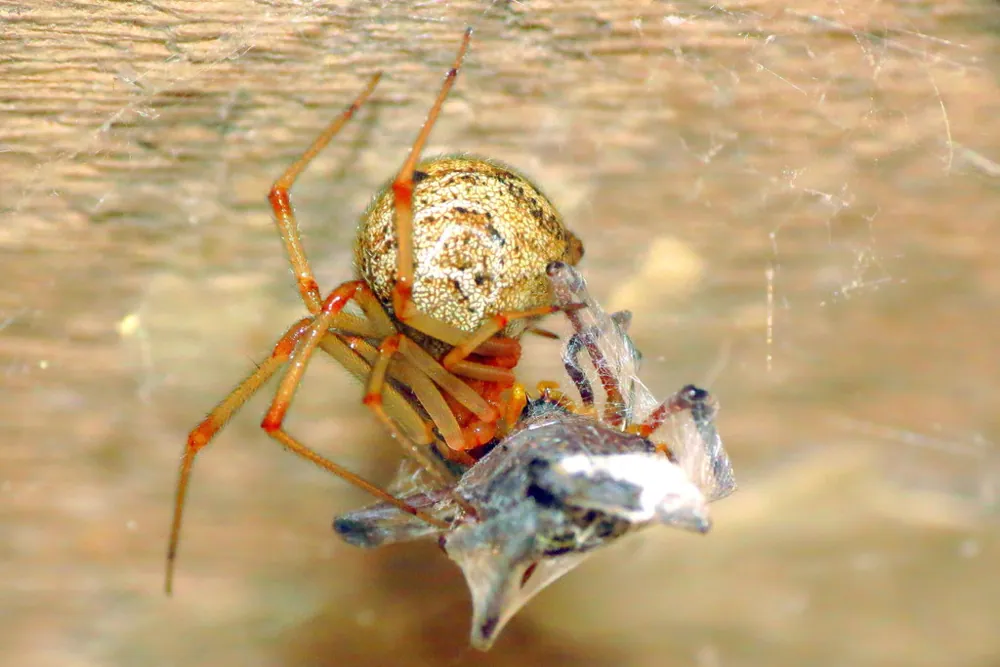
The common house spider is a small spider that lives in and around human homes. It spins messy three-dimensional webs in dark corners and catches household insects. It is found in many parts of the world, and its bite is not known to be dangerous to people.1



 Ho e tseba jwang
- Its colour varies from tan to nearly black, often with patterns of different shades on the body.1
- Females are usually 5 to 6 mm long, and males are usually 3.8 to 4.7 mm long.1
- With legs outspread, it can measure 2.5 cm or more across.1
- Its webs are three-dimensional and built in dark corners.1
Hangata e ferekanngwa le: Its body shape is similar to that of widow spiders. Males have a less bulbous (rounded) abdomen than females.1
Matla a chefo
Chefo e tswa ka meno a yona a chefo (fangs) kapa ka meno a mang ha e loma.
Chefo ya yona (eo e e kenyang ka ho loma kapa ho hlaba) e etsang?
It has neurotoxic venom, which attacks the nerves. Its bites are less severe than those of other theridiids (a family of cobweb spiders).1
E kotsi hakae ho batho?
Kotsi ho batho: E bobebeJwaloka ho hlajwa ke notshi kapa ho fetang moo. Ha e na kotsi ho batho.Its bites are not known to be dangerous to humans. It bites people only in self-defence, when it is grabbed and squeezed.1
E etsang ha e tshohile?
It runs to a secure hiding place when it senses movement, and if cornered it plays dead as a last resort.1
 Haeba e loma
- Hlatswa moo e lomileng teng mme o bee pakete ya leqhwa hodima teng bakeng sa bohloko. Fumana thuso ya bongaka haeba bohloko bo le matla, bo phatlalla kapa motho a ikutlwa a kula.
Kamehla letsetsa nomoro ya tshohanyetso pele (112, 000, 911). Ena ke tataiso e akaretsang ya thuso ya pele, hase keletso ya bongaka. Metheo ya thuso ya pele
 Dula o bolokehile
- O se ke wa ama, wa tshwara kapa wa tena phoofolo ya naheng, leha e le e nyenyane, le leha e shebahala e robetse kapa e shwele.
- E fe sebaka. Ha o kopana le yona, dula o kgutsitse, kgutlela morao butle mme o e tlohele e tsamaye ka tsela ya yona.
- Haeba e nngwe e o loma: dula o kgutsitse, o se ke wa sisinyeha, letsetsa nomoro ya tshohanyetso (112, 000, 911) kapa o ye sepetlele kapele. Hopola hore e ne e shebahala jwang, foto e a thusa.
Ha e o batle. E sebedisa chefo ya yona ho tshwara dijo kapa ho itshireletsa, mme e kgetha ho ipata. Ho eketsehileng ka ho dula o bolokehile
Hokae lefatsheng?
E kgolo hakae?
E telele hakae?
 e nyenyane hoo e ka dulang lenalong la hao
Common house spider e kgolo hakae ha e bapiswa le WENA?
Ke dipalo feela ka hara sebatli sa hao. Ha ho letho le bolokwang kapa le romelwang kae kapa kae.
E potlaka hakae?


Dintlha
The assassin bug Stenolemus lanipes apparently feeds only on its young, though it can also eat adults.1
When food dries out, it usually drops it to the floor to free up space in its web, rather than rebuilding the web.1
It has poor eyesight and cannot detect movement more than three to four inches away.1
Males and females often share the same web for long periods, though females sometimes fight when they meet.1
Ho senya ditshomo
Tshomo: Common house spiders are dangerous to people.
Nnete: Their venom is neurotoxic, but their bites are not known to be dangerous to humans. They bite only when grabbed and squeezed.1
Bakeng sa ditsebi tsa chefo
- Lebitso la saense
- Parasteatoda tepidariorum
- Sehlopha
- Dikgo
- Lelapa
- Theridiidae2
- Tatelano
- Araneae
- Dikontinente
- Amerika Leboya, Amerika Borwa
- Masea
- Females hang their spherical egg sacs in their webs, with clutches averaging 149 eggs. The young stay in the mother's web for several days after hatching.1
- Kotsi ho batho
- 1 / 5: E bobebe3
Moo dintlha di tswang teng
- Parasteatoda tepidariorum (Wikipedia (CC BY-SA 4.0))
- Parasteatoda tepidariorum (iNaturalist): mabitso le tlhophiso.
- Venom Wiki: boemo ba kotsi, boholo bo tlwaelehileng le kakanyo ya lebelo ke tsa rona. Bona kamoo re di balang ka teng: Kamoo re lekanyang kotsi ka teng.
Taba e nngwe le e nngwe leqepheng lena e na le nomoro e bontshang mohlodi wa yona. Haeba re entse phoso, re kopa tshwarelo, re barati ba diphoofolo, hase makasine wa saense. Re bolelle ho [email protected] mme re tla e lokisa.
 Phepheng e lapile! Venom Wiki ke projeke ya motho a le mong: ke mahala, ha e na dipapatso ebile ha e na di-tracker. Thuso e nyenyane ya tjhelete e e boloka e ntse e le inthaneteng.Fepa phepheng
 Brazilian wandering spider
 Brown recluse
 Southern black widow
 Amazon wandering spider
 Chilean recluse
 Northern black widow
 Terciopelo
 Eastern coral snake
 Eastern diamondback rattlesnake
 Eyelash viper
 Timber rattlesnake
 Western diamondback rattlesnake