
 Afrika
 Asia
Asia Yuropa
 Amerika Borwa
 Australia le Oceania
 Antarctica
 Lewatle la Pacific
 Lewatle la Atlantic
 Lewatle la India
 Lewatle la Arctic
 Lewatle la Mediterranean
 Lewatle le Lefubedu
 Lewatle la Caribbean
 Lewatle la Coral
 Lewatle la China Borwa
 Lewatle la Philippine
 Lewatle la Andaman
 Lewatle la Leboya
 Lewatle la Timor le Arafura
 Kgwohlo ya Bengal
 Kgwohlo ya California
Congo water cobra
 Ho loma
The Congo water cobra is a venomous snake that spends much of its time in rivers, lakes and streams in central Africa. It is an excellent swimmer and is the only cobra in its range that lives mainly in the water. Its venom is thought to be dangerous, so it is worth knowing about if you live near or visit the Congo River.1



 Ho e tseba jwang
- Blackish brown above, with irregular pale brown and black cross bars on the neck and front third of the body1
- Black rings on the neck, formed by the black bars1
- Pale brown upper lip with black lines between the shields, and a brownish white lower head1
- Blackish belly and underside of the tail1
- Medium to moderately long and heavily built, with a short head and a narrow hood1
Matla a chefo
Chefo e tswa ka meno a yona a chefo (fangs) kapa ka meno a mang ha e loma.
Chefo ya yona (eo e e kenyang ka ho loma kapa ho hlaba) e etsang?
Its venom is thought to be dangerously neurotoxic, like that of most cobras, which means it attacks the nerves. Lab tests on mice showed that its venom is among the strongest of any African cobra species studied so far. The venom has not been well studied, so the exact symptoms in people are not clear.1
E kotsi hakae ho batho?
Kotsi ho batho: E kotsi haholoE ka bolaya motho ya sa fumaneng kalafo.It is not usually aggressive, so bites are rare. One human bite has been reported, which caused only mild symptoms: headache and local pain. The species is still capable of causing serious envenomation in people.1
E etsang ha e tshohile?
If it is approached in water, it swims away quickly. On land, it rears up, spreads its narrow hood and hisses, and it may strike if provoked a lot.1
 Haeba e loma
- Boloka motho a sa sisinyehe ebile a kgutsitse, tlosa mesale le dintho tse tiileng, mme o mo ise sepetlele kapele: antivenom ke yona kalafo.
Kamehla letsetsa nomoro ya tshohanyetso pele (112, 000, 911). Ena ke tataiso e akaretsang ya thuso ya pele, hase keletso ya bongaka. Metheo ya thuso ya pele
 Dula o bolokehile
- O se ke wa ama, wa tshwara kapa wa tena phoofolo ya naheng, leha e le e nyenyane, le leha e shebahala e robetse kapa e shwele.
- E fe sebaka. Ha o kopana le yona, dula o kgutsitse, kgutlela morao butle mme o e tlohele e tsamaye ka tsela ya yona.
- Haeba e nngwe e o loma: dula o kgutsitse, o se ke wa sisinyeha, letsetsa nomoro ya tshohanyetso (112, 000, 911) kapa o ye sepetlele kapele. Hopola hore e ne e shebahala jwang, foto e a thusa.
Ha e o batle. E sebedisa chefo ya yona ho tshwara dijo kapa ho itshireletsa, mme e kgetha ho ipata. Ho eketsehileng ka ho dula o bolokehile
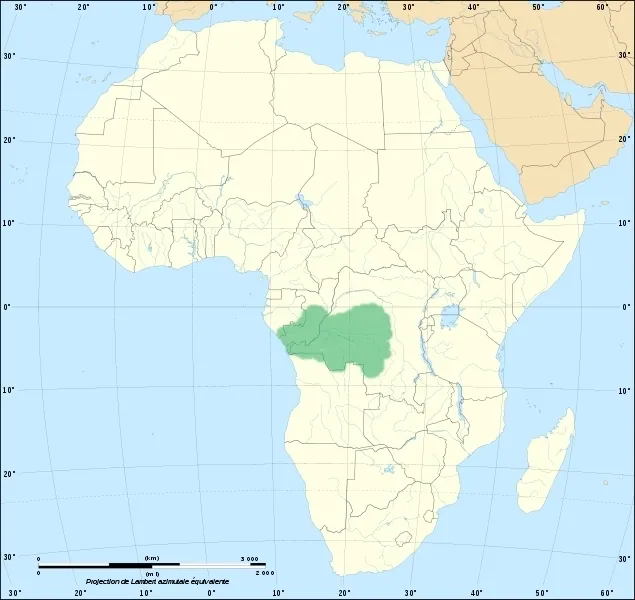
Hokae lefatsheng?
E kgolo hakae?
E telele hakae?
 e telele jwaloka dikatse tsa lapeng tse 5 ho tloha nkong ho isa mohatleng
 e telele jwaloka dibanana tse 13 tse latellanang
 e ka matha metara e 100 ka metsotswana e 51 (motho ya potlakang ka ho fetisisa o hloka 9,6)
Congo water cobra e kgolo hakae ha e bapiswa le WENA?
Ke dipalo feela ka hara sebatli sa hao. Ha ho letho le bolokwang kapa le romelwang kae kapa kae.
E potlaka hakae?


Dintlha
Moo dintlha di tswang teng
- Naja christyi (Wikipedia (CC BY-SA 4.0))
- Naja christyi (iNaturalist): mabitso le tlhophiso.
- Venom Wiki: boemo ba kotsi, boholo bo tlwaelehileng le kakanyo ya lebelo ke tsa rona. Bona kamoo re di balang ka teng: Kamoo re lekanyang kotsi ka teng.
Taba e nngwe le e nngwe leqepheng lena e na le nomoro e bontshang mohlodi wa yona. Haeba re entse phoso, re kopa tshwarelo, re barati ba diphoofolo, hase makasine wa saense. Re bolelle ho [email protected] mme re tla e lokisa.
 Phepheng e lapile! Venom Wiki ke projeke ya motho a le mong: ke mahala, ha e na dipapatso ebile ha e na di-tracker. Thuso e nyenyane ya tjhelete e e boloka e ntse e le inthaneteng.Fepa phepheng
Tse ding tsa sehlopha se le seng: Di-cobra, di-mamba le di-krait
 Black mambaDi-cobra, di-mamba le di-kraitE a bolaya
 Egyptian cobraDi-cobra, di-mamba le di-kraitE a bolaya
 Cape cobraDi-cobra, di-mamba le di-kraitE a bolaya
 Eastern green mambaDi-cobra, di-mamba le di-kraitE a bolaya
 Jameson's mambaDi-cobra, di-mamba le di-kraitE a bolaya
 Western green mambaDi-cobra, di-mamba le di-kraitE a bolaya
 Deathstalker
 Puff adder
 Boomslang
 Fat-tailed scorpion
 Gaboon viper
 Western honey bee