
 Afrika
 Asia
Asia Yuropa
 Amerika Borwa
 Australia le Oceania
 Antarctica
 Lewatle la Pacific
 Lewatle la Atlantic
 Lewatle la India
 Lewatle la Arctic
 Lewatle la Mediterranean
 Lewatle le Lefubedu
 Lewatle la Caribbean
 Lewatle la Coral
 Lewatle la China Borwa
 Lewatle la Philippine
 Lewatle la Andaman
 Lewatle la Leboya
 Lewatle la Timor le Arafura
 Kgwohlo ya Bengal
 Kgwohlo ya California
Gaboon viper
 Ho loma
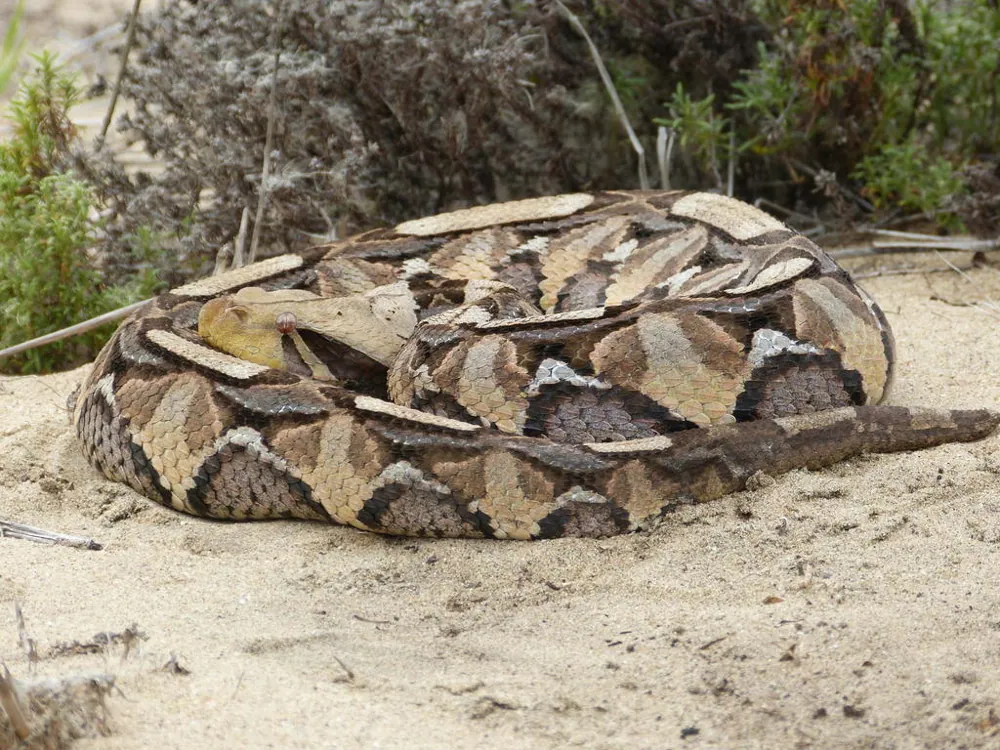
The Gaboon viper is a large, heavy snake with a striking pattern of pale and dark markings. It lives in the rainforests and savannas of sub-Saharan Africa. It is one of the most venomous snakes in the world, so knowing what it looks like matters.1


 Ho e tseba jwang
- A large, heavy, stout body, with a large triangular head and a neck much narrower than the head1
- A series of pale, rectangular blotches down the centre of the back, with dark hourglass markings edged in yellow1
- A white or cream head with a fine dark central line and a dark blue-black triangle behind and below each eye1
- Small raised 'horns' between the nostrils, which are tiny in this species1
- Its camouflage works well among dead leaves under trees, so it can be hard to see1
Hangata e ferekanngwa le: The Congolese giant toad (Sclerophrys channingi) may be a mimic of this snake. Its head appears to resemble the viper's head, while its body is darker.1
Matla a chefo
Chefo e tswa ka meno a yona a chefo (fangs) kapa ka meno a mang ha e loma.
Chefo ya yona (eo e e kenyang ka ho loma kapa ho hlaba) e etsang?
The venom is cytotoxic, which means it damages cells, and cardiotoxic, which means it harms the heart. Each bite can deliver a large amount of venom, because the snake does not release its grip after biting.1
E kotsi hakae ho batho?
Kotsi ho batho: E kotsi haholoE ka bolaya motho ya sa fumaneng kalafo.Bites are extremely rare, because the snake is seldom aggressive and lives mostly in rainforest areas. Most bites happen when people accidentally step on it. Even an average bite from an average-sized snake is potentially fatal.1
 Ditaba tse monate: dingaka di na le moriana (antivenom) kapa kalafo bakeng sa sena.1
E etsang ha e tshohile?
When threatened it hisses loudly in a deep, steady rhythm and flattens its head slightly with each breath. It is unlikely to strike unless it is severely provoked.1
 Haeba e loma
- Any bite should be treated as a serious medical emergency. Antivenom should be given as soon as possible to save the limb or the person's life.1
- Boloka motho a sa sisinyehe ebile a kgutsitse, boloka setho se lomilweng se lekana le bophahamo ba pelo, tlosa mesale le dintho tse tiileng, mme o mo ise sepetlele kapele.
Kamehla letsetsa nomoro ya tshohanyetso pele (112, 000, 911). Ena ke tataiso e akaretsang ya thuso ya pele, hase keletso ya bongaka. Metheo ya thuso ya pele
 Dula o bolokehile
- O se ke wa ama, wa tshwara kapa wa tena phoofolo ya naheng, leha e le e nyenyane, le leha e shebahala e robetse kapa e shwele.
- E fe sebaka. Ha o kopana le yona, dula o kgutsitse, kgutlela morao butle mme o e tlohele e tsamaye ka tsela ya yona.
- Haeba e nngwe e o loma: dula o kgutsitse, o se ke wa sisinyeha, letsetsa nomoro ya tshohanyetso (112, 000, 911) kapa o ye sepetlele kapele. Hopola hore e ne e shebahala jwang, foto e a thusa.
Ha e o batle. E sebedisa chefo ya yona ho tshwara dijo kapa ho itshireletsa, mme e kgetha ho ipata. Ho eketsehileng ka ho dula o bolokehile
Hokae lefatsheng?
E kgolo hakae?
E telele hakae?
E boima hakae?
 e telele jwaloka dikatse tsa lapeng tse 4 ho tloha nkong ho isa mohatleng
 e telele jwaloka dibanana tse 10 tse latellanang
 e ka matha metara e 100 ka metsotswana e 90 (motho ya potlakang ka ho fetisisa o hloka 9,6)
Gaboon viper e kgolo hakae ha e bapiswa le WENA?
Ke dipalo feela ka hara sebatli sa hao. Ha ho letho le bolokwang kapa le romelwang kae kapa kae.
E potlaka hakae?


Dintlha
A 1.8 m specimen caught in 1973 weighed 11.3 kg with an empty stomach. It is the heaviest venomous snake in Africa.1
Its eyes can move in unusual ways. If its head is turned 360°, one eye tilts up and the other tilts down.1
Although it is one of the fastest-striking snakes in the world, it usually tolerates handling and rarely bites or hisses.1
Unlike many African vipers, such as the puff adder, it does not release its grip after biting.1
Males fight by intertwining their necks and pushing. The winner pushes the other's head to the ground and raises his own head by 20–30 cm.1
Ho senya ditshomo
Tshomo: Because it is calm and tolerant, it is safe to handle.
Nnete: Some writers have described it as so docile it can be handled as freely as a harmless snake. This is absolutely not recommended: it is one of the fastest-striking snakes, and bites by bad-tempered individuals do occur.1
Moo dintlha di tswang teng
- Gaboon viper (Wikipedia (CC BY-SA 4.0))
- Bitis gabonica (iNaturalist): mabitso le tlhophiso.
- Venom Wiki: boemo ba kotsi, boholo bo tlwaelehileng le kakanyo ya lebelo ke tsa rona. Bona kamoo re di balang ka teng: Kamoo re lekanyang kotsi ka teng.
Taba e nngwe le e nngwe leqepheng lena e na le nomoro e bontshang mohlodi wa yona. Haeba re entse phoso, re kopa tshwarelo, re barati ba diphoofolo, hase makasine wa saense. Re bolelle ho [email protected] mme re tla e lokisa.
 Phepheng e lapile! Venom Wiki ke projeke ya motho a le mong: ke mahala, ha e na dipapatso ebile ha e na di-tracker. Thuso e nyenyane ya tjhelete e e boloka e ntse e le inthaneteng.Fepa phepheng
Tse ding tsa sehlopha se le seng: Di-viper le di-adder
 Puff adderDi-viper le di-adderE a bolaya
 Northeast African carpet viperDi-viper le di-adderE a bolaya
 West African carpet viperDi-viper le di-adderE a bolaya
 Rhinoceros viperDi-viper le di-adderE ka bolaya
 West African Gaboon viperDi-viper le di-adderE ka bolaya
 Horned adderDi-viper le di-adderE hloka ngaka
 Black mamba
 Deathstalker
 Egyptian cobra
 Boomslang
 Fat-tailed scorpion
 Western honey bee