
 Afrika
 Asia
Asia Yuropa
 Amerika Borwa
 Australia le Oceania
 Antarctica
 Lewatle la Pacific
 Lewatle la Atlantic
 Lewatle la India
 Lewatle la Arctic
 Lewatle la Mediterranean
 Lewatle le Lefubedu
 Lewatle la Caribbean
 Lewatle la Coral
 Lewatle la China Borwa
 Lewatle la Philippine
 Lewatle la Andaman
 Lewatle la Leboya
 Lewatle la Timor le Arafura
 Kgwohlo ya Bengal
 Kgwohlo ya California
Fat-tailed scorpion
 Ho hlaba
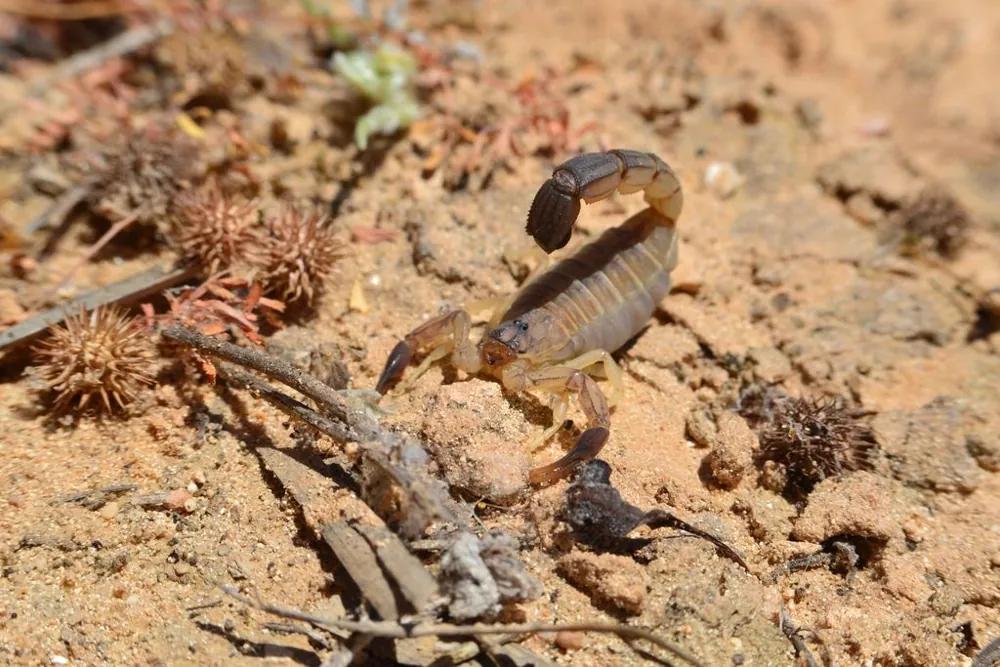
The fat-tailed scorpion is a hardy desert scorpion from North Africa. It can survive powerful sandstorms without digging a burrow. Its venom is among the most dangerous of any scorpion in the world, so it is important to know it by sight and keep well away from it.1



 Ho e tseba jwang
- It is a medium-sized scorpion that can grow up to 10 centimetres long.1
- It has a very thick, powerful tail.1
- Stripes run along the sides of its dome-shaped body.1
- Its armour is covered in tiny dome-shaped granules.1
- It is active at night and hides by day.1
Hangata e ferekanngwa le: Generally similar scorpions from the Middle East and India were once thought to be this species. Recent studies treat them as different species.1
Matla a chefo
Chefo e tswa ka lemao le hlabang.
Chefo ya yona (eo e e kenyang ka ho loma kapa ho hlaba) e etsang?
Its venom is very potent and is mainly made of neurotoxins (which attack the nerves), cardiotoxins (which harm the heart) and myotoxins (which damage muscle). It also contains hemotoxins, which affect the blood. Deaths in people usually occur through heart and breathing failure, and sometimes through bleeding in the brain, organ damage or shock.1
E kotsi hakae ho batho?
Kotsi ho batho: E kotsi haholoE ka bolaya motho ya sa fumaneng kalafo.It is one of the world's most dangerous scorpions, due to the strength of its venom and its aggressive temperament. It claims several lives each year.1
 Haeba e hlaba
- Pholisa moo e hlabileng teng ka pakete ya leqhwa mme o boloke motho a sa sisinyehe. Fumana thuso ya bongaka kapele, haholoholo bakeng sa bana: diphepheng tse ding di bolaya bana.
Kamehla letsetsa nomoro ya tshohanyetso pele (112, 000, 911). Ena ke tataiso e akaretsang ya thuso ya pele, hase keletso ya bongaka. Metheo ya thuso ya pele
 Dula o bolokehile
- O se ke wa ama, wa tshwara kapa wa tena phoofolo ya naheng, leha e le e nyenyane, le leha e shebahala e robetse kapa e shwele.
- E fe sebaka. Ha o kopana le yona, dula o kgutsitse, kgutlela morao butle mme o e tlohele e tsamaye ka tsela ya yona.
- Haeba e nngwe e o hlaba: dula o kgutsitse, o se ke wa sisinyeha, letsetsa nomoro ya tshohanyetso (112, 000, 911) kapa o ye sepetlele kapele. Hopola hore e ne e shebahala jwang, foto e a thusa.
Ha e o batle. E sebedisa chefo ya yona ho tshwara dijo kapa ho itshireletsa, mme e kgetha ho ipata. Ho eketsehileng ka ho dula o bolokehile
Hokae lefatsheng?
E kgolo hakae?
E telele hakae?
 e telele jwaloka diboloko tsa ho bapala tse 3 moleng
 e ka matha metara e 100 ka metsotswana e 180 (motho ya potlakang ka ho fetisisa o hloka 9,6)
Fat-tailed scorpion e kgolo hakae ha e bapiswa le WENA?
Ke dipalo feela ka hara sebatli sa hao. Ha ho letho le bolokwang kapa le romelwang kae kapa kae.
E potlaka hakae?


Dintlha
It can withstand sandstorms strong enough to strip paint off steel, and it does not dig burrows to shelter from them.1
Researchers have considered copying this surface texture for use on aeroplanes and helicopters.1
Its armour has dome-shaped granules about 10 micrometres high, and scientists think this texture helps protect it from sand.1
The lethal dose (LD50) of its venom is 0.32 mg per kg when injected under the skin.1
Its venom contains a toxin called AaTX1, which was first found in this species.1
Ho senya ditshomo
Tshomo: The fat-tailed scorpion lives across the Middle East and as far east as India.
Nnete: Older data suggested a wider range, but more recent studies have discredited this. It is found in North Africa.1
Moo dintlha di tswang teng
- Androctonus australis (Wikipedia (CC BY-SA 4.0))
- Androctonus australis (iNaturalist): mabitso le tlhophiso.
- Venom Wiki: boemo ba kotsi, boholo bo tlwaelehileng le kakanyo ya lebelo ke tsa rona. Bona kamoo re di balang ka teng: Kamoo re lekanyang kotsi ka teng.
Taba e nngwe le e nngwe leqepheng lena e na le nomoro e bontshang mohlodi wa yona. Haeba re entse phoso, re kopa tshwarelo, re barati ba diphoofolo, hase makasine wa saense. Re bolelle ho [email protected] mme re tla e lokisa.
 Phepheng e lapile! Venom Wiki ke projeke ya motho a le mong: ke mahala, ha e na dipapatso ebile ha e na di-tracker. Thuso e nyenyane ya tjhelete e e boloka e ntse e le inthaneteng.Fepa phepheng
Tse ding tsa sehlopha se le seng: Diphepheng
 Deathstalker
 Emperor scorpion
 Arabian fat-tailed scorpion
 Transvaal thick-tailed scorpion
 European yellow-tailed scorpion
 Flat rock scorpion
E boetse e phela: Afrika
 Black mambaDi-cobra, di-mamba le di-kraitE a bolaya
 Egyptian cobraDi-cobra, di-mamba le di-kraitE a bolaya
 Puff adderDi-viper le di-adderE a bolaya
 BoomslangDinoha tse meno a ka moraoE ka bolaya
 Gaboon viperDi-viper le di-adderE ka bolaya
 Western honey beeDinotshi, di-wasp le di-hornetE utlwisa bohloko feela