
 Afrika
 Asia
Asia Yuropa
 Amerika Borwa
 Australia le Oceania
 Antarctica
 Lewatle la Pacific
 Lewatle la Atlantic
 Lewatle la India
 Lewatle la Arctic
 Lewatle la Mediterranean
 Lewatle le Lefubedu
 Lewatle la Caribbean
 Lewatle la Coral
 Lewatle la China Borwa
 Lewatle la Philippine
 Lewatle la Andaman
 Lewatle la Leboya
 Lewatle la Timor le Arafura
 Kgwohlo ya Bengal
 Kgwohlo ya California
Eurasian water shrew
 Ho loma
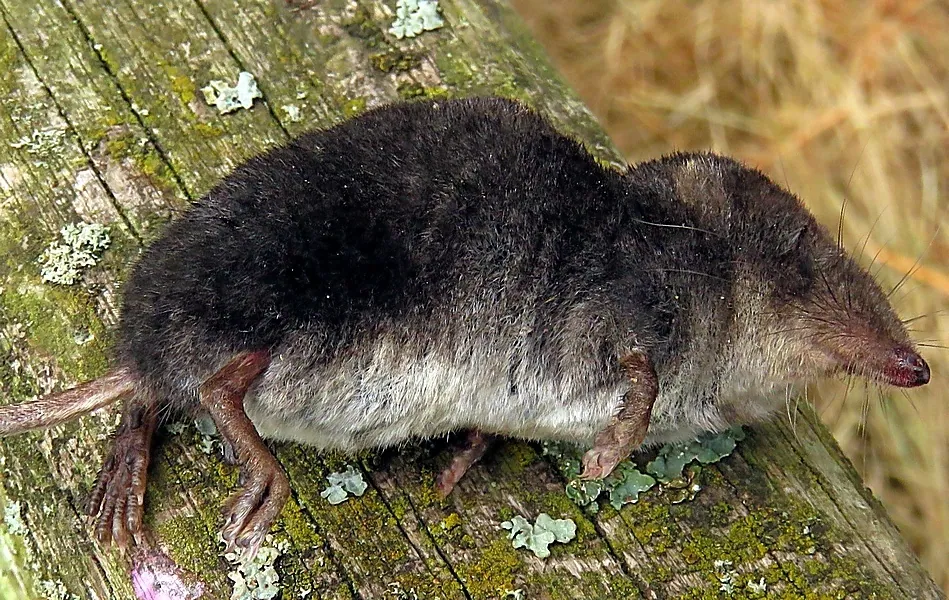
The Eurasian water shrew is a small, dark mammal that lives close to fresh water across northern Europe and Asia. It is one of the few venomous mammals, and it uses its venom to paralyse the prey it catches in the water.1



 Ho e tseba jwang
- Short, dark greyish-black fur on the head, back and sides1
- Dirty white underparts, sharply separated from the darker back1
- A white spot just behind the eye, and often another near the small ear1
- Black nose and a long, tapering snout1
- Sharp teeth tipped with red, and a slender tail with a keel of short white hairs underneath1
Matla a chefo
Chefo e tswa ka meno a yona a chefo (fangs) kapa ka meno a mang ha e loma.
Chefo ya yona (eo e e kenyang ka ho loma kapa ho hlaba) e etsang?
Its saliva contains a neurotoxic venom, which attacks the nerves. It delivers this venom at the base of the skull of its prey, and the venom paralyses prey even when the prey is larger than the shrew. Tests on field voles showed the venom is lethal at a minimum dose of 15 mg per kg of body weight.1
E kotsi hakae ho batho?
Kotsi ho batho: E bobebeJwaloka ho hlajwa ke notshi kapa ho fetang moo. Ha e na kotsi ho batho.Hantaviruses have been detected in shrews in Hungary and Poland, which raises public health concerns, although how the virus spreads is largely unknown.1
E etsang ha e tshohile?
Its venom is thought to immobilise organisms that may threaten it.1
 Haeba e loma
- Hlatswa leqeba hantle mme o fumane thuso ya bongaka.
Kamehla letsetsa nomoro ya tshohanyetso pele (112, 000, 911). Ena ke tataiso e akaretsang ya thuso ya pele, hase keletso ya bongaka. Metheo ya thuso ya pele
 Dula o bolokehile
- O se ke wa ama, wa tshwara kapa wa tena phoofolo ya naheng, leha e le e nyenyane, le leha e shebahala e robetse kapa e shwele.
- E fe sebaka. Ha o kopana le yona, dula o kgutsitse, kgutlela morao butle mme o e tlohele e tsamaye ka tsela ya yona.
- Haeba e nngwe e o loma: dula o kgutsitse, o se ke wa sisinyeha, letsetsa nomoro ya tshohanyetso (112, 000, 911) kapa o ye sepetlele kapele. Hopola hore e ne e shebahala jwang, foto e a thusa.
Ha e o batle. E sebedisa chefo ya yona ho tshwara dijo kapa ho itshireletsa, mme e kgetha ho ipata. Ho eketsehileng ka ho dula o bolokehile
Hokae lefatsheng?
E kgolo hakae?
E telele hakae?
E boima hakae?

 e telele jwaloka diboloko tsa ho bapala tse 3 moleng
 e bobebe hoo o neng o ke ke wa e utlwa letsohong la hao
 e ka matha metara e 100 ka metsotswana e 90 (motho ya potlakang ka ho fetisisa o hloka 9,6)
Eurasian water shrew e kgolo hakae ha e bapiswa le WENA?
Ke dipalo feela ka hara sebatli sa hao. Ha ho letho le bolokwang kapa le romelwang kae kapa kae.
E potlaka hakae?


Dintlha
It is one of the few venomous mammals. Its venom comes from glands at the base of its lower front teeth, and grooves along the teeth channel the venom into the bite.1
Its teeth are tipped with red because of deposits of iron, which harden the enamel of the tips.1
It can dive up to two metres underwater and stay under for about twenty seconds before it must surface to breathe.1
Its short fur holds air, so its skin stays dry while it swims.1
It has a home range of about 500 square metres, but when foraging on land it can travel up to 3 km.1
Bakeng sa ditsebi tsa chefo
- Lebitso la saense
- Neomys fodiens
- Sehlopha
- Diphoofolo tse anyesang tse nang le chefo
- Lelapa
- Soricidae2
- Tatelano
- Eulipotyphla
- Dikontinente
- Yuropa, Asia
- Masea
- Litters of four to eight or more young are born after a 24-day gestation period, and females can have one or two litters a year.1
- Nako ya bophelo
- e ka bang dilemo tse 31
- Boemo ba yona naheng
- Least concern1
- Kotsi ho batho
- 1 / 5: E bobebe3
Moo dintlha di tswang teng
- Eurasian water shrew (Wikipedia (CC BY-SA 4.0))
- Neomys fodiens (iNaturalist): mabitso le tlhophiso.
- Venom Wiki: boemo ba kotsi, boholo bo tlwaelehileng le kakanyo ya lebelo ke tsa rona. Bona kamoo re di balang ka teng: Kamoo re lekanyang kotsi ka teng.
Taba e nngwe le e nngwe leqepheng lena e na le nomoro e bontshang mohlodi wa yona. Haeba re entse phoso, re kopa tshwarelo, re barati ba diphoofolo, hase makasine wa saense. Re bolelle ho [email protected] mme re tla e lokisa.
 Phepheng e lapile! Venom Wiki ke projeke ya motho a le mong: ke mahala, ha e na dipapatso ebile ha e na di-tracker. Thuso e nyenyane ya tjhelete e e boloka e ntse e le inthaneteng.Fepa phepheng
Tse ding tsa sehlopha se le seng: Diphoofolo tse anyesang tse nang le chefo
 Bengal slow lorisDiphoofolo tse anyesang tse nang le chefoE utlwisa bohloko feela
 Javan slow lorisDiphoofolo tse anyesang tse nang le chefoE utlwisa bohloko feela
 Pygmy slow lorisDiphoofolo tse anyesang tse nang le chefoE utlwisa bohloko feela
 Sunda slow lorisDiphoofolo tse anyesang tse nang le chefoE utlwisa bohloko feela
 Kayan River slow lorisDiphoofolo tse anyesang tse nang le chefoE utlwisa bohloko feela
 Philippine slow lorisDiphoofolo tse anyesang tse nang le chefoE utlwisa bohloko feela
E boetse e phela: Yuropa
 Common European adderDi-viper le di-adderE hloka ngaka
 Spanish flyDiphoofolo tse ding tse chefangE hloka ngakaO se ke wa ama
 Common waspDinotshi, di-wasp le di-hornetE utlwisa bohloko feela
 European hornetDinotshi, di-wasp le di-hornetE utlwisa bohloko feela
 Fire salamanderDihoho tse chefang, mampotsana le di-newtE utlwisa bohloko feelaO se ke wa ama
 Western honey beeDinotshi, di-wasp le di-hornetE utlwisa bohloko feela