
 Afrika
 Asia
Asia Yuropa
 Amerika Borwa
 Australia le Oceania
 Antarctica
 Lewatle la Pacific
 Lewatle la Atlantic
 Lewatle la India
 Lewatle la Arctic
 Lewatle la Mediterranean
 Lewatle le Lefubedu
 Lewatle la Caribbean
 Lewatle la Coral
 Lewatle la China Borwa
 Lewatle la Philippine
 Lewatle la Andaman
 Lewatle la Leboya
 Lewatle la Timor le Arafura
 Kgwohlo ya Bengal
 Kgwohlo ya California
Javan slow loris
 Ho loma
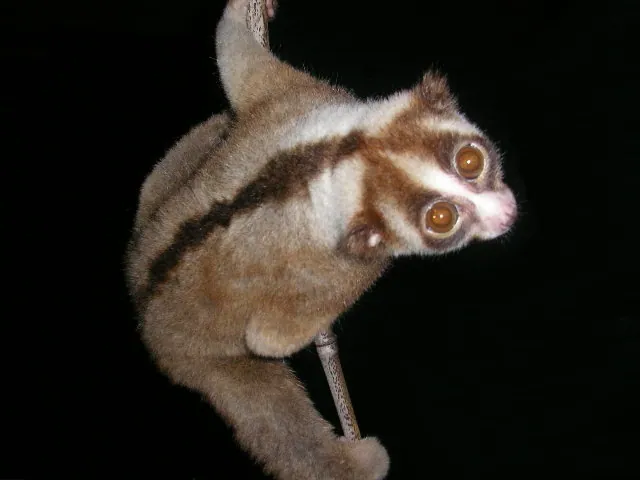
The Javan slow loris is a small, slow-moving primate that lives only on the western and central parts of the island of Java in Indonesia. It moves through the trees at night, creeping along vines and branches rather than leaping. It is critically endangered, mainly because it is captured for the pet trade.1



 Ho e tseba jwang
- A distinct white diamond pattern on the forehead, made by a stripe that runs over the head and forks towards the eyes and ears1
- Yellowish-grey body with cream-coloured head, neck and shoulders1
- Weighs between 565 and 687 g, with a head-body length of about 29 cm1
- Moves slowly through vines and lianas rather than jumping between trees, and is active at night1
Hangata e ferekanngwa le: It closely resembles the Bengal slow loris, which is similar in appearance, and the Sunda slow loris, which it was long considered a subspecies of. Rescue centres have sometimes misidentified it. It is larger than both the Sunda and Bornean slow lorises.1
Matla a chefo
Chefo e tswa ka meno a yona a chefo (fangs) kapa ka meno a mang ha e loma.
E kotsi hakae ho batho?
Kotsi ho batho: E bohlokoE ka utlwisa bohloko haholo, empa hoo e batlang e le kamehla ha e kotsi haholo. Haeba e loma
- Hlatswa leqeba hantle mme o fumane thuso ya bongaka.
Kamehla letsetsa nomoro ya tshohanyetso pele (112, 000, 911). Ena ke tataiso e akaretsang ya thuso ya pele, hase keletso ya bongaka. Metheo ya thuso ya pele
 Dula o bolokehile
- O se ke wa ama, wa tshwara kapa wa tena phoofolo ya naheng, leha e le e nyenyane, le leha e shebahala e robetse kapa e shwele.
- E fe sebaka. Ha o kopana le yona, dula o kgutsitse, kgutlela morao butle mme o e tlohele e tsamaye ka tsela ya yona.
- Haeba e nngwe e o loma: dula o kgutsitse, o se ke wa sisinyeha, letsetsa nomoro ya tshohanyetso (112, 000, 911) kapa o ye sepetlele kapele. Hopola hore e ne e shebahala jwang, foto e a thusa.
Ha e o batle. E sebedisa chefo ya yona ho tshwara dijo kapa ho itshireletsa, mme e kgetha ho ipata. Ho eketsehileng ka ho dula o bolokehile
Hokae lefatsheng?
E kgolo hakae?
E telele hakae?
E boima hakae?

 e telele jwaloka diboloko tsa ho bapala tse 9 moleng
 e ka matha metara e 100 ka metsotswana e 180 (motho ya potlakang ka ho fetisisa o hloka 9,6)
Javan slow loris e kgolo hakae ha e bapiswa le WENA?
Ke dipalo feela ka hara sebatli sa hao. Ha ho letho le bolokwang kapa le romelwang kae kapa kae.
E potlaka hakae?


Dintlha
Local farmers have helped maintain mid-air walkways that conservationists built so the lorises can cross between treetops in cleared farmland. These walkways also serve as irrigation pipes.1
Unlike most primates, it sleeps curled up on exposed branches rather than in nest holes.1
It is the largest of the slow lorises found in Indonesia.1
It can move on the ground to cross open spaces in disturbed habitat.1
Ho senya ditshomo
Tshomo: It has magical and curative properties.
Nnete: This is a myth. Even so, it is still sometimes used in traditional medicine in Indonesia, which adds to the pressure on the species.1
Moo dintlha di tswang teng
- Javan slow loris (Wikipedia (CC BY-SA 4.0))
- Nycticebus javanicus (iNaturalist): mabitso le tlhophiso.
- Venom Wiki: boemo ba kotsi, boholo bo tlwaelehileng le kakanyo ya lebelo ke tsa rona. Bona kamoo re di balang ka teng: Kamoo re lekanyang kotsi ka teng.
Taba e nngwe le e nngwe leqepheng lena e na le nomoro e bontshang mohlodi wa yona. Haeba re entse phoso, re kopa tshwarelo, re barati ba diphoofolo, hase makasine wa saense. Re bolelle ho [email protected] mme re tla e lokisa.
 Phepheng e lapile! Venom Wiki ke projeke ya motho a le mong: ke mahala, ha e na dipapatso ebile ha e na di-tracker. Thuso e nyenyane ya tjhelete e e boloka e ntse e le inthaneteng.Fepa phepheng
Tse ding tsa sehlopha se le seng: Diphoofolo tse anyesang tse nang le chefo
 Bengal slow lorisDiphoofolo tse anyesang tse nang le chefoE utlwisa bohloko feela
 Pygmy slow lorisDiphoofolo tse anyesang tse nang le chefoE utlwisa bohloko feela
 Sunda slow lorisDiphoofolo tse anyesang tse nang le chefoE utlwisa bohloko feela
 Kayan River slow lorisDiphoofolo tse anyesang tse nang le chefoE utlwisa bohloko feela
 Philippine slow lorisDiphoofolo tse anyesang tse nang le chefoE utlwisa bohloko feela
 Eurasian water shrewDiphoofolo tse anyesang tse nang le chefoHa e na kotsi
 Deathstalker
 Indian cobra
 Indian saw-scaled viper
 King cobra
 Puff adder
 Noha ea Russell