
 Afrika
 Asia
Asia Yuropa
 Amerika Borwa
 Australia le Oceania
 Antarctica
 Lewatle la Pacific
 Lewatle la Atlantic
 Lewatle la India
 Lewatle la Arctic
 Lewatle la Mediterranean
 Lewatle le Lefubedu
 Lewatle la Caribbean
 Lewatle la Coral
 Lewatle la China Borwa
 Lewatle la Philippine
 Lewatle la Andaman
 Lewatle la Leboya
 Lewatle la Timor le Arafura
 Kgwohlo ya Bengal
 Kgwohlo ya California
Kayan River slow loris
 Ho loma
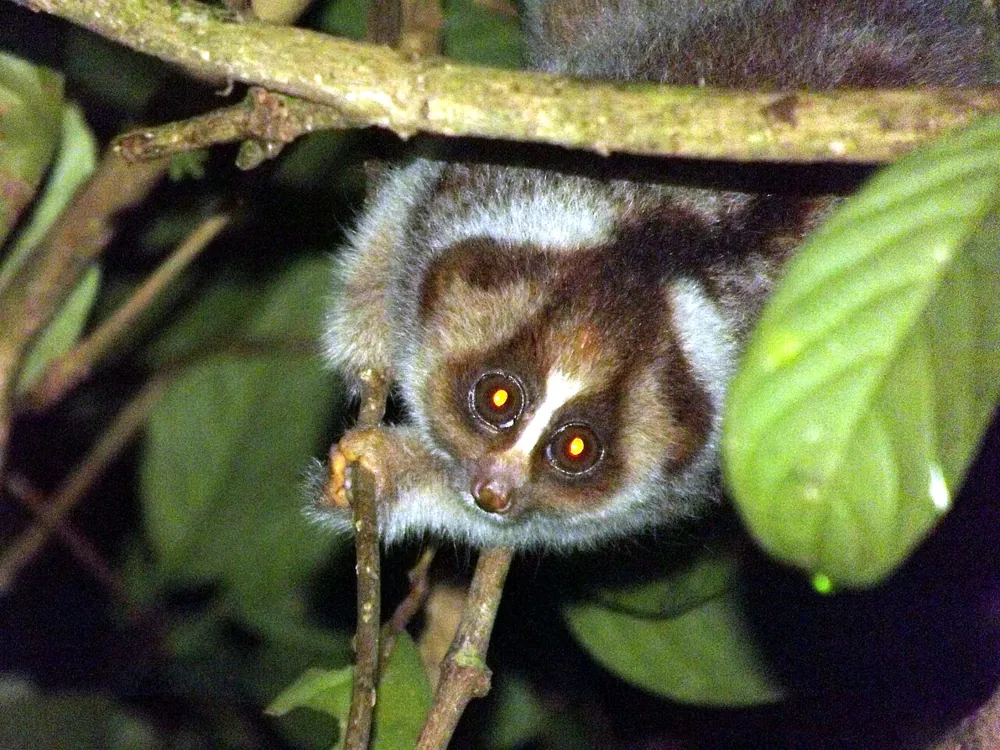
The Kayan River slow loris is a small, nocturnal primate that lives in the highlands of northern and central Borneo. It is the only primate known to have a toxic bite, which it uses to defend itself. It is classed as Vulnerable because its forest home is being lost.1



 Ho e tseba jwang
- High contrast between its black and white facial markings1
- The stripe between its eyes is sometimes bulb-shaped rather than rectangular1
- The ears are always covered in hair1
- Its fur is generally longer and fluffier than that of the Bornean slow loris1
Hangata e ferekanngwa le: It is often confused with the Bornean slow loris (N. menagensis). The Kayan River slow loris has more contrast in its facial markings, hairy ears instead of naked ears, and longer, fluffier fur.1
Matla a chefo
Chefo e tswa ka meno a yona a chefo (fangs) kapa ka meno a mang ha e loma.
Chefo ya yona (eo e e kenyang ka ho loma kapa ho hlaba) e etsang?
It has a toxic bite, which is unusual among primates. A pungent, clear, oily toxin is made in a gland on the inside of its elbow. The animal licks this gland, and the secretion mixes with its saliva to become active. The toxin is also rubbed onto its fur as protection for infants.1
E kotsi hakae ho batho?
Kotsi ho batho: E bohlokoE ka utlwisa bohloko haholo, empa hoo e batlang e le kamehla ha e kotsi haholo.E etsang ha e tshohile?
When threatened, it wipes the toxin from its elbow gland onto its toothcomb, and it may bite the attacker. Slow lorises can be slow to let go of a bite, which helps deliver more toxin.1
 Haeba e loma
- Hlatswa leqeba hantle mme o fumane thuso ya bongaka.
Kamehla letsetsa nomoro ya tshohanyetso pele (112, 000, 911). Ena ke tataiso e akaretsang ya thuso ya pele, hase keletso ya bongaka. Metheo ya thuso ya pele
 Dula o bolokehile
- O se ke wa ama, wa tshwara kapa wa tena phoofolo ya naheng, leha e le e nyenyane, le leha e shebahala e robetse kapa e shwele.
- E fe sebaka. Ha o kopana le yona, dula o kgutsitse, kgutlela morao butle mme o e tlohele e tsamaye ka tsela ya yona.
- Haeba e nngwe e o loma: dula o kgutsitse, o se ke wa sisinyeha, letsetsa nomoro ya tshohanyetso (112, 000, 911) kapa o ye sepetlele kapele. Hopola hore e ne e shebahala jwang, foto e a thusa.
Ha e o batle. E sebedisa chefo ya yona ho tshwara dijo kapa ho itshireletsa, mme e kgetha ho ipata. Ho eketsehileng ka ho dula o bolokehile
Hokae lefatsheng?
E kgolo hakae?
E telele hakae?
E boima hakae?

 e telele jwaloka diboloko tsa ho bapala tse 9 moleng
 e ka matha metara e 100 ka metsotswana e 180 (motho ya potlakang ka ho fetisisa o hloka 9,6)
Kayan River slow loris e kgolo hakae ha e bapiswa le WENA?
Ke dipalo feela ka hara sebatli sa hao. Ha ho letho le bolokwang kapa le romelwang kae kapa kae.
E potlaka hakae?


Dintlha
It is one of the few primates known to have a toxic bite, and this is a unique feature among primates.1
Its face mask may help it recognise other lorises of its own kind, and it may also make its eyes look bigger than they really are, which can deter predators.1
It has a toothcomb, a set of specialised lower front teeth that it uses for grooming.1
Its population is estimated to have fallen by more than 30% over about 21 to 24 years.1
Ho senya ditshomo
Tshomo: The Kayan River slow loris was always known as a separate species.
Nnete: Until 2013 its museum specimens were identified as the Bornean slow loris. A study of facial markings then showed it was a distinct species.1
Moo dintlha di tswang teng
- Nycticebus kayan (Wikipedia (CC BY-SA 4.0))
- Nycticebus kayan (iNaturalist): mabitso le tlhophiso.
- Venom Wiki: boemo ba kotsi, boholo bo tlwaelehileng le kakanyo ya lebelo ke tsa rona. Bona kamoo re di balang ka teng: Kamoo re lekanyang kotsi ka teng.
Taba e nngwe le e nngwe leqepheng lena e na le nomoro e bontshang mohlodi wa yona. Haeba re entse phoso, re kopa tshwarelo, re barati ba diphoofolo, hase makasine wa saense. Re bolelle ho [email protected] mme re tla e lokisa.
 Phepheng e lapile! Venom Wiki ke projeke ya motho a le mong: ke mahala, ha e na dipapatso ebile ha e na di-tracker. Thuso e nyenyane ya tjhelete e e boloka e ntse e le inthaneteng.Fepa phepheng
Tse ding tsa sehlopha se le seng: Diphoofolo tse anyesang tse nang le chefo
 Bengal slow lorisDiphoofolo tse anyesang tse nang le chefoE utlwisa bohloko feela
 Javan slow lorisDiphoofolo tse anyesang tse nang le chefoE utlwisa bohloko feela
 Pygmy slow lorisDiphoofolo tse anyesang tse nang le chefoE utlwisa bohloko feela
 Sunda slow lorisDiphoofolo tse anyesang tse nang le chefoE utlwisa bohloko feela
 Philippine slow lorisDiphoofolo tse anyesang tse nang le chefoE utlwisa bohloko feela
 Eurasian water shrewDiphoofolo tse anyesang tse nang le chefoHa e na kotsi
 Deathstalker
 Indian cobra
 Indian saw-scaled viper
 King cobra
 Puff adder
 Noha ea Russell