
 Afrika
 Asia
Asia Yuropa
 Amerika Borwa
 Australia le Oceania
 Antarctica
 Lewatle la Pacific
 Lewatle la Atlantic
 Lewatle la India
 Lewatle la Arctic
 Lewatle la Mediterranean
 Lewatle le Lefubedu
 Lewatle la Caribbean
 Lewatle la Coral
 Lewatle la China Borwa
 Lewatle la Philippine
 Lewatle la Andaman
 Lewatle la Leboya
 Lewatle la Timor le Arafura
 Kgwohlo ya Bengal
 Kgwohlo ya California
European yellow-tailed scorpion
 Ho hlaba
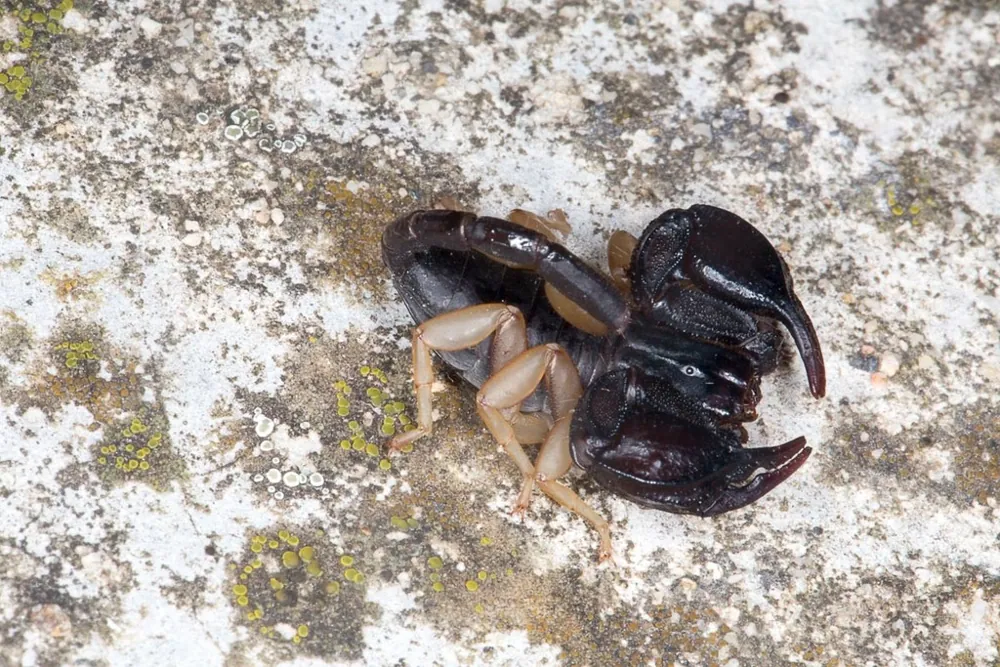
This is a small black scorpion with yellow-brown legs and tail. It lives in warm parts of Southern Europe and Northwest Africa, and a colony has also settled in the United Kingdom. It is one of the few scorpions that can be found living in towns and cities.1

 Ho e tseba jwang
Matla a chefo
Chefo e tswa ka lemao le hlabang.
Chefo ya yona (eo e e kenyang ka ho loma kapa ho hlaba) e etsang?
It is a mildly venomous scorpion and rarely uses its stinger. Its sting is less painful for people than a bee sting.1
E kotsi hakae ho batho?
Kotsi ho batho: E bobebeJwaloka ho hlajwa ke notshi kapa ho fetang moo. Ha e na kotsi ho batho.It is mildly venomous and rarely uses its sting. Its sting is less painful than a bee sting.1
 Haeba e hlaba
- Pholisa moo e hlabileng teng ka pakete ya leqhwa mme o boloke motho a sa sisinyehe. Fumana thuso ya bongaka kapele, haholoholo bakeng sa bana: diphepheng tse ding di bolaya bana.
Kamehla letsetsa nomoro ya tshohanyetso pele (112, 000, 911). Ena ke tataiso e akaretsang ya thuso ya pele, hase keletso ya bongaka. Metheo ya thuso ya pele
 Dula o bolokehile
- O se ke wa ama, wa tshwara kapa wa tena phoofolo ya naheng, leha e le e nyenyane, le leha e shebahala e robetse kapa e shwele.
- E fe sebaka. Ha o kopana le yona, dula o kgutsitse, kgutlela morao butle mme o e tlohele e tsamaye ka tsela ya yona.
- Haeba e nngwe e o hlaba: dula o kgutsitse, o se ke wa sisinyeha, letsetsa nomoro ya tshohanyetso (112, 000, 911) kapa o ye sepetlele kapele. Hopola hore e ne e shebahala jwang, foto e a thusa.
Ha e o batle. E sebedisa chefo ya yona ho tshwara dijo kapa ho itshireletsa, mme e kgetha ho ipata. Ho eketsehileng ka ho dula o bolokehile
Hokae lefatsheng?
E kgolo hakae?
E telele hakae?
 e kgutshwane ho feta monwana wa hao o monyenyane
 e ka matha metara e 100 ka metsotswana e 330 (motho ya potlakang ka ho fetisisa o hloka 9,6)
European yellow-tailed scorpion e kgolo hakae ha e bapiswa le WENA?
Ke dipalo feela ka hara sebatli sa hao. Ha ho letho le bolokwang kapa le romelwang kae kapa kae.
E potlaka hakae?


Dintlha
Thanks to a low metabolic rate, these scorpions can go for long periods without food, surviving on as few as four or five woodlice per year.1
The UK population is thought to have arrived in the early 19th century in a shipment of Italian masonry.1
In 2013 the British colony numbered 10,000 to 15,000 individuals, making it the northernmost population of scorpions outside the Americas.1
Cannibalism has been noted in colonies of this scorpion.1
Bakeng sa ditsebi tsa chefo
- Lebitso la saense
- Euscorpius flavicaudis
- Sehlopha
- Diphepheng
- Lelapa
- Euscorpiidae2
- Tatelano
- Scorpiones
- Dikontinente
- Yuropa, Afrika
- Masea
- It gives birth to live young, from a few to about 30 at a time, after a gestation period of 10–14 months; the newborns are white, soft and swollen and ride on their mother's back until their first moult, about 6 days later.1
- Kotsi ho batho
- 1 / 5: E bobebe3
Moo dintlha di tswang teng
- Tetratrichobothrius flavicaudis (Wikipedia (CC BY-SA 4.0))
- Euscorpius flavicaudis (iNaturalist): mabitso le tlhophiso.
- Venom Wiki: boemo ba kotsi, boholo bo tlwaelehileng le kakanyo ya lebelo ke tsa rona. Bona kamoo re di balang ka teng: Kamoo re lekanyang kotsi ka teng.
Taba e nngwe le e nngwe leqepheng lena e na le nomoro e bontshang mohlodi wa yona. Haeba re entse phoso, re kopa tshwarelo, re barati ba diphoofolo, hase makasine wa saense. Re bolelle ho [email protected] mme re tla e lokisa.
 Phepheng e lapile! Venom Wiki ke projeke ya motho a le mong: ke mahala, ha e na dipapatso ebile ha e na di-tracker. Thuso e nyenyane ya tjhelete e e boloka e ntse e le inthaneteng.Fepa phepheng
Tse ding tsa sehlopha se le seng: Diphepheng
 Deathstalker
 Fat-tailed scorpion
 Emperor scorpion
 Arabian fat-tailed scorpion
 Transvaal thick-tailed scorpion
 Common yellow scorpion
E boetse e phela: Yuropa
 Common European adderDi-viper le di-adderE hloka ngaka
 Spanish flyDiphoofolo tse ding tse chefangE hloka ngakaO se ke wa ama
 Common waspDinotshi, di-wasp le di-hornetE utlwisa bohloko feela
 European hornetDinotshi, di-wasp le di-hornetE utlwisa bohloko feela
 Fire salamanderDihoho tse chefang, mampotsana le di-newtE utlwisa bohloko feelaO se ke wa ama
 Western honey beeDinotshi, di-wasp le di-hornetE utlwisa bohloko feela