
 Afrika
 Asia
Asia Yuropa
 Amerika Borwa
 Australia le Oceania
 Antarctica
 Lewatle la Pacific
 Lewatle la Atlantic
 Lewatle la India
 Lewatle la Arctic
 Lewatle la Mediterranean
 Lewatle le Lefubedu
 Lewatle la Caribbean
 Lewatle la Coral
 Lewatle la China Borwa
 Lewatle la Philippine
 Lewatle la Andaman
 Lewatle la Leboya
 Lewatle la Timor le Arafura
 Kgwohlo ya Bengal
 Kgwohlo ya California
Transvaal thick-tailed scorpion
 Ho hlaba
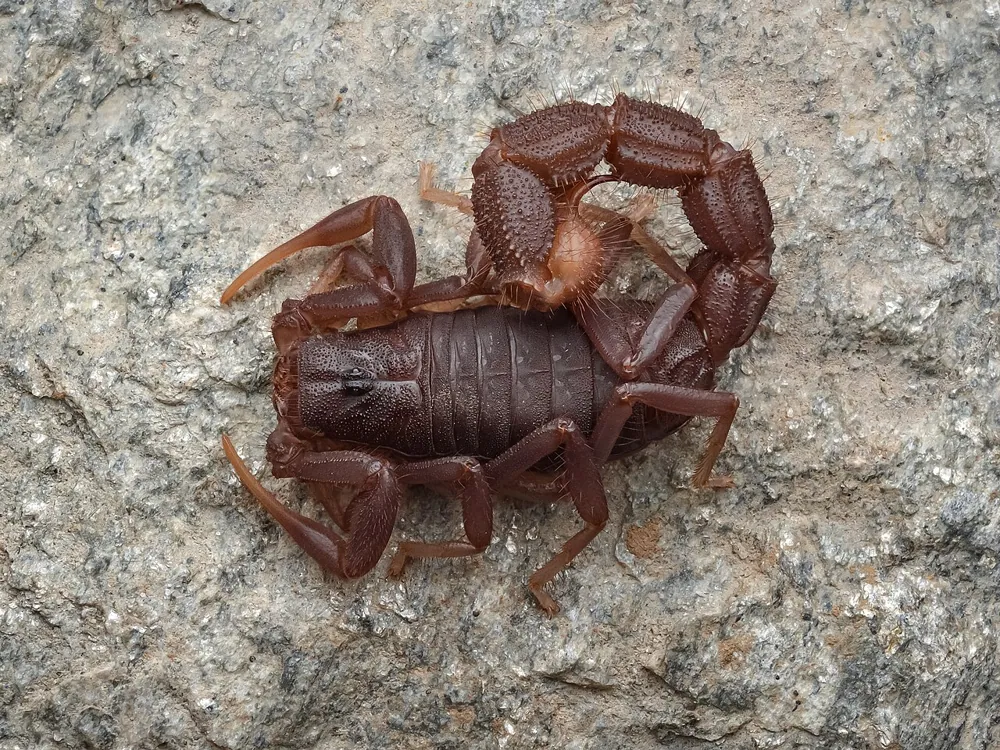
The Transvaal thick-tailed scorpion is a dark brown or black scorpion with a thick tail. It lives in dry, semi-arid parts of southern Africa. It matters because it is a medically significant scorpion that can sting and can also spray venom.1
 Ho e tseba jwang
- Dark brown or black in colour1
- Grows to 90–110 mm long1
- Thin pincers and a thickened tail1
- The sting segment is as wide as the rest of the tail1
- Mostly active at night1
Hangata e ferekanngwa le: It resembles P. villosus, its close relative. P. villosus is hairier, is less strictly nocturnal and lives further west.1
Matla a chefo
Chefo e tswa ka lemao le hlabang.
Chefo ya yona (eo e e kenyang ka ho loma kapa ho hlaba) e etsang?
Its venom contains kurtoxin, and a related toxin called parabutoxin has been isolated from it. Parabutoxin is a potassium channel inhibitor, which means it blocks channels that the body uses to control nerve and muscle signals. The first droplet of venom is different from the rest and is called "pre-venom".1
E kotsi hakae ho batho?
Kotsi ho batho: E kotsi haholoE ka bolaya motho ya sa fumaneng kalafo.It is described as a dangerous, medically significant scorpion. It can both sting and spray its venom.1
E etsang ha e tshohile?
It can sting and spray its venom when threatened.1
 Haeba e hlaba
- Pholisa moo e hlabileng teng ka pakete ya leqhwa mme o boloke motho a sa sisinyehe. Fumana thuso ya bongaka kapele, haholoholo bakeng sa bana: diphepheng tse ding di bolaya bana.
Kamehla letsetsa nomoro ya tshohanyetso pele (112, 000, 911). Ena ke tataiso e akaretsang ya thuso ya pele, hase keletso ya bongaka. Metheo ya thuso ya pele
 Dula o bolokehile
- O se ke wa ama, wa tshwara kapa wa tena phoofolo ya naheng, leha e le e nyenyane, le leha e shebahala e robetse kapa e shwele.
- E fe sebaka. Ha o kopana le yona, dula o kgutsitse, kgutlela morao butle mme o e tlohele e tsamaye ka tsela ya yona.
- Haeba e nngwe e o hlaba: dula o kgutsitse, o se ke wa sisinyeha, letsetsa nomoro ya tshohanyetso (112, 000, 911) kapa o ye sepetlele kapele. Hopola hore e ne e shebahala jwang, foto e a thusa.
Ha e o batle. E sebedisa chefo ya yona ho tshwara dijo kapa ho itshireletsa, mme e kgetha ho ipata. Ho eketsehileng ka ho dula o bolokehile
Hokae lefatsheng?
E kgolo hakae?
E telele hakae?
 e telele jwaloka diboloko tsa ho bapala tse 3 moleng
 e ka matha metara e 100 ka metsotswana e 160 (motho ya potlakang ka ho fetisisa o hloka 9,6)
Transvaal thick-tailed scorpion e kgolo hakae ha e bapiswa le WENA?
Ke dipalo feela ka hara sebatli sa hao. Ha ho letho le bolokwang kapa le romelwang kae kapa kae.
E potlaka hakae?


Dintlha
It can spray its venom as well as sting.1
The first droplet of its venom is different from the rest and is called "pre-venom".1
A toxin called parabutoxin has been isolated from its venom.1
Its tail is thickened, and the sting segment is as wide as the rest of the tail.1
It is nocturnal and rests in a shallow burrow under rocks during the day.1
Moo dintlha di tswang teng
- Parabuthus transvaalicus (Wikipedia (CC BY-SA 4.0))
- Parabuthus transvaalicus (iNaturalist): mabitso le tlhophiso.
- Venom Wiki: boemo ba kotsi, boholo bo tlwaelehileng le kakanyo ya lebelo ke tsa rona. Bona kamoo re di balang ka teng: Kamoo re lekanyang kotsi ka teng.
Taba e nngwe le e nngwe leqepheng lena e na le nomoro e bontshang mohlodi wa yona. Haeba re entse phoso, re kopa tshwarelo, re barati ba diphoofolo, hase makasine wa saense. Re bolelle ho [email protected] mme re tla e lokisa.
 Phepheng e lapile! Venom Wiki ke projeke ya motho a le mong: ke mahala, ha e na dipapatso ebile ha e na di-tracker. Thuso e nyenyane ya tjhelete e e boloka e ntse e le inthaneteng.Fepa phepheng
Tse ding tsa sehlopha se le seng: Diphepheng
 Deathstalker
 Fat-tailed scorpion
 Emperor scorpion
 Arabian fat-tailed scorpion
 European yellow-tailed scorpion
 Flat rock scorpion
E boetse e phela: Afrika
 Black mambaDi-cobra, di-mamba le di-kraitE a bolaya
 Egyptian cobraDi-cobra, di-mamba le di-kraitE a bolaya
 Puff adderDi-viper le di-adderE a bolaya
 BoomslangDinoha tse meno a ka moraoE ka bolaya
 Gaboon viperDi-viper le di-adderE ka bolaya
 Western honey beeDinotshi, di-wasp le di-hornetE utlwisa bohloko feela