
 Afrika
 Asia
Asia Yuropa
 Amerika Borwa
 Australia le Oceania
 Antarctica
 Lewatle la Pacific
 Lewatle la Atlantic
 Lewatle la India
 Lewatle la Arctic
 Lewatle la Mediterranean
 Lewatle le Lefubedu
 Lewatle la Caribbean
 Lewatle la Coral
 Lewatle la China Borwa
 Lewatle la Philippine
 Lewatle la Andaman
 Lewatle la Leboya
 Lewatle la Timor le Arafura
 Kgwohlo ya Bengal
 Kgwohlo ya California
Fea's viper
 Ho loma
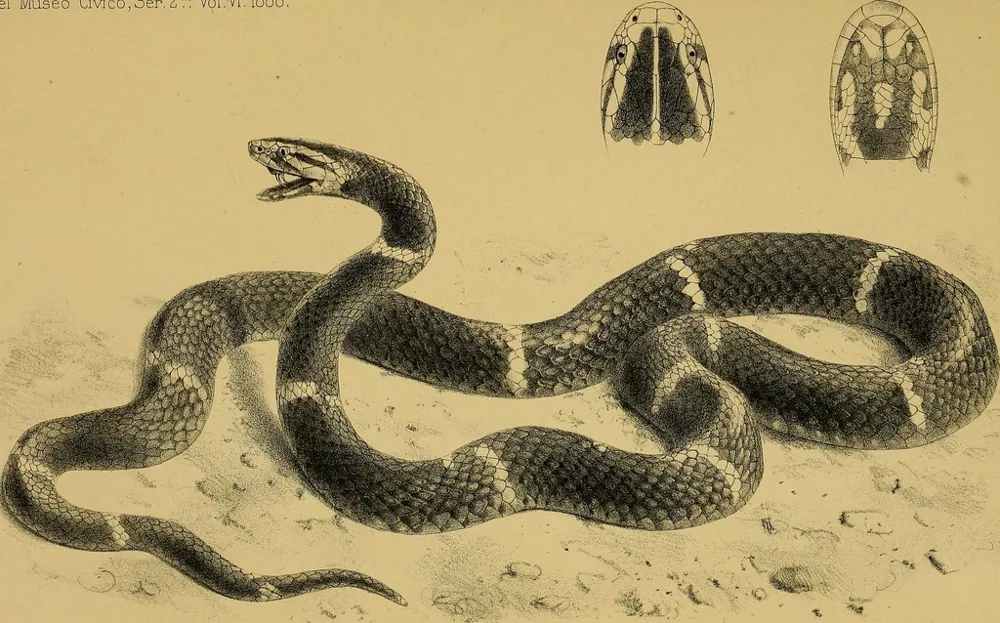
Fea's viper is a venomous snake that lives in the mountains of Southeast Asia. It is special because scientists once thought it was one of the most primitive vipers, but later studies showed it is more closely related to the pit vipers. It can also be found on roadsides, in rice fields and around homes.1

 Ho e tseba jwang
- The body is shiny, deep blue-grey to black, with several widely spaced, thin white-orange crossbands.1
- The head is orange to slightly yellow, with a cross-pattern outlined in grey.1
- The eyes are yellowish with vertical pupils.1
- The scales are smooth, not keeled, and arranged in 17 rows at midbody.1
- Adults are no longer than about 77 cm.1
Matla a chefo
Chefo e tswa ka meno a yona a chefo (fangs) kapa ka meno a mang ha e loma.
Chefo ya yona (eo e e kenyang ka ho loma kapa ho hlaba) e etsang?
Its venom is remarkably similar to that of Wagler's viper. Its venom does not cause blood clotting, bleeding or muscle breakdown, according to the studies described. One toxin, azemiopsin, blocks nicotinic acetylcholine receptors in muscles, which interferes with signals that tell muscles to move.1
E kotsi hakae ho batho?
Kotsi ho batho: E tebilengHo longwa ho hloka ngaka. Lefu le etsahala ka seoelo haholo.E etsang ha e tshohile?
When disturbed, it flattens its body to look wider, flares its jaws so the head looks triangular, sometimes vibrates its tail, and then may strike.1
 Haeba e loma
- Boloka motho a sa sisinyehe ebile a kgutsitse, boloka setho se lomilweng se lekana le bophahamo ba pelo, tlosa mesale le dintho tse tiileng, mme o mo ise sepetlele kapele.
Kamehla letsetsa nomoro ya tshohanyetso pele (112, 000, 911). Ena ke tataiso e akaretsang ya thuso ya pele, hase keletso ya bongaka. Metheo ya thuso ya pele
 Dula o bolokehile
- O se ke wa ama, wa tshwara kapa wa tena phoofolo ya naheng, leha e le e nyenyane, le leha e shebahala e robetse kapa e shwele.
- E fe sebaka. Ha o kopana le yona, dula o kgutsitse, kgutlela morao butle mme o e tlohele e tsamaye ka tsela ya yona.
- Haeba e nngwe e o loma: dula o kgutsitse, o se ke wa sisinyeha, letsetsa nomoro ya tshohanyetso (112, 000, 911) kapa o ye sepetlele kapele. Hopola hore e ne e shebahala jwang, foto e a thusa.
Ha e o batle. E sebedisa chefo ya yona ho tshwara dijo kapa ho itshireletsa, mme e kgetha ho ipata. Ho eketsehileng ka ho dula o bolokehile
Hokae lefatsheng?
E kgolo hakae?
E telele hakae?
 e telele jwaloka dibanana tse 4 tse latellanang
 e ka matha metara e 100 ka metsotswana e 100 (motho ya potlakang ka ho fetisisa o hloka 9,6)
Fea's viper e kgolo hakae ha e bapiswa le WENA?
Ke dipalo feela ka hara sebatli sa hao. Ha ho letho le bolokwang kapa le romelwang kae kapa kae.
E potlaka hakae?


Dintlha
Its fangs are hollow and rotate, but they are short. It also has a blade-like structure on the underside of the fang, which is seen only in a few other snake groups.1
It has large head shields like colubrids and elapids, instead of the many small scales found on most vipers.1
It hibernates during the winter, which is unusual for most vipers.1
It is thought to be crepuscular, which means it is most active at dusk and dawn, and it is active from early March into late November.1
Ho senya ditshomo
Tshomo: It is one of the most primitive vipers.
Nnete: It was once thought to be among the most primitive vipers, but molecular studies show it is the sister group to the pit vipers, Crotalinae.1
Moo dintlha di tswang teng
- Azemiops (Wikipedia (CC BY-SA 4.0))
- Azemiops feae (iNaturalist): mabitso le tlhophiso.
- Venom Wiki: boemo ba kotsi, boholo bo tlwaelehileng le kakanyo ya lebelo ke tsa rona. Bona kamoo re di balang ka teng: Kamoo re lekanyang kotsi ka teng.
Taba e nngwe le e nngwe leqepheng lena e na le nomoro e bontshang mohlodi wa yona. Haeba re entse phoso, re kopa tshwarelo, re barati ba diphoofolo, hase makasine wa saense. Re bolelle ho [email protected] mme re tla e lokisa.
 Phepheng e lapile! Venom Wiki ke projeke ya motho a le mong: ke mahala, ha e na dipapatso ebile ha e na di-tracker. Thuso e nyenyane ya tjhelete e e boloka e ntse e le inthaneteng.Fepa phepheng
Tse ding tsa sehlopha se le seng: Di-viper le di-adder
 Indian saw-scaled viperDi-viper le di-adderE a bolaya
 Puff adderDi-viper le di-adderE a bolaya
 Noha ea RussellDi-viper le di-adderE a bolaya
 Common European adderDi-viper le di-adderE hloka ngaka
 Eastern Russell's viperDi-viper le di-adderE a bolaya
 Northeast African carpet viperDi-viper le di-adderE a bolaya
E boetse e phela: Asia
 DeathstalkerDiphephengE a bolaya
 Indian cobraDi-cobra, di-mamba le di-kraitE a bolaya
 King cobraDi-cobra, di-mamba le di-kraitE a bolaya
 Asian giant hornetDinotshi, di-wasp le di-hornetE ka bolaya
 Komodo dragonMekgodutswane e nang le chefoE ka bolaya
 Spanish flyDiphoofolo tse ding tse chefangE hloka ngakaO se ke wa ama