
 Afrika
 Asia
Asia Yuropa
 Amerika Borwa
 Australia le Oceania
 Antarctica
 Lewatle la Pacific
 Lewatle la Atlantic
 Lewatle la India
 Lewatle la Arctic
 Lewatle la Mediterranean
 Lewatle le Lefubedu
 Lewatle la Caribbean
 Lewatle la Coral
 Lewatle la China Borwa
 Lewatle la Philippine
 Lewatle la Andaman
 Lewatle la Leboya
 Lewatle la Timor le Arafura
 Kgwohlo ya Bengal
 Kgwohlo ya California
Forest cobra
 Ho loma
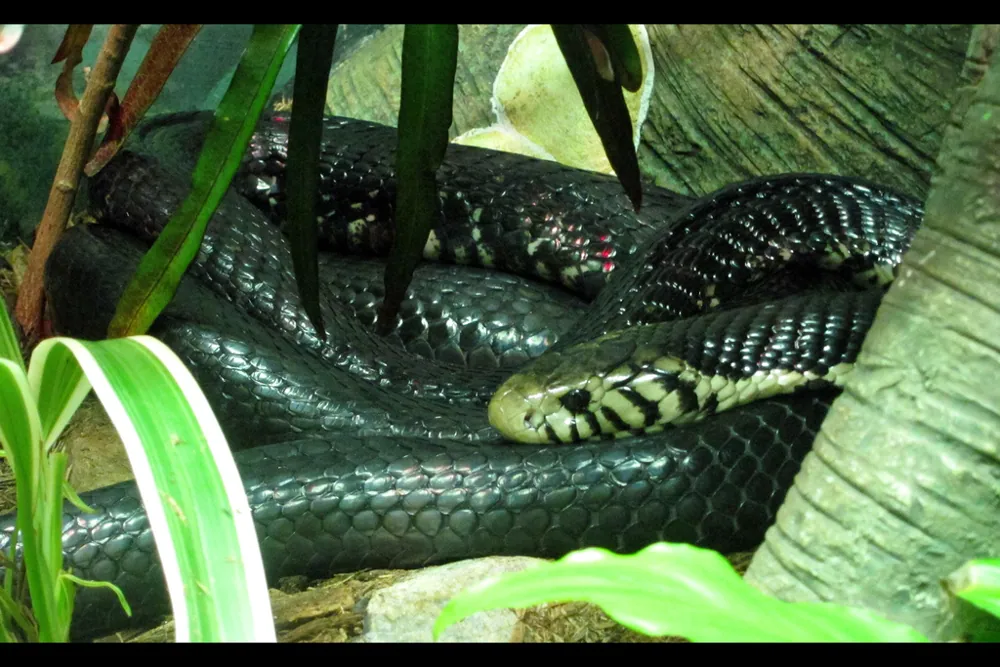
The forest cobra is a large, highly venomous snake that lives in central and western Africa. It is the largest true cobra, and it is one of the few African cobras that lives in high forest. It is dangerous, so anyone bitten needs urgent medical care.1



 Ho e tseba jwang
- Forest and forest-edge forms are glossy black, with cream or white chin, throat and belly, and broad black cross-bars and blotches.1
- The sides of the head show black and white markings that look like vertical bars on the lips.1
- West African savanna forms are banded black and yellow, with a black tail and yellow lips, chin and throat.1
- East African coastal forms are brownish or blackish-brown above, with a yellow or cream belly speckled with brown or black.1
- Adults are usually 140 to 220 cm long.1
Matla a chefo
Chefo e tswa ka meno a yona a chefo (fangs) kapa ka meno a mang ha e loma.
Chefo ya yona (eo e e kenyang ka ho loma kapa ho hlaba) e etsang?
Its venom is a postsynaptic neurotoxin, which attacks the nerves and causes severe neurotoxicity. Symptoms can include drooping eyelids, drowsiness, limb paralysis, hearing loss, inability to speak, dizziness, shock, low blood pressure, stomach pain, fever and breathing problems. A large amount of venom can be injected in one bite.1
E kotsi hakae ho batho?
Kotsi ho batho: E kotsi haholoE ka bolaya motho ya sa fumaneng kalafo.It is one of the least frequent causes of snake bites among African cobras, largely because it lives in forests. Even so, it ranks as the 4th most venomous Naja (true cobra) species, and a bite is a life-threatening emergency. Deaths from respiratory failure have been reported. A child in Ghana died within 20 minutes of being bitten by a snake thought to be this species.1
 Ditaba tse monate: dingaka di na le moriana (antivenom) kapa kalafo bakeng sa sena.1
E etsang ha e tshohile?
When threatened, it raises the front of its body off the ground, spreads a narrow hood and hisses loudly. If cornered or agitated, it can attack quickly.1
 Haeba e loma
- Most victims survive if antivenom is given promptly, as soon as signs of envenomation appear. Because a bite is a life-threatening emergency, the bitten person needs urgent medical care.1
- Boloka motho a sa sisinyehe ebile a kgutsitse, tlosa mesale le dintho tse tiileng, mme o mo ise sepetlele kapele: antivenom ke yona kalafo.
Kamehla letsetsa nomoro ya tshohanyetso pele (112, 000, 911). Ena ke tataiso e akaretsang ya thuso ya pele, hase keletso ya bongaka. Metheo ya thuso ya pele
 Dula o bolokehile
- O se ke wa ama, wa tshwara kapa wa tena phoofolo ya naheng, leha e le e nyenyane, le leha e shebahala e robetse kapa e shwele.
- E fe sebaka. Ha o kopana le yona, dula o kgutsitse, kgutlela morao butle mme o e tlohele e tsamaye ka tsela ya yona.
- Haeba e nngwe e o loma: dula o kgutsitse, o se ke wa sisinyeha, letsetsa nomoro ya tshohanyetso (112, 000, 911) kapa o ye sepetlele kapele. Hopola hore e ne e shebahala jwang, foto e a thusa.
Ha e o batle. E sebedisa chefo ya yona ho tshwara dijo kapa ho itshireletsa, mme e kgetha ho ipata. Ho eketsehileng ka ho dula o bolokehile
Hokae lefatsheng?
E kgolo hakae?
E telele hakae?
E boima hakae?
 e telele jwaloka dintja tse 3 ho tloha nkong ho isa mohatleng
 e telele jwaloka dibanana tse 18 tse latellanang
 e boima jwaloka katse ya lapeng
 e ka matha metara e 100 ka metsotswana e 41 (motho ya potlakang ka ho fetisisa o hloka 9,6)
Forest cobra e kgolo hakae ha e bapiswa le WENA?
Ke dipalo feela ka hara sebatli sa hao. Ha ho letho le bolokwang kapa le romelwang kae kapa kae.
E potlaka hakae?


Dintlha
It is the largest true cobra species and possibly the largest of all Naja species in the world.1
It is an excellent climber and has been known to climb trees to 10 m or more.1
It swims well and is often considered semi-aquatic.1
It does not spit or spray its venom.1
It is mainly active during the day in quiet areas, but it can be active at night in towns.1
Moo dintlha di tswang teng
- Forest cobra (Wikipedia (CC BY-SA 4.0))
- Naja melanoleuca (iNaturalist): mabitso le tlhophiso.
- Venom Wiki: boemo ba kotsi, boholo bo tlwaelehileng le kakanyo ya lebelo ke tsa rona. Bona kamoo re di balang ka teng: Kamoo re lekanyang kotsi ka teng.
Taba e nngwe le e nngwe leqepheng lena e na le nomoro e bontshang mohlodi wa yona. Haeba re entse phoso, re kopa tshwarelo, re barati ba diphoofolo, hase makasine wa saense. Re bolelle ho [email protected] mme re tla e lokisa.
 Phepheng e lapile! Venom Wiki ke projeke ya motho a le mong: ke mahala, ha e na dipapatso ebile ha e na di-tracker. Thuso e nyenyane ya tjhelete e e boloka e ntse e le inthaneteng.Fepa phepheng
Tse ding tsa sehlopha se le seng: Di-cobra, di-mamba le di-krait
 Black mambaDi-cobra, di-mamba le di-kraitE a bolaya
 Egyptian cobraDi-cobra, di-mamba le di-kraitE a bolaya
 Cape cobraDi-cobra, di-mamba le di-kraitE a bolaya
 Eastern green mambaDi-cobra, di-mamba le di-kraitE a bolaya
 Jameson's mambaDi-cobra, di-mamba le di-kraitE a bolaya
 Western green mambaDi-cobra, di-mamba le di-kraitE a bolaya
 Deathstalker
 Puff adder
 Boomslang
 Fat-tailed scorpion
 Gaboon viper
 Western honey bee