
 Afrika
 Asia
Asia Yuropa
 Amerika Borwa
 Australia le Oceania
 Antarctica
 Lewatle la Pacific
 Lewatle la Atlantic
 Lewatle la India
 Lewatle la Arctic
 Lewatle la Mediterranean
 Lewatle le Lefubedu
 Lewatle la Caribbean
 Lewatle la Coral
 Lewatle la China Borwa
 Lewatle la Philippine
 Lewatle la Andaman
 Lewatle la Leboya
 Lewatle la Timor le Arafura
 Kgwohlo ya Bengal
 Kgwohlo ya California
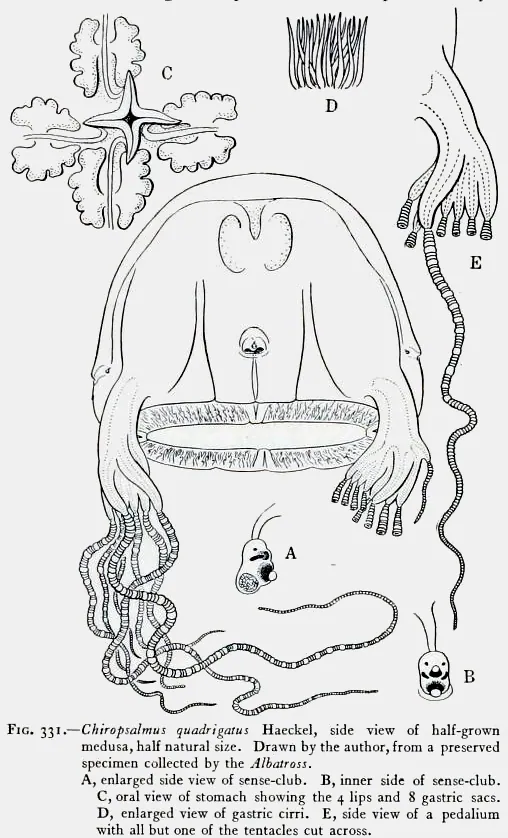
Four-handed box jellyfish
 Di-tentacle tse hlabang
The four-handed box jellyfish is a clear, cube-shaped jellyfish that lives in warm seas. It is found in the western Atlantic, the Gulf of Mexico and parts of the Pacific. Its sting is venomous and can be dangerous to people, especially children.1


 Ho e tseba jwang
Matla a chefo
Dikete tsa disele tse nyenyane tse hlabang di thunya ha ho na le se di amang.
Chefo ya yona (eo e e kenyang ka ho loma kapa ho hlaba) e etsang?
The stinging cells on the tentacles release venom that causes an extremely painful sting. The sting is linear, meaning it leaves a line of marks on the skin. Apart from pain, it can cause heart dysfunction and slowed breathing, which are systemic symptoms that affect the whole body. The rash can last for several months.1
E kotsi hakae ho batho?
Kotsi ho batho: E kotsi haholoE ka bolaya motho ya sa fumaneng kalafo.The sting is extremely painful and can be life-threatening. A four-year-old boy in the Gulf of Mexico died within forty minutes of being stung. Off the coast of Brazil, 16 stings over five years were identified as coming from this species. Children are especially at risk.1
 Ditaba tse monate: dingaka di na le moriana (antivenom) kapa kalafo bakeng sa sena.1
E etsang ha e tshohile?
Its long, stinging tentacles deter predators.1
 Haeba e hlaba
- Antivenom given within a few hours of the sting relieves the pain somewhat, reduces the severity of the rash and improves other symptoms. In extreme cases, cardiopulmonary resuscitation (CPR) can be effective if started promptly.1
- Tswa metsing mme o tlose di-tentacle tsohle (ka ditlelafo kapa ka lesela).
- Bakeng sa box jellyfish tsa tropike: tshela asene (vinegar) moo e hlabileng teng bonyane metsotswana e 30, bitsa thuso mme o itokisetse ho etsa CPR. Bakeng sa di-bluebottle le tse ding tse ngata: hlatswa ka metsi a lewatle, ebe ka metsi a tjhesang bakeng sa bohloko.
Kamehla letsetsa nomoro ya tshohanyetso pele (112, 000, 911). Ena ke tataiso e akaretsang ya thuso ya pele, hase keletso ya bongaka. Metheo ya thuso ya pele
 Dula o bolokehile
- O se ke wa ama, wa tshwara kapa wa tena phoofolo ya naheng, leha e le e nyenyane, le leha e shebahala e robetse kapa e shwele.
- E fe sebaka. Ha o kopana le yona, dula o kgutsitse, kgutlela morao butle mme o e tlohele e tsamaye ka tsela ya yona.
- Haeba e nngwe e o hlaba: dula o kgutsitse, o se ke wa sisinyeha, letsetsa nomoro ya tshohanyetso (112, 000, 911) kapa o ye sepetlele kapele. Hopola hore e ne e shebahala jwang, foto e a thusa.
Ha e o batle. E sebedisa chefo ya yona ho tshwara dijo kapa ho itshireletsa, mme e kgetha ho ipata. Ho eketsehileng ka ho dula o bolokehile
Hokae lefatsheng?
E kgolo hakae?
E telele hakae?
 e telele jwaloka diboloko tsa ho bapala tse 4 moleng
 e ka sesa bolelele ba letangwane le leholo la ho sesa (50 m) ka metsotswana e 36
Four-handed box jellyfish e kgolo hakae ha e bapiswa le WENA?
Ke dipalo feela ka hara sebatli sa hao. Ha ho letho le bolokwang kapa le romelwang kae kapa kae.
E potlaka hakae?
Dintlha
Its bell is almost completely transparent, which makes it hard to spot in the water.1
Its tentacles are the longest part of its body, reaching several metres in length.1
Along the Texas Gulf coast in 1955 and 1956, large numbers appeared inshore during drought, when the water was saltier than normal.1
Scientists have done little research on this species, and studies have found that jellyfish from different regions can have different stinging cells.1
Small specimens were often caught in shrimp trawls, while the adults were seldom seen near the surface.1
Moo dintlha di tswang teng
- Chiropsalmus quadrumanus (Wikipedia (CC BY-SA 4.0))
- Chiropsalmus quadrumanus (iNaturalist): mabitso le tlhophiso.
- Venom Wiki: boemo ba kotsi, boholo bo tlwaelehileng le kakanyo ya lebelo ke tsa rona. Bona kamoo re di balang ka teng: Kamoo re lekanyang kotsi ka teng.
Taba e nngwe le e nngwe leqepheng lena e na le nomoro e bontshang mohlodi wa yona. Haeba re entse phoso, re kopa tshwarelo, re barati ba diphoofolo, hase makasine wa saense. Re bolelle ho [email protected] mme re tla e lokisa.
 Phepheng e lapile! Venom Wiki ke projeke ya motho a le mong: ke mahala, ha e na dipapatso ebile ha e na di-tracker. Thuso e nyenyane ya tjhelete e e boloka e ntse e le inthaneteng.Fepa phepheng
Tse ding tsa sehlopha se le seng: Di-jellyfish le diphoofolo tsa lewatle tse hlabang
 Australian box jellyfishDi-jellyfish le diphoofolo tsa lewatle tse hlabangE a bolayaO se ke wa ama
 Irukandji jellyfishDi-jellyfish le diphoofolo tsa lewatle tse hlabangE ka bolayaO se ke wa ama
 Portuguese man o' warDi-jellyfish le diphoofolo tsa lewatle tse hlabangE hloka ngakaO se ke wa ama
 Lion's mane jellyfishDi-jellyfish le diphoofolo tsa lewatle tse hlabangE utlwisa bohloko feelaO se ke wa ama
 Moon jellyfishDi-jellyfish le diphoofolo tsa lewatle tse hlabangHa e na kotsi
 Common kingslayerDi-jellyfish le diphoofolo tsa lewatle tse hlabangE ka bolayaO se ke wa ama
E boetse e phela: Lewatle la Atlantic
 Hawksbill sea turtleDiphoofolo tse ding tse chefangE ka bolaya
 Blue sea dragonDikgofu tsa cone le di-octopusE utlwisa bohloko feela
 Greenland sharkDiphoofolo tse ding tse chefangE utlwisa bohloko feela
 Common octopusDikgofu tsa cone le di-octopusHa e na kotsi
 Common stingrayDitlhapi tse nang le chefoE hloka ngaka
 Greater weeverDitlhapi tse nang le chefoE hloka ngakaO se ke wa ama