
 Afrika
 Asia
Asia Yuropa
 Amerika Borwa
 Australia le Oceania
 Antarctica
 Lewatle la Pacific
 Lewatle la Atlantic
 Lewatle la India
 Lewatle la Arctic
 Lewatle la Mediterranean
 Lewatle le Lefubedu
 Lewatle la Caribbean
 Lewatle la Coral
 Lewatle la China Borwa
 Lewatle la Philippine
 Lewatle la Andaman
 Lewatle la Leboya
 Lewatle la Timor le Arafura
 Kgwohlo ya Bengal
 Kgwohlo ya California
Fried egg jellyfish
 Di-tentacle tse hlabang
The fried egg jellyfish is a jellyfish that lives in the Mediterranean, Aegean and Adriatic Seas. It gets its name from its flat, rounded body, which looks like a fried egg. Its sting has little or no effect on most people, so it is more of a nuisance than a danger.1


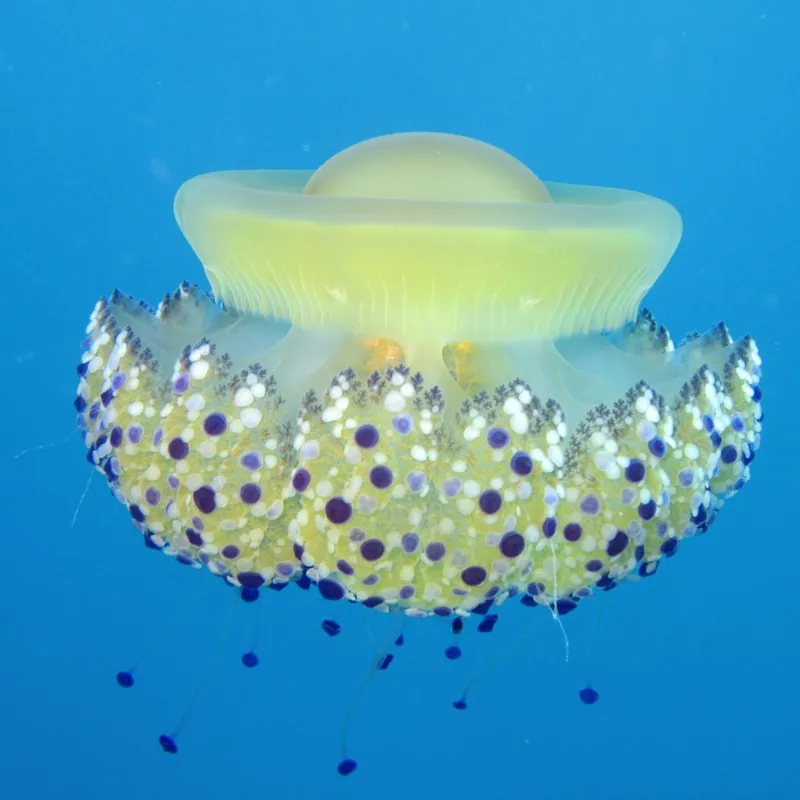
 Ho e tseba jwang
- A smooth, raised central dome sits inside a gutter-like ring.1
- The marginal lappets, the flaps around the edge of the bell, are long and roughly rectangular.1
- Each mouth arm splits near its base and branches several times.1
- Many short, club-shaped appendages with disc-like ends surround the mouth arms.1
- Adults can reach 40 cm across, but are usually less than 17 cm wide. Older jellyfish lose colour and their bodies become damaged.1
Matla a chefo
Dikete tsa disele tse nyenyane tse hlabang di thunya ha ho na le se di amang.
E kotsi hakae ho batho?
Kotsi ho batho: E bobebeJwaloka ho hlajwa ke notshi kapa ho fetang moo. Ha e na kotsi ho batho.Its sting has very little or no effect on humans. However, it can cause allergic reactions in more sensitive people, usually itching and scratching in the stung area. Large summer blooms mainly cause problems for tourism and fishing.1
 Haeba e hlaba
- Tswa metsing mme o tlose di-tentacle tsohle (ka ditlelafo kapa ka lesela).
- Bakeng sa box jellyfish tsa tropike: tshela asene (vinegar) moo e hlabileng teng bonyane metsotswana e 30, bitsa thuso mme o itokisetse ho etsa CPR. Bakeng sa di-bluebottle le tse ding tse ngata: hlatswa ka metsi a lewatle, ebe ka metsi a tjhesang bakeng sa bohloko.
Kamehla letsetsa nomoro ya tshohanyetso pele (112, 000, 911). Ena ke tataiso e akaretsang ya thuso ya pele, hase keletso ya bongaka. Metheo ya thuso ya pele
 Dula o bolokehile
- O se ke wa ama, wa tshwara kapa wa tena phoofolo ya naheng, leha e le e nyenyane, le leha e shebahala e robetse kapa e shwele.
- E fe sebaka. Ha o kopana le yona, dula o kgutsitse, kgutlela morao butle mme o e tlohele e tsamaye ka tsela ya yona.
- Haeba e nngwe e o hlaba: dula o kgutsitse, o se ke wa sisinyeha, letsetsa nomoro ya tshohanyetso (112, 000, 911) kapa o ye sepetlele kapele. Hopola hore e ne e shebahala jwang, foto e a thusa.
Ha e o batle. E sebedisa chefo ya yona ho tshwara dijo kapa ho itshireletsa, mme e kgetha ho ipata. Ho eketsehileng ka ho dula o bolokehile
Hokae lefatsheng?
E kgolo hakae?
E telele hakae?
 e telele jwaloka dibanana tse 2 tse latellanang
 e telele jwaloka diboloko tsa ho bapala tse 12 moleng
Fried egg jellyfish e kgolo hakae ha e bapiswa le WENA?
Ke dipalo feela ka hara sebatli sa hao. Ha ho letho le bolokwang kapa le romelwang kae kapa kae.
E potlaka hakae?


_-_Mar_Jonio,_Italy.jpg)
Dintlha
It has algae living inside its body, which use sunlight to make energy that the jellyfish can use and store.1
Researchers have studied its effects on certain breast cancer cells, though much more work is still needed.1
Its young cannot develop properly without these algae, as the algae help start the early stage of adult form.1
Its mouth arms carry sperm to females, which fertilise the eggs inside them.1
Its population grows into large blooms every summer, and it has a yearly life cycle.1
Ho senya ditshomo
Tshomo: The fried egg jellyfish is dangerous to people because it stings.
Nnete: Its sting has very little or no effect on most people. Only sensitive people may react, usually with itching.1
Bakeng sa ditsebi tsa chefo
- Lebitso la saense
- Cotylorhiza tuberculata
- Sehlopha
- Di-jellyfish le diphoofolo tsa lewatle tse hlabang
- Lelapa
- Cepheidae2
- Tatelano
- Rhizostomeae
- Dikontinente
- Lewatle la Atlantic, Lewatle la Mediterranean, Mawatle
- Masea
- After internal fertilisation, females release large numbers of larvae called planulae into the water, mainly between August and October.1
- Kotsi ho batho
- 1 / 5: E bobebe3
Moo dintlha di tswang teng
- Cotylorhiza tuberculata (Wikipedia (CC BY-SA 4.0))
- Cotylorhiza tuberculata (iNaturalist): mabitso le tlhophiso.
- Venom Wiki: boemo ba kotsi, boholo bo tlwaelehileng le kakanyo ya lebelo ke tsa rona. Bona kamoo re di balang ka teng: Kamoo re lekanyang kotsi ka teng.
Taba e nngwe le e nngwe leqepheng lena e na le nomoro e bontshang mohlodi wa yona. Haeba re entse phoso, re kopa tshwarelo, re barati ba diphoofolo, hase makasine wa saense. Re bolelle ho [email protected] mme re tla e lokisa.
 Phepheng e lapile! Venom Wiki ke projeke ya motho a le mong: ke mahala, ha e na dipapatso ebile ha e na di-tracker. Thuso e nyenyane ya tjhelete e e boloka e ntse e le inthaneteng.Fepa phepheng
Tse ding tsa sehlopha se le seng: Di-jellyfish le diphoofolo tsa lewatle tse hlabang
 Australian box jellyfishDi-jellyfish le diphoofolo tsa lewatle tse hlabangE a bolayaO se ke wa ama
 Irukandji jellyfishDi-jellyfish le diphoofolo tsa lewatle tse hlabangE ka bolayaO se ke wa ama
 Portuguese man o' warDi-jellyfish le diphoofolo tsa lewatle tse hlabangE hloka ngakaO se ke wa ama
 Lion's mane jellyfishDi-jellyfish le diphoofolo tsa lewatle tse hlabangE utlwisa bohloko feelaO se ke wa ama
 Moon jellyfishDi-jellyfish le diphoofolo tsa lewatle tse hlabangHa e na kotsi
 Common kingslayerDi-jellyfish le diphoofolo tsa lewatle tse hlabangE ka bolayaO se ke wa ama
E boetse e phela: Lewatle la Atlantic
 Hawksbill sea turtleDiphoofolo tse ding tse chefangE ka bolaya
 Blue sea dragonDikgofu tsa cone le di-octopusE utlwisa bohloko feela
 Greenland sharkDiphoofolo tse ding tse chefangE utlwisa bohloko feela
 Common octopusDikgofu tsa cone le di-octopusHa e na kotsi
 Common stingrayDitlhapi tse nang le chefoE hloka ngaka
 Greater weeverDitlhapi tse nang le chefoE hloka ngakaO se ke wa ama