
 Afrika
 Asia
Asia Yuropa
 Amerika Borwa
 Australia le Oceania
 Antarctica
 Lewatle la Pacific
 Lewatle la Atlantic
 Lewatle la India
 Lewatle la Arctic
 Lewatle la Mediterranean
 Lewatle le Lefubedu
 Lewatle la Caribbean
 Lewatle la Coral
 Lewatle la China Borwa
 Lewatle la Philippine
 Lewatle la Andaman
 Lewatle la Leboya
 Lewatle la Timor le Arafura
 Kgwohlo ya Bengal
 Kgwohlo ya California
Giant Caribbean sea anemone
 Di-tentacle tse hlabang
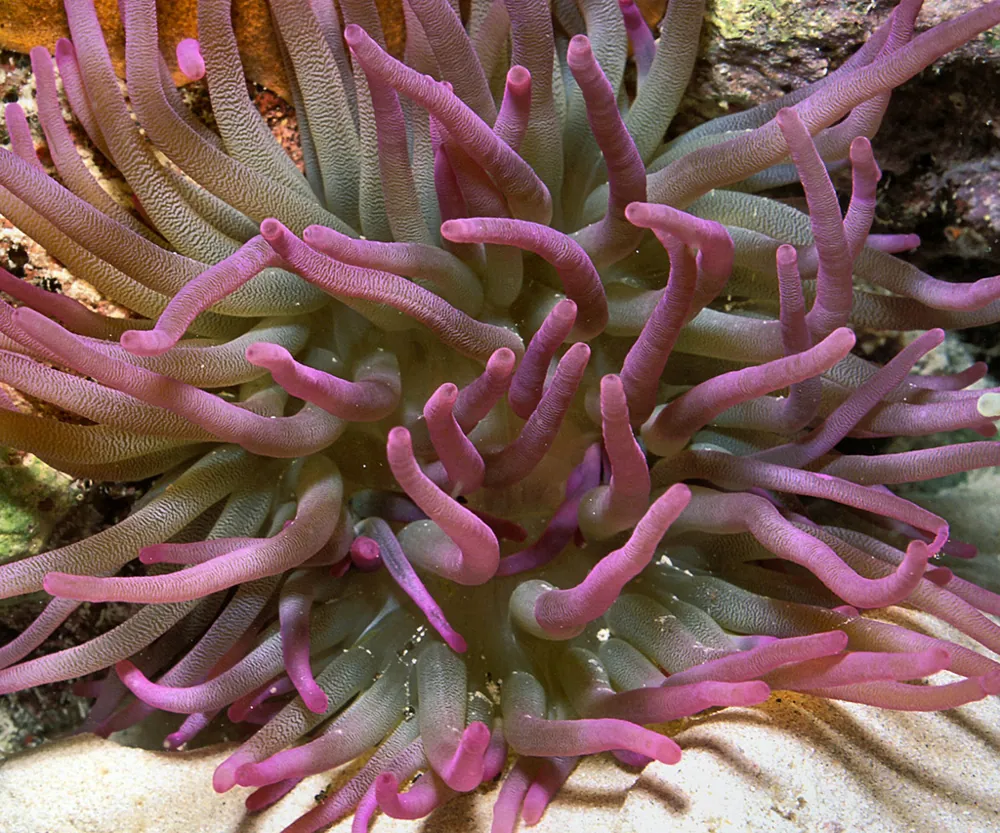
The giant Caribbean sea anemone is a large, colourful sea animal that looks like a soft, flower-shaped blob on the seabed. It lives in shallow reefs and calm inshore waters in the Caribbean and western Atlantic. Its sting is strong enough to stun the fish and shrimp it eats.1



 Ho e tseba jwang
- Grows about 15 cm high and 30 cm wide, with a disc up to about 40 cm across1
- Body can be white, light blue, pink, orange, pale red or light brown1
- More than 100 tentacles surround the mouth1
- Tentacle tips may be purple or rose-coloured, or may be paler than the body1
- Grows singly or in loose groups, never as colonies1
Matla a chefo
Dikete tsa disele tse nyenyane tse hlabang di thunya ha ho na le se di amang.
Chefo ya yona (eo e e kenyang ka ho loma kapa ho hlaba) e etsang?
Its stinging cells (nematocysts) at the tentacle tips contain a toxin called CgNa. When the stinging cells fire, they impale the attacker and release the toxin, which causes extreme pain and paralysis.1
E kotsi hakae ho batho?
Kotsi ho batho: E bobebeJwaloka ho hlajwa ke notshi kapa ho fetang moo. Ha e na kotsi ho batho.E etsang ha e tshohile?
When threatened it shrinks by pulling its tentacles into its body and forcing out most of the water, which reduces the surface a predator can attack.1
 Haeba e hlaba
- Tswa metsing mme o tlose di-tentacle tsohle (ka ditlelafo kapa ka lesela).
- Bakeng sa box jellyfish tsa tropike: tshela asene (vinegar) moo e hlabileng teng bonyane metsotswana e 30, bitsa thuso mme o itokisetse ho etsa CPR. Bakeng sa di-bluebottle le tse ding tse ngata: hlatswa ka metsi a lewatle, ebe ka metsi a tjhesang bakeng sa bohloko.
Kamehla letsetsa nomoro ya tshohanyetso pele (112, 000, 911). Ena ke tataiso e akaretsang ya thuso ya pele, hase keletso ya bongaka. Metheo ya thuso ya pele
 Dula o bolokehile
- O se ke wa ama, wa tshwara kapa wa tena phoofolo ya naheng, leha e le e nyenyane, le leha e shebahala e robetse kapa e shwele.
- E fe sebaka. Ha o kopana le yona, dula o kgutsitse, kgutlela morao butle mme o e tlohele e tsamaye ka tsela ya yona.
- Haeba e nngwe e o hlaba: dula o kgutsitse, o se ke wa sisinyeha, letsetsa nomoro ya tshohanyetso (112, 000, 911) kapa o ye sepetlele kapele. Hopola hore e ne e shebahala jwang, foto e a thusa.
Ha e o batle. E sebedisa chefo ya yona ho tshwara dijo kapa ho itshireletsa, mme e kgetha ho ipata. Ho eketsehileng ka ho dula o bolokehile
Hokae lefatsheng?
E kgolo hakae?
E telele hakae?
 e telele jwaloka diboloko tsa ho bapala tse 5 moleng
 e dieha ho feta kgofu ya serapeng
Giant Caribbean sea anemone e kgolo hakae ha e bapiswa le WENA?
Ke dipalo feela ka hara sebatli sa hao. Ha ho letho le bolokwang kapa le romelwang kae kapa kae.
E potlaka hakae?

Dintlha
Its nerve cells contain proteins that are molecularly similar to those in mammal nerve cells, which helps scientists study how nervous systems evolved.1
Fish and cleaner shrimp shelter among its tentacles, and it serves as a base station for fish cleaning.1
Although mostly stuck in place, it can crawl very slowly on its base, the pedal disc.1
Its larvae carry their own food in a yolk, so starvation is unlikely and they can drift far to spread out.1
Most individuals are either male or female, with a roughly equal ratio of the two sexes, though they occasionally have both.1
Bakeng sa ditsebi tsa chefo
- Lebitso la saense
- Condylactis gigantea
- Sehlopha
- Di-jellyfish le diphoofolo tsa lewatle tse hlabang
- Lelapa
- Actiniidae2
- Tatelano
- Actiniaria
- Dikontinente
- Lewatle la Atlantic, Lewatle la Caribbean, Kgwohlo ya Mexico, Mawatle
- Masea
- Eggs and sperm are released into the water, where fertilisation happens. The fertilised egg becomes a larva that settles on the seabed and grows into an adult.1
- Kotsi ho batho
- 1 / 5: E bobebe3
Moo dintlha di tswang teng
- Condylactis gigantea (Wikipedia (CC BY-SA 4.0))
- Condylactis gigantea (iNaturalist): mabitso le tlhophiso.
- Venom Wiki: boemo ba kotsi, boholo bo tlwaelehileng le kakanyo ya lebelo ke tsa rona. Bona kamoo re di balang ka teng: Kamoo re lekanyang kotsi ka teng.
Taba e nngwe le e nngwe leqepheng lena e na le nomoro e bontshang mohlodi wa yona. Haeba re entse phoso, re kopa tshwarelo, re barati ba diphoofolo, hase makasine wa saense. Re bolelle ho [email protected] mme re tla e lokisa.
 Phepheng e lapile! Venom Wiki ke projeke ya motho a le mong: ke mahala, ha e na dipapatso ebile ha e na di-tracker. Thuso e nyenyane ya tjhelete e e boloka e ntse e le inthaneteng.Fepa phepheng
Tse ding tsa sehlopha se le seng: Di-jellyfish le diphoofolo tsa lewatle tse hlabang
 Australian box jellyfishDi-jellyfish le diphoofolo tsa lewatle tse hlabangE a bolayaO se ke wa ama
 Irukandji jellyfishDi-jellyfish le diphoofolo tsa lewatle tse hlabangE ka bolayaO se ke wa ama
 Portuguese man o' warDi-jellyfish le diphoofolo tsa lewatle tse hlabangE hloka ngakaO se ke wa ama
 Lion's mane jellyfishDi-jellyfish le diphoofolo tsa lewatle tse hlabangE utlwisa bohloko feelaO se ke wa ama
 Moon jellyfishDi-jellyfish le diphoofolo tsa lewatle tse hlabangHa e na kotsi
 Common kingslayerDi-jellyfish le diphoofolo tsa lewatle tse hlabangE ka bolayaO se ke wa ama
E boetse e phela: Lewatle la Atlantic
 Hawksbill sea turtleDiphoofolo tse ding tse chefangE ka bolaya
 Blue sea dragonDikgofu tsa cone le di-octopusE utlwisa bohloko feela
 Greenland sharkDiphoofolo tse ding tse chefangE utlwisa bohloko feela
 Common octopusDikgofu tsa cone le di-octopusHa e na kotsi
 Common stingrayDitlhapi tse nang le chefoE hloka ngaka
 Greater weeverDitlhapi tse nang le chefoE hloka ngakaO se ke wa ama