
 Afrika
 Asia
Asia Yuropa
 Amerika Borwa
 Australia le Oceania
 Antarctica
 Lewatle la Pacific
 Lewatle la Atlantic
 Lewatle la India
 Lewatle la Arctic
 Lewatle la Mediterranean
 Lewatle le Lefubedu
 Lewatle la Caribbean
 Lewatle la Coral
 Lewatle la China Borwa
 Lewatle la Philippine
 Lewatle la Andaman
 Lewatle la Leboya
 Lewatle la Timor le Arafura
 Kgwohlo ya Bengal
 Kgwohlo ya California
Himalayan giant honey bee
 Ho hlaba
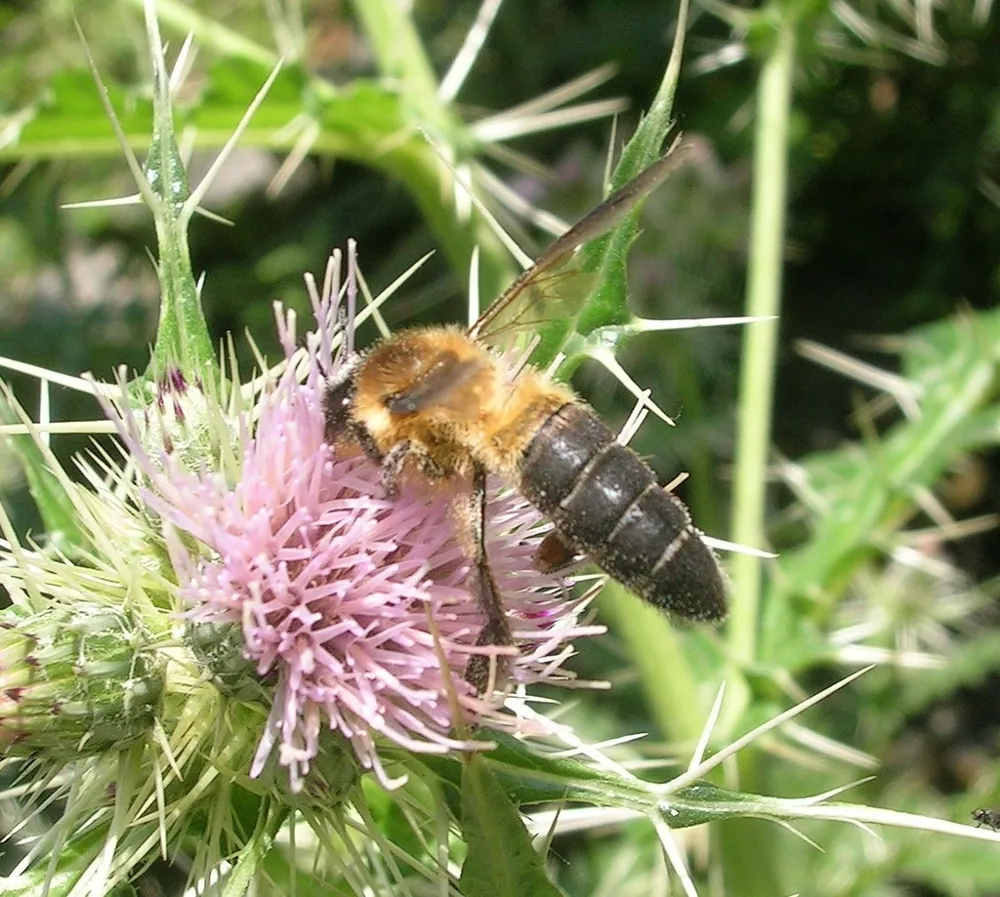
The Himalayan giant honey bee is the largest honey bee in the world. It lives in the mountains of the Himalayas, where it builds huge nests on steep cliff faces. It is special because it is highly adapted to life at high altitude.1
 Ho e tseba jwang
- It is the largest honey bee in the world, with single adults measuring up to 3.0 cm long.1
- It has a darker abdomen (rear body section) than the giant honey bee, Apis dorsata.1
- It has longer hair on the thorax (middle body section) than Apis dorsata.1
- It builds very large nests on the underside of cliff overhangs at high altitude.1
Hangata e ferekanngwa le: It is often confused with the giant honey bee, Apis dorsata, which it is very similar to in shape. The Himalayan giant honey bee has a darker abdomen, longer thoracic hair, and different nest-keeping and swarming behaviour.1
Matla a chefo
Chefo e tswa ka lemao le hlabang.
E kotsi hakae ho batho?
Kotsi ho batho: E tebilengHo hlajwa ho hloka ngaka. Lefu le etsahala ka seoelo haholo. Haeba e hlaba
- Kgwaratla lemao la notshi o le ntshe mme o pholise sebaka seo.
- Haeba motho a hema ka thata, sefahleho kapa qoqotho di ruruha, kapa a ikutlwa a tla idibala, ke tshohanyetso ya aletjhi (allergy): letsetsa nomoro ya tshohanyetso mme o sebedise pene ya hae ya adrenaline (adrenaline auto-injector) haeba a na le yona.
Kamehla letsetsa nomoro ya tshohanyetso pele (112, 000, 911). Ena ke tataiso e akaretsang ya thuso ya pele, hase keletso ya bongaka. Metheo ya thuso ya pele
 Dula o bolokehile
- O se ke wa ama, wa tshwara kapa wa tena phoofolo ya naheng, leha e le e nyenyane, le leha e shebahala e robetse kapa e shwele.
- E fe sebaka. Ha o kopana le yona, dula o kgutsitse, kgutlela morao butle mme o e tlohele e tsamaye ka tsela ya yona.
- Haeba e nngwe e o hlaba: dula o kgutsitse, o se ke wa sisinyeha, letsetsa nomoro ya tshohanyetso (112, 000, 911) kapa o ye sepetlele kapele. Hopola hore e ne e shebahala jwang, foto e a thusa.
Ha e o batle. E sebedisa chefo ya yona ho tshwara dijo kapa ho itshireletsa, mme e kgetha ho ipata. Ho eketsehileng ka ho dula o bolokehile
Hokae lefatsheng?
E kgolo hakae?
E telele hakae?
 e telele jwaloka klipi ya pampiri
 e ka fofa ho tshela lebala lohle la bolo ya maoto ka metsotswana e 11
Himalayan giant honey bee e kgolo hakae ha e bapiswa le WENA?
Ke dipalo feela ka hara sebatli sa hao. Ha ho letho le bolokwang kapa le romelwang kae kapa kae.
E potlaka hakae?


Dintlha
Red honey has an intoxicating effect, which is linked to grayanotoxin in nectar from white rhododendrons.1
The Gurung people of Nepal are known for using this mad honey for both medicinal and hallucinogenic purposes.1
A nest of this bee can hold as much as 60 kg of honey.1
Red honey made by this bee is valuable, and wholesale prices are about five times higher than regular honey from the western honey bee or the Asian honey bee.1
The yellow-rumped honeyguide, a small sparrow-like bird, feeds on beeswax and is often seen near colonies of this bee.1
Moo dintlha di tswang teng
- Apis laboriosa (Wikipedia (CC BY-SA 4.0))
- Apis laboriosa (iNaturalist): mabitso le tlhophiso.
- Venom Wiki: boemo ba kotsi, boholo bo tlwaelehileng le kakanyo ya lebelo ke tsa rona. Bona kamoo re di balang ka teng: Kamoo re lekanyang kotsi ka teng.
Taba e nngwe le e nngwe leqepheng lena e na le nomoro e bontshang mohlodi wa yona. Haeba re entse phoso, re kopa tshwarelo, re barati ba diphoofolo, hase makasine wa saense. Re bolelle ho [email protected] mme re tla e lokisa.
 Phepheng e lapile! Venom Wiki ke projeke ya motho a le mong: ke mahala, ha e na dipapatso ebile ha e na di-tracker. Thuso e nyenyane ya tjhelete e e boloka e ntse e le inthaneteng.Fepa phepheng
Tse ding tsa sehlopha se le seng: Dinotshi, di-wasp le di-hornet
 Asian giant hornetDinotshi, di-wasp le di-hornetE ka bolaya
 Common waspDinotshi, di-wasp le di-hornetE utlwisa bohloko feela
 European hornetDinotshi, di-wasp le di-hornetE utlwisa bohloko feela
 Western honey beeDinotshi, di-wasp le di-hornetE utlwisa bohloko feela
 Giant honey beeDinotshi, di-wasp le di-hornetE hloka ngaka
 Asian hornetDinotshi, di-wasp le di-hornetE utlwisa bohloko feela
 Deathstalker
 Indian cobra
 Indian saw-scaled viper
 King cobra
 Puff adder
 Noha ea Russell