
 Afrika
 Asia
Asia Yuropa
 Amerika Borwa
 Australia le Oceania
 Antarctica
 Lewatle la Pacific
 Lewatle la Atlantic
 Lewatle la India
 Lewatle la Arctic
 Lewatle la Mediterranean
 Lewatle le Lefubedu
 Lewatle la Caribbean
 Lewatle la Coral
 Lewatle la China Borwa
 Lewatle la Philippine
 Lewatle la Andaman
 Lewatle la Leboya
 Lewatle la Timor le Arafura
 Kgwohlo ya Bengal
 Kgwohlo ya California
Hura centipede
 Ho loma
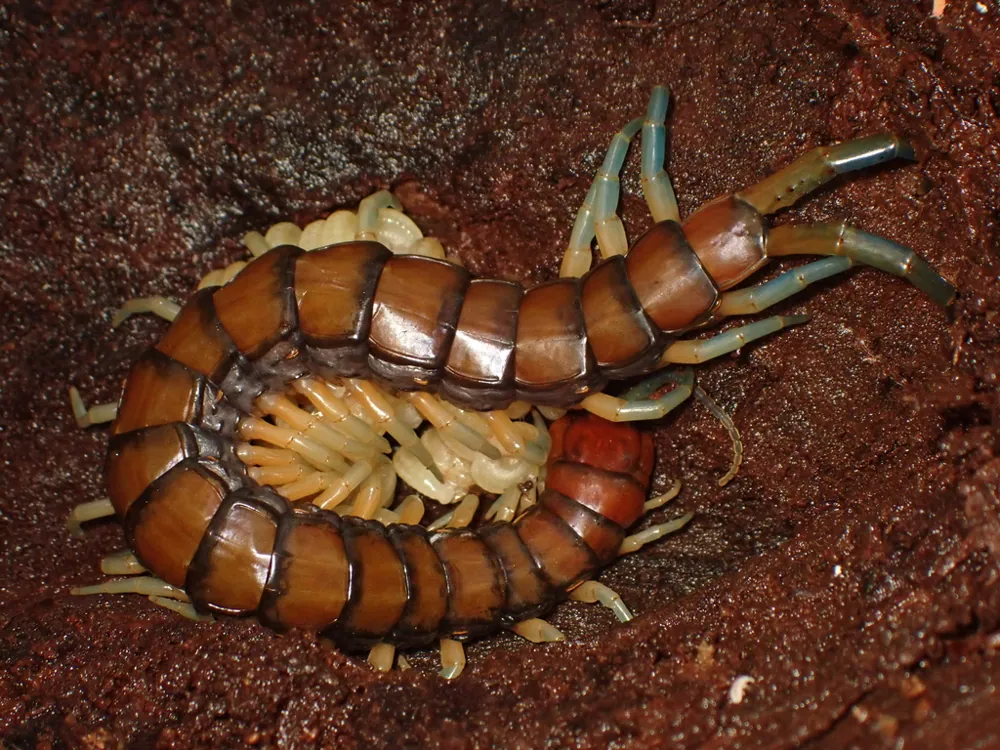
The hura, also called the giant centipede, is a centipede found in Australia and New Zealand. In New Zealand it can grow to over 20 centimetres, which makes it one of the largest centipedes there. It hunts small animals and can give a painful bite when threatened.1


 Ho e tseba jwang
- The head and first body plate are reddish-brown, and the other body plates are olive-brown.1
- It has large black forcipules, which are fang-like claws near the head.1
- Its legs are yellowish at the base and turn green towards the tip.1
- The last pair of legs has light blue tips.1
- In New Zealand it can exceed 20 cm long, but in Australia it usually reaches only about 3.9 cm.1
Matla a chefo
Chefo e tswa ka meno a yona a chefo (fangs) kapa ka meno a mang ha e loma.
Chefo ya yona (eo e e kenyang ka ho loma kapa ho hlaba) e etsang?
The bite can cause swelling. In one recorded case it caused severe pain and vomiting.1
E kotsi hakae ho batho?
Kotsi ho batho: E bohlokoE ka utlwisa bohloko haholo, empa hoo e batlang e le kamehla ha e kotsi haholo.When threatened, it can inflict a painful bite.1
E etsang ha e tshohile?
When threatened, it uses its forcipules to bite.1
 Haeba e loma
- Hlatswa moo e lomileng teng, o pholise kapa o ho kenye metsing a futhumetseng bakeng sa bohloko, mme o fumane thuso ya bongaka haeba ho mpefala.
Kamehla letsetsa nomoro ya tshohanyetso pele (112, 000, 911). Ena ke tataiso e akaretsang ya thuso ya pele, hase keletso ya bongaka. Metheo ya thuso ya pele
 Dula o bolokehile
- O se ke wa ama, wa tshwara kapa wa tena phoofolo ya naheng, leha e le e nyenyane, le leha e shebahala e robetse kapa e shwele.
- E fe sebaka. Ha o kopana le yona, dula o kgutsitse, kgutlela morao butle mme o e tlohele e tsamaye ka tsela ya yona.
- Haeba e nngwe e o loma: dula o kgutsitse, o se ke wa sisinyeha, letsetsa nomoro ya tshohanyetso (112, 000, 911) kapa o ye sepetlele kapele. Hopola hore e ne e shebahala jwang, foto e a thusa.
Ha e o batle. E sebedisa chefo ya yona ho tshwara dijo kapa ho itshireletsa, mme e kgetha ho ipata. Ho eketsehileng ka ho dula o bolokehile
Hokae lefatsheng?
E kgolo hakae?
E telele hakae?
 e telele jwaloka diboloko tsa ho bapala tse 6 moleng
 e ka matha metara e 100 ka metsotswana e 180 (motho ya potlakang ka ho fetisisa o hloka 9,6)
Hura centipede e kgolo hakae ha e bapiswa le WENA?
Ke dipalo feela ka hara sebatli sa hao. Ha ho letho le bolokwang kapa le romelwang kae kapa kae.
E potlaka hakae?


Dintlha
In a study on the Three Kings Islands, researchers reportedly had to wrap their sleeping bags in tinfoil to warn them of the centipedes nearby.1
In New Zealand, introduced rats and European hedgehogs eat hura, so the centipedes are most common on islands without these pests.1
North Island brown kiwi are known to prey on hura.1
Its blood-like fluid, called haemolymph, has a high concentration of protein and is thought to be typical of more primitive arthropods.1
Moo dintlha di tswang teng
- Cormocephalus rubriceps (Wikipedia (CC BY-SA 4.0))
- Cormocephalus rubriceps (iNaturalist): mabitso le tlhophiso.
- Venom Wiki: boemo ba kotsi, boholo bo tlwaelehileng le kakanyo ya lebelo ke tsa rona. Bona kamoo re di balang ka teng: Kamoo re lekanyang kotsi ka teng.
Taba e nngwe le e nngwe leqepheng lena e na le nomoro e bontshang mohlodi wa yona. Haeba re entse phoso, re kopa tshwarelo, re barati ba diphoofolo, hase makasine wa saense. Re bolelle ho [email protected] mme re tla e lokisa.
 Phepheng e lapile! Venom Wiki ke projeke ya motho a le mong: ke mahala, ha e na dipapatso ebile ha e na di-tracker. Thuso e nyenyane ya tjhelete e e boloka e ntse e le inthaneteng.Fepa phepheng
Tse ding tsa sehlopha se le seng: Di-centipede
 Giant Australian centipedeDi-centipedeE utlwisa bohloko feela
 Orange-footed centipedeDi-centipedeE utlwisa bohloko feela
 Tanzanian blue ringleg centipedeDi-centipedeE utlwisa bohloko feela
 Peruvian giant centipedeDi-centipedeE hloka ngaka
 Chinese red-headed centipedeDi-centipedeE hloka ngaka
 Giant desert centipedeDi-centipedeE utlwisa bohloko feela
E boetse e phela: Australia le Oceania
 Coastal taipanDinoha tsa AustraliaE a bolaya
 Common death adderDinoha tsa AustraliaE a bolaya
 Eastern brown snakeDinoha tsa AustraliaE a bolaya
 Taipan ya naheng e kahareDinoha tsa AustraliaE a bolaya
 Sydney funnel-web spiderDi-tarantula le di-funnel-webE a bolaya
 Noha ya tigerDinoha tsa AustraliaE a bolaya