
 Afrika
 Asia
Asia Yuropa
 Amerika Borwa
 Australia le Oceania
 Antarctica
 Lewatle la Pacific
 Lewatle la Atlantic
 Lewatle la India
 Lewatle la Arctic
 Lewatle la Mediterranean
 Lewatle le Lefubedu
 Lewatle la Caribbean
 Lewatle la Coral
 Lewatle la China Borwa
 Lewatle la Philippine
 Lewatle la Andaman
 Lewatle la Leboya
 Lewatle la Timor le Arafura
 Kgwohlo ya Bengal
 Kgwohlo ya California
Sydney funnel-web spider
 Ho loma
The Sydney funnel-web spider is a venomous spider from eastern Australia. It is found mostly within about 100 km of Sydney. Its bite can cause serious illness or death if it is not treated, so it is one of the most important spiders to know about in the region.1



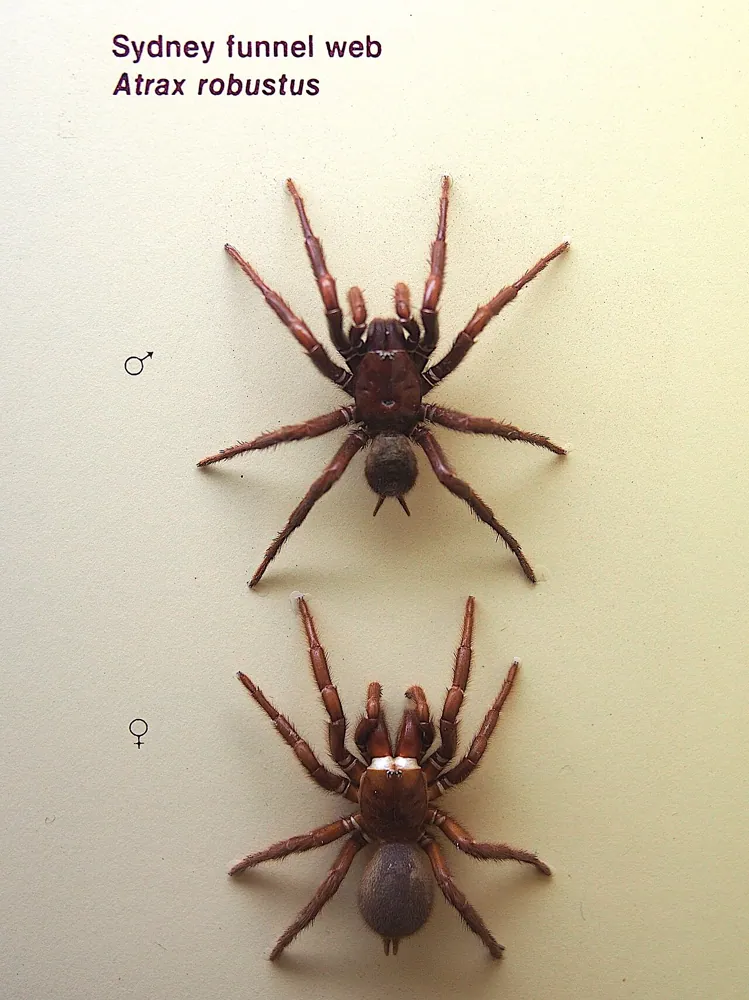
 Ho e tseba jwang
Matla a chefo
Chefo e tswa ka meno a yona a chefo (fangs) kapa ka meno a mang ha e loma.
Chefo ya yona (eo e e kenyang ka ho loma kapa ho hlaba) e etsang?
The venom contains delta-atracotoxin, which affects the ion channels of nerves and makes it highly toxic to humans and other primates. Symptoms can include intense nausea, vomiting, excessive saliva, muscle twitching, breathing difficulty, confusion and unconsciousness. In severe cases, symptoms begin in under one hour, with a median time of 28 minutes in one study.1
E kotsi hakae ho batho?
Kotsi ho batho: E a bolayaE nngwe ya diphoofolo tse kotsi ka ho fetisisa lefatsheng.A bite can cause serious illness or death if untreated. Children are at particular risk: in one study, 42% of severe cases were children. There is at least one recorded case of a small child dying within 15 minutes of a bite. Only the Sydney funnel-web and the northern tree-dwelling funnel-web have been known to cause fatal bites in humans. There have been no recorded deaths since antivenom became available in 1981.1
 Ditaba tse monate: dingaka di na le moriana (antivenom) kapa kalafo bakeng sa sena.1
E etsang ha e tshohile?
When threatened or provoked, it rears up on its hind legs, shows its fangs and may bite repeatedly while holding on tightly.1
 Haeba e loma
- A Sydney funnel-web bite is a medical emergency that needs immediate hospital treatment. Guidelines recommend two vials of antivenom, or four if symptoms are severe, with patients assessed every 15 minutes and more vials given if symptoms do not resolve.1
- Hlatswa moo e lomileng teng mme o pholise. Fumana thuso ya bongaka haeba bohloko bo le matla kapa motho a ikutlwa a kula.
- Australia, nka ho longwa ke sekgo sefe kapa sefe se seholo se setsho e le ho longwa ke funnel-web: Pressure immobilisation: phuthela bandeje e tiileng e huduhang (elastiki) hodima moo e lomileng teng ebe o nyolla setho sohle, o se tlame ka splint (lepolanka la ho se tshehetsa), mme o boloke motho a sa sisinyehe ho hang ho fihlela thuso e fihla.
Kamehla letsetsa nomoro ya tshohanyetso pele (112, 000, 911). Ena ke tataiso e akaretsang ya thuso ya pele, hase keletso ya bongaka. Metheo ya thuso ya pele
 Dula o bolokehile
- O se ke wa ama, wa tshwara kapa wa tena phoofolo ya naheng, leha e le e nyenyane, le leha e shebahala e robetse kapa e shwele.
- E fe sebaka. Ha o kopana le yona, dula o kgutsitse, kgutlela morao butle mme o e tlohele e tsamaye ka tsela ya yona.
- Haeba e nngwe e o loma: dula o kgutsitse, o se ke wa sisinyeha, letsetsa nomoro ya tshohanyetso (112, 000, 911) kapa o ye sepetlele kapele. Hopola hore e ne e shebahala jwang, foto e a thusa.
Ha e o batle. E sebedisa chefo ya yona ho tshwara dijo kapa ho itshireletsa, mme e kgetha ho ipata. Ho eketsehileng ka ho dula o bolokehile
Hokae lefatsheng?
E kgolo hakae?
E telele hakae?
 e kgutshwane ho feta monwana wa hao o monyenyane
 e ka matha metara e 100 ka metsotswana e 260 (motho ya potlakang ka ho fetisisa o hloka 9,6)
Sydney funnel-web spider e kgolo hakae ha e bapiswa le WENA?
Ke dipalo feela ka hara sebatli sa hao. Ha ho letho le bolokwang kapa le romelwang kae kapa kae.
E potlaka hakae?


Dintlha
Males can survive submersion in water for up to twenty-four hours by trapping air bubbles on the hairs of their abdomen.1
One dose of antivenom needs around 70 milkings from a Sydney funnel-web spider.1
The most antivenom vials used to treat one bite is twelve, for a 10-year-old boy bitten in February 2017 by a male hiding in a shoe.1
Female spiders are long-lived and spend most of their time in their burrows. No severe envenoming by a female has been reported.1
Activity increases after heavy rain, because burrows can become flooded.1
Ho senya ditshomo
Tshomo: The male and female funnel-web spiders were thought to be different species.
Nnete: In 1927, Anthony Musgrave showed from anatomical similarities that the male Euctimena tibialis was the male of Atrax robustus, the same species as the female.1
Moo dintlha di tswang teng
- Sydney funnel-web spider (Wikipedia (CC BY-SA 4.0))
- Atrax robustus (iNaturalist): mabitso le tlhophiso.
- Venom Wiki: boemo ba kotsi, boholo bo tlwaelehileng le kakanyo ya lebelo ke tsa rona. Bona kamoo re di balang ka teng: Kamoo re lekanyang kotsi ka teng.
Taba e nngwe le e nngwe leqepheng lena e na le nomoro e bontshang mohlodi wa yona. Haeba re entse phoso, re kopa tshwarelo, re barati ba diphoofolo, hase makasine wa saense. Re bolelle ho [email protected] mme re tla e lokisa.
 Phepheng e lapile! Venom Wiki ke projeke ya motho a le mong: ke mahala, ha e na dipapatso ebile ha e na di-tracker. Thuso e nyenyane ya tjhelete e e boloka e ntse e le inthaneteng.Fepa phepheng
Tse ding tsa sehlopha se le seng: Di-tarantula le di-funnel-web
 Northern tree-dwelling funnel-web spiderDi-tarantula le di-funnel-webE a bolaya
 Red-headed mouse spiderDi-tarantula le di-funnel-webE hloka ngaka
 Queensland whistling tarantulaDi-tarantula le di-funnel-webE utlwisa bohloko feela
 Blue Mountains funnel-web spiderDi-tarantula le di-funnel-webE ka bolaya
 Darling Downs funnel-web spiderDi-tarantula le di-funnel-webE ka bolaya
 Illawarra funnel-web spiderDi-tarantula le di-funnel-webE ka bolaya
 Coastal taipan
 Common death adder
 Eastern brown snake
 Taipan ya naheng e kahare
 Noha ya tiger
 Redback spider