
 Afrika
 Asia
Asia Yuropa
 Amerika Borwa
 Australia le Oceania
 Antarctica
 Lewatle la Pacific
 Lewatle la Atlantic
 Lewatle la India
 Lewatle la Arctic
 Lewatle la Mediterranean
 Lewatle le Lefubedu
 Lewatle la Caribbean
 Lewatle la Coral
 Lewatle la China Borwa
 Lewatle la Philippine
 Lewatle la Andaman
 Lewatle la Leboya
 Lewatle la Timor le Arafura
 Kgwohlo ya Bengal
 Kgwohlo ya California
Io moth
 Boya bo hlabang
The Io moth is a colourful moth from North America. Its adults are striking, with large eyespots on their wings. Its green caterpillars carry spines that release a very painful venom, so they should be left alone.1
 Ho e tseba jwang
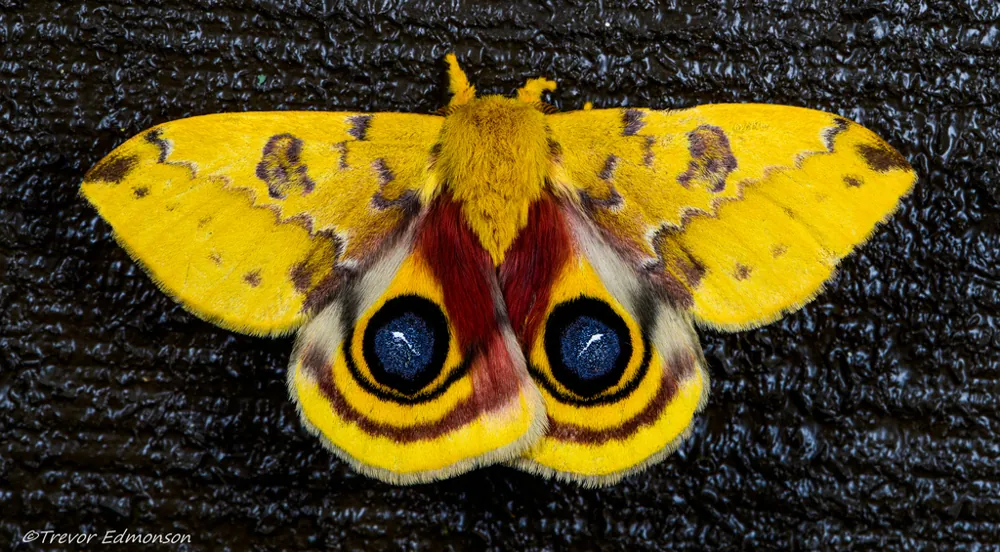
- Males have bright yellow forewings, body and legs, and much bigger feathery antennae than females.1
- Females have reddish-brown to purple forewings, body and legs.1
- Both sexes have one large black to bluish eyespot with some white in the centre on each hindwing.1
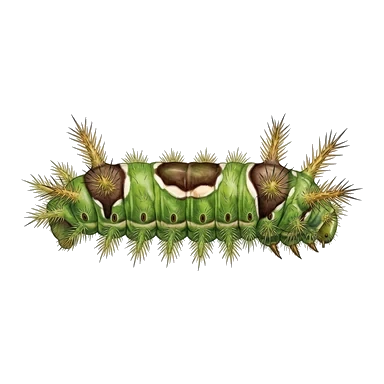
- Mature caterpillars are bright green and covered in spines, with two lateral stripes: the upper one bright red and the lower one white.1
- Adults have a wingspan of 6.3 to 8.8 cm.1
Matla a chefo
Boya bo bonyenyane kapa ditlhaka di robehela letlalong mme di a hlaba.
Chefo ya yona (eo e e kenyang ka ho loma kapa ho hlaba) e etsang?
The spines of the green caterpillars release a very painful venom at the slightest touch. Contact is not life-threatening to humans, but it irritates the skin and causes an acute skin inflammation called erucism.1
E kotsi hakae ho batho?
Kotsi ho batho: E bohlokoE ka utlwisa bohloko haholo, empa hoo e batlang e le kamehla ha e kotsi haholo.Contact with the spines is not life-threatening to humans, but it causes painful skin irritation.1
E etsang ha e tshohile?
When sitting head-down or when touched, adults shake and expose their hindwing eyespots. Caterpillars defend themselves with stinging spines.1
 Haeba o ama boya ba yona
- Bakeng sa boya bo hlabang ba diboko: bo tlose ka theipi e kgomarelang, ebe o hlatswa letlalo. O se ke wa hohla.
- Bakeng sa ho longwa: hlatswa mme o pholise. Fumana thuso ya bongaka haeba motho a ikutlwa a kula kapa a tswa madi habonolo.
Kamehla letsetsa nomoro ya tshohanyetso pele (112, 000, 911). Ena ke tataiso e akaretsang ya thuso ya pele, hase keletso ya bongaka. Metheo ya thuso ya pele
 Dula o bolokehile
- O se ke wa ama, wa tshwara kapa wa tena phoofolo ya naheng, leha e le e nyenyane, le leha e shebahala e robetse kapa e shwele.
- E fe sebaka. Ha o kopana le yona, dula o kgutsitse, kgutlela morao butle mme o e tlohele e tsamaye ka tsela ya yona.
- Haeba o ama boya ba yona: dula o kgutsitse, o se ke wa sisinyeha, letsetsa nomoro ya tshohanyetso (112, 000, 911) kapa o ye sepetlele kapele. Hopola hore e ne e shebahala jwang, foto e a thusa.
Ha e o batle. E sebedisa chefo ya yona ho tshwara dijo kapa ho itshireletsa, mme e kgetha ho ipata. Ho eketsehileng ka ho dula o bolokehile
Hokae lefatsheng?
E kgolo hakae?
E telele hakae?
 e telele jwaloka diboloko tsa ho bapala tse 3 moleng
 e dieha ho feta kgofu ya serapeng
Io moth e kgolo hakae ha e bapiswa le WENA?
Ke dipalo feela ka hara sebatli sa hao. Ha ho letho le bolokwang kapa le romelwang kae kapa kae.
E potlaka hakae?

Dintlha
The caterpillars' spines are urticating, meaning they can cause a stinging reaction on contact.1
Adults live only 1 to 2 weeks and do not eat during this stage.1
After emerging from the cocoon, adults inflate their furled wings with fluid pumped from the body, which takes about twenty minutes.1
Females attract males by releasing wind-borne scent chemicals (pheromones) from a gland at the end of the abdomen.1
Many flies and wasps are parasitoids of this moth, laying their eggs in or on it.1
Bakeng sa ditsebi tsa chefo
- Lebitso la saense
- Automeris io
- Sehlopha
- Diboko le dikokoanyana
- Lelapa
- Saturniidae2
- Tatelano
- Lepidoptera
- Dikontinente
- Amerika Leboya
- Masea
- Females lay clusters of more than twenty small white eggs on leaves. The eggs hatch within 8 to 11 days.1
- Boemo ba yona naheng
- Not evaluated by the IUCN Red List and has no special status on the US Federal List. Populations in the eastern US are declining and becoming more localised.1
- Kotsi ho batho
- 2 / 5: E bohloko3
Moo dintlha di tswang teng
- Automeris io (Wikipedia (CC BY-SA 4.0))
- Automeris io (iNaturalist): mabitso le tlhophiso.
- Venom Wiki: boemo ba kotsi, boholo bo tlwaelehileng le kakanyo ya lebelo ke tsa rona. Bona kamoo re di balang ka teng: Kamoo re lekanyang kotsi ka teng.
Taba e nngwe le e nngwe leqepheng lena e na le nomoro e bontshang mohlodi wa yona. Haeba re entse phoso, re kopa tshwarelo, re barati ba diphoofolo, hase makasine wa saense. Re bolelle ho [email protected] mme re tla e lokisa.
 Phepheng e lapile! Venom Wiki ke projeke ya motho a le mong: ke mahala, ha e na dipapatso ebile ha e na di-tracker. Thuso e nyenyane ya tjhelete e e boloka e ntse e le inthaneteng.Fepa phepheng
Tse ding tsa sehlopha se le seng: Diboko le dikokoanyana
 Giant water bugDiboko le dikokoanyanaE utlwisa bohloko feela
 Puss caterpillarDiboko le dikokoanyanaE utlwisa bohloko feelaO se ke wa ama
 Saddleback caterpillarDiboko le dikokoanyanaE utlwisa bohloko feelaO se ke wa ama
 Wheel bugDiboko le dikokoanyanaE utlwisa bohloko feela
 Giant vinegaroonDiboko le dikokoanyanaHa e na kotsi
 Rhodnius kissing bugDiboko le dikokoanyanaE hloka ngaka
 Terciopelo
 Eastern coral snake
 Eastern diamondback rattlesnake
 Eyelash viper
 Timber rattlesnake
 Western diamondback rattlesnake