
 Afrika
 Asia
Asia Yuropa
 Amerika Borwa
 Australia le Oceania
 Antarctica
 Lewatle la Pacific
 Lewatle la Atlantic
 Lewatle la India
 Lewatle la Arctic
 Lewatle la Mediterranean
 Lewatle le Lefubedu
 Lewatle la Caribbean
 Lewatle la Coral
 Lewatle la China Borwa
 Lewatle la Philippine
 Lewatle la Andaman
 Lewatle la Leboya
 Lewatle la Timor le Arafura
 Kgwohlo ya Bengal
 Kgwohlo ya California
Lace monitor
 Ho loma
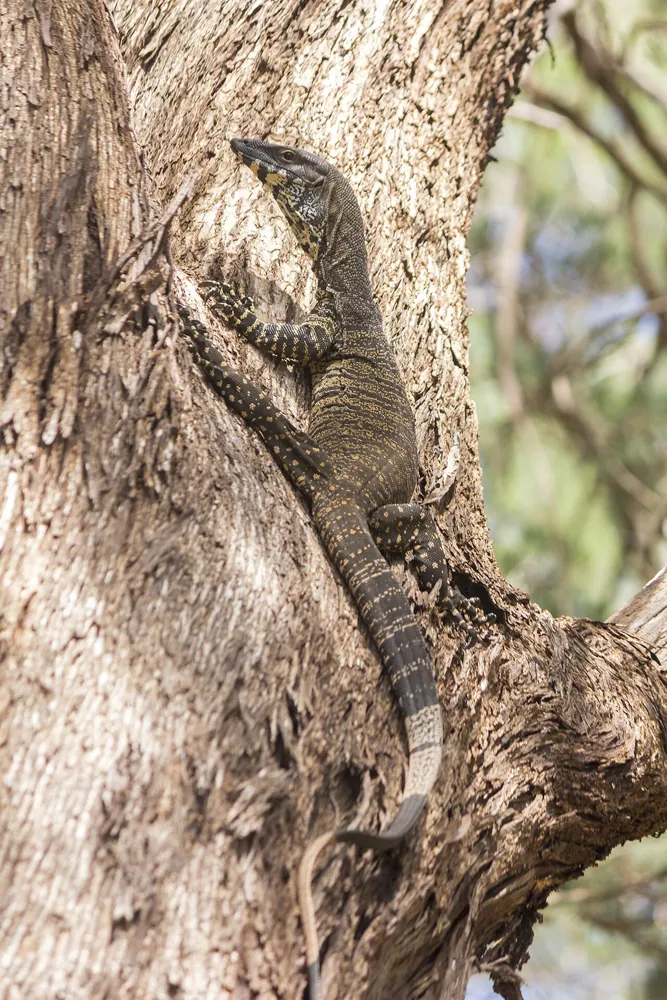
The lace monitor is a large lizard that lives in eastern Australia, and it can grow up to 2 metres long. It is a skilled climber that often lives in trees, and it is one of the country's biggest monitor lizards. It is also known as the tree goanna.1



 Ho e tseba jwang
- The main form is dark grey to dull bluish-black with scattered cream-coloured spots.1
- The head is black, and the snout has prominent black and yellow bands that extend under the chin and neck.1
- The tail has narrow black and cream bands that get wider towards the tip.1
- Bell's form has a yellow-brown or yellow base colour with fine black mottling and broad black or dark brown bands from the shoulders to the tail.1
- Juveniles have more defined banding, with five narrow black bands on the neck and eight on the body.1
Matla a chefo
Chefo e tswa ka meno a yona a chefo (fangs) kapa ka meno a mang ha e loma.
Chefo ya yona (eo e e kenyang ka ho loma kapa ho hlaba) e etsang?
Lace monitors have venom glands, and their venom is similar to snake venom, but it is not strong enough to cause serious harm. A bite on the hand can cause swelling within minutes, localised disruption of blood clotting (the blood clots less well in that area), and shooting pain up to the elbow. This pain can often last for several hours.1
E kotsi hakae ho batho?
Kotsi ho batho: E bohlokoE ka utlwisa bohloko haholo, empa hoo e batlang e le kamehla ha e kotsi haholo.Its venom is not enough to cause serious harm. Scientists have cautioned that calling these lizards venomous overestimates the medical risk to bite victims.1
E etsang ha e tshohile?
When disturbed, lace monitors retreat to a nearby tree.1
 Haeba e loma
- Hlatswa leqeba, boloka motho a kgutsitse mme o fumane thuso ya bongaka.
Kamehla letsetsa nomoro ya tshohanyetso pele (112, 000, 911). Ena ke tataiso e akaretsang ya thuso ya pele, hase keletso ya bongaka. Metheo ya thuso ya pele
 Dula o bolokehile
- O se ke wa ama, wa tshwara kapa wa tena phoofolo ya naheng, leha e le e nyenyane, le leha e shebahala e robetse kapa e shwele.
- E fe sebaka. Ha o kopana le yona, dula o kgutsitse, kgutlela morao butle mme o e tlohele e tsamaye ka tsela ya yona.
- Haeba e nngwe e o loma: dula o kgutsitse, o se ke wa sisinyeha, letsetsa nomoro ya tshohanyetso (112, 000, 911) kapa o ye sepetlele kapele. Hopola hore e ne e shebahala jwang, foto e a thusa.
Ha e o batle. E sebedisa chefo ya yona ho tshwara dijo kapa ho itshireletsa, mme e kgetha ho ipata. Ho eketsehileng ka ho dula o bolokehile
Hokae lefatsheng?
E kgolo hakae?
E telele hakae?
E boima hakae?
 e telele jwaloka dikatse tsa lapeng tse 4 ho tloha nkong ho isa mohatleng
 e telele jwaloka dibanana tse 11 tse latellanang
 e ka matha metara e 100 ka metsotswana e 22 (motho ya potlakang ka ho fetisisa o hloka 9,6)
Lace monitor e kgolo hakae ha e bapiswa le WENA?
Ke dipalo feela ka hara sebatli sa hao. Ha ho letho le bolokwang kapa le romelwang kae kapa kae.
E potlaka hakae?

,_photographed_in_the_Kindra_State_Forest.jpg)
Dintlha
Populations near rubbish tips were thirty five times greater than in natural forest, and individuals were around twice as heavy.1
Lace monitors quickly learned to avoid cane toads after they had been poisoned by them.1
One lace monitor was recorded climbing a brick wall to find shelter during a thunderstorm.1
Its closest living relative is the Komodo dragon.1
Ho senya ditshomo
Tshomo: Bites from monitors were thought to be dangerous mainly because of infection from bacteria in their mouths.
Nnete: Researchers found in 2005 that the immediate effects of bites were more likely caused by venom.1
Bakeng sa ditsebi tsa chefo
- Lebitso la saense
- Varanus varius
- Sehlopha
- Mekgodutswane e nang le chefo
- Lelapa
- Varanidae2
- Tatelano
- Squamata
- Dikontinente
- Australia le Oceania
- Masea
- Females lay an average of eight eggs, and up to 12, in active termite nests on the ground or in trees. The eggs hatch 6 to 7 months later.1
- Nako ya bophelo
- e ka bang dilemo tse 201
- Boemo ba yona naheng
- Least Concern1
- Kotsi ho batho
- 2 / 5: E bohloko3
Moo dintlha di tswang teng
- Lace monitor (Wikipedia (CC BY-SA 4.0))
- Varanus varius (iNaturalist): mabitso le tlhophiso.
- Venom Wiki: boemo ba kotsi, boholo bo tlwaelehileng le kakanyo ya lebelo ke tsa rona. Bona kamoo re di balang ka teng: Kamoo re lekanyang kotsi ka teng.
Taba e nngwe le e nngwe leqepheng lena e na le nomoro e bontshang mohlodi wa yona. Haeba re entse phoso, re kopa tshwarelo, re barati ba diphoofolo, hase makasine wa saense. Re bolelle ho [email protected] mme re tla e lokisa.
 Phepheng e lapile! Venom Wiki ke projeke ya motho a le mong: ke mahala, ha e na dipapatso ebile ha e na di-tracker. Thuso e nyenyane ya tjhelete e e boloka e ntse e le inthaneteng.Fepa phepheng
Tse ding tsa sehlopha se le seng: Mekgodutswane e nang le chefo
 PerentieMekgodutswane e nang le chefoE utlwisa bohloko feela
 Spiny-tailed monitorMekgodutswane e nang le chefoHa e na kotsi
 Yellow-spotted monitorMekgodutswane e nang le chefoE utlwisa bohloko feela
 Mitchell's water monitorMekgodutswane e nang le chefoHa e na kotsi
 Komodo dragonMekgodutswane e nang le chefoE ka bolaya
 Gila monsterMekgodutswane e nang le chefoE hloka ngaka
E boetse e phela: Australia le Oceania
 Coastal taipanDinoha tsa AustraliaE a bolaya
 Common death adderDinoha tsa AustraliaE a bolaya
 Eastern brown snakeDinoha tsa AustraliaE a bolaya
 Taipan ya naheng e kahareDinoha tsa AustraliaE a bolaya
 Sydney funnel-web spiderDi-tarantula le di-funnel-webE a bolaya
 Noha ya tigerDinoha tsa AustraliaE a bolaya