
 Afrika
 Asia
Asia Yuropa
 Amerika Borwa
 Australia le Oceania
 Antarctica
 Lewatle la Pacific
 Lewatle la Atlantic
 Lewatle la India
 Lewatle la Arctic
 Lewatle la Mediterranean
 Lewatle le Lefubedu
 Lewatle la Caribbean
 Lewatle la Coral
 Lewatle la China Borwa
 Lewatle la Philippine
 Lewatle la Andaman
 Lewatle la Leboya
 Lewatle la Timor le Arafura
 Kgwohlo ya Bengal
 Kgwohlo ya California
Mitchell's water monitor
 Ho loma
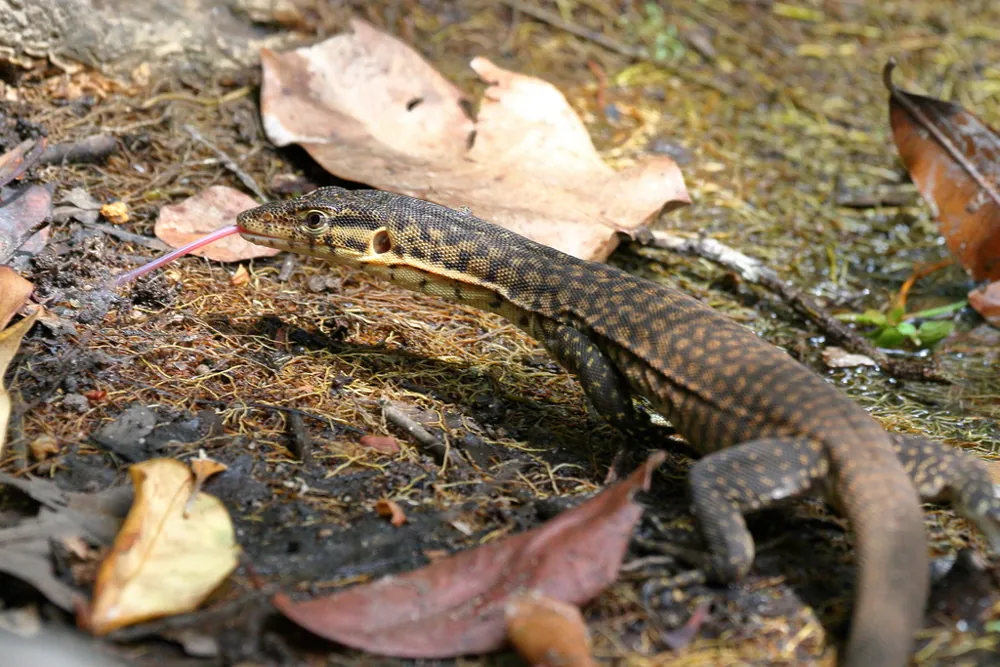
Mitchell's water monitor is a large, slender lizard that lives in the northern rivers, swamps and lagoons of Australia. It spends much of its time near water and can climb trees. It is on the IUCN Red List as Critically Endangered, so it matters a great deal to protect it.1



 Ho e tseba jwang
Matla a chefo
Chefo e tswa ka meno a yona a chefo (fangs) kapa ka meno a mang ha e loma.
E kotsi hakae ho batho?
Kotsi ho batho: E bobebeJwaloka ho hlajwa ke notshi kapa ho fetang moo. Ha e na kotsi ho batho.E etsang ha e tshohile?
If disturbed, it heads for the water. It is described as nervous and shy.1
 Haeba e loma
- Hlatswa leqeba, boloka motho a kgutsitse mme o fumane thuso ya bongaka.
Kamehla letsetsa nomoro ya tshohanyetso pele (112, 000, 911). Ena ke tataiso e akaretsang ya thuso ya pele, hase keletso ya bongaka. Metheo ya thuso ya pele
 Dula o bolokehile
- O se ke wa ama, wa tshwara kapa wa tena phoofolo ya naheng, leha e le e nyenyane, le leha e shebahala e robetse kapa e shwele.
- E fe sebaka. Ha o kopana le yona, dula o kgutsitse, kgutlela morao butle mme o e tlohele e tsamaye ka tsela ya yona.
- Haeba e nngwe e o loma: dula o kgutsitse, o se ke wa sisinyeha, letsetsa nomoro ya tshohanyetso (112, 000, 911) kapa o ye sepetlele kapele. Hopola hore e ne e shebahala jwang, foto e a thusa.
Ha e o batle. E sebedisa chefo ya yona ho tshwara dijo kapa ho itshireletsa, mme e kgetha ho ipata. Ho eketsehileng ka ho dula o bolokehile
Hokae lefatsheng?
E kgolo hakae?
E telele hakae?
 e telele jwaloka dibanana tse 4 tse latellanang
 e ka matha metara e 100 ka metsotswana e 30 (motho ya potlakang ka ho fetisisa o hloka 9,6)
Mitchell's water monitor e kgolo hakae ha e bapiswa le WENA?
Ke dipalo feela ka hara sebatli sa hao. Ha ho letho le bolokwang kapa le romelwang kae kapa kae.
E potlaka hakae?

Dintlha
Where cane toads arrived at Kakadu National Park, almost the entire population of this lizard was wiped out. Its numbers have been estimated to have dropped by as much as 97% within three years.1
Its eyesight is excellent, but it is night blind because its retinas have no rods, the cells used for night vision.1
The biggest threat to this lizard is the cane toad. Cane toads are poisonous to it, and it can eat the larger toads, which carry lethal doses of poison.1
The Australian name 'goanna' probably comes from 'iguana', because the first European settlers thought these lizards looked like the iguanas of South America.1
Bakeng sa ditsebi tsa chefo
- Lebitso la saense
- Varanus mitchelli
- Sehlopha
- Mekgodutswane e nang le chefo
- Lelapa
- Varanidae2
- Tatelano
- Squamata
- Dikontinente
- Australia le Oceania
- Masea
- It lays eggs (it is oviparous). Females lay between April and June in the dry season, with clutches of 3 to 12 eggs.1
- Nako ya bophelo
- e ka bang dilemo tse 101
- Boemo ba yona naheng
- Critically Endangered1
- Kotsi ho batho
- 1 / 5: E bobebe3
Moo dintlha di tswang teng
- Mitchell's water monitor (Wikipedia (CC BY-SA 4.0))
- Varanus mitchelli (iNaturalist): mabitso le tlhophiso.
- Venom Wiki: boemo ba kotsi, boholo bo tlwaelehileng le kakanyo ya lebelo ke tsa rona. Bona kamoo re di balang ka teng: Kamoo re lekanyang kotsi ka teng.
Taba e nngwe le e nngwe leqepheng lena e na le nomoro e bontshang mohlodi wa yona. Haeba re entse phoso, re kopa tshwarelo, re barati ba diphoofolo, hase makasine wa saense. Re bolelle ho [email protected] mme re tla e lokisa.
 Phepheng e lapile! Venom Wiki ke projeke ya motho a le mong: ke mahala, ha e na dipapatso ebile ha e na di-tracker. Thuso e nyenyane ya tjhelete e e boloka e ntse e le inthaneteng.Fepa phepheng
Tse ding tsa sehlopha se le seng: Mekgodutswane e nang le chefo
 Lace monitorMekgodutswane e nang le chefoE utlwisa bohloko feela
 PerentieMekgodutswane e nang le chefoE utlwisa bohloko feela
 Spiny-tailed monitorMekgodutswane e nang le chefoHa e na kotsi
 Yellow-spotted monitorMekgodutswane e nang le chefoE utlwisa bohloko feela
 Komodo dragonMekgodutswane e nang le chefoE ka bolaya
 Gila monsterMekgodutswane e nang le chefoE hloka ngaka
E boetse e phela: Australia le Oceania
 Coastal taipanDinoha tsa AustraliaE a bolaya
 Common death adderDinoha tsa AustraliaE a bolaya
 Eastern brown snakeDinoha tsa AustraliaE a bolaya
 Taipan ya naheng e kahareDinoha tsa AustraliaE a bolaya
 Sydney funnel-web spiderDi-tarantula le di-funnel-webE a bolaya
 Noha ya tigerDinoha tsa AustraliaE a bolaya