
 Afrika
 Asia
Asia Yuropa
 Amerika Borwa
 Australia le Oceania
 Antarctica
 Lewatle la Pacific
 Lewatle la Atlantic
 Lewatle la India
 Lewatle la Arctic
 Lewatle la Mediterranean
 Lewatle le Lefubedu
 Lewatle la Caribbean
 Lewatle la Coral
 Lewatle la China Borwa
 Lewatle la Philippine
 Lewatle la Andaman
 Lewatle la Leboya
 Lewatle la Timor le Arafura
 Kgwohlo ya Bengal
 Kgwohlo ya California
Mottled cup moth
 Boya bo hlabang
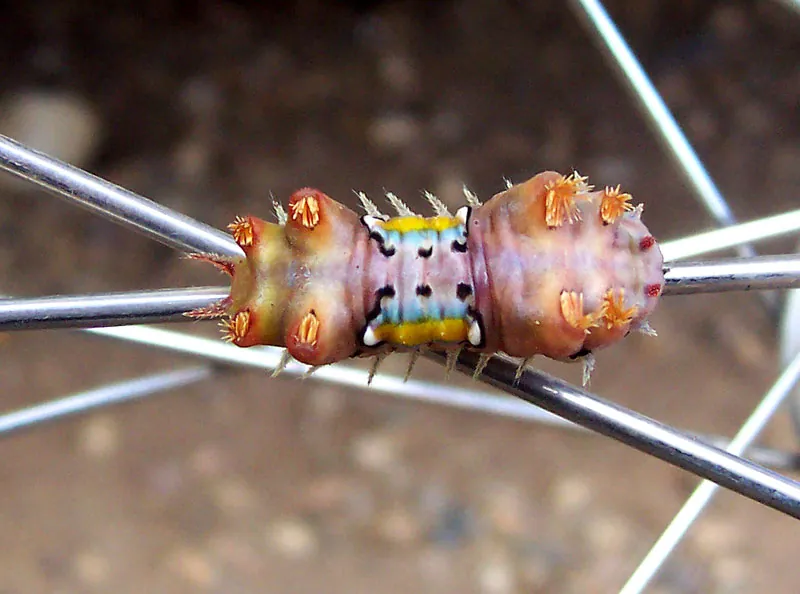
The mottled cup moth is a small Australian moth. Its caterpillar is the part to know about, because it has yellow stinging spines that release painful toxins when touched. The caterpillar's bright bands warn that it is dangerous.1

 Ho e tseba jwang
- The adult moth has a rust-coloured body and a white area around its antennae.1
- Its two pairs of legs have white bands on the front pair.1
- The forewings are shiny rust-coloured with silvery edges, and the hindwings are dull white.1
- The caterpillar is only about 2 cm long, grey with many dark spots and streaks.1
- Each side of the caterpillar has a clear yellow band lined with green, and it has spiny projections at both ends.1
Matla a chefo
Boya bo bonyenyane kapa ditlhaka di robehela letlalong mme di a hlaba.
Chefo ya yona (eo e e kenyang ka ho loma kapa ho hlaba) e etsang?
The caterpillar's yellow needle-like spines contain a mixture of at least 151 toxins, which are proteins or protein-like substances. The spines cause pain and can induce severely inflamed swellings. The toxins are released when the spine tips break on contact.1
E kotsi hakae ho batho?
Kotsi ho batho: E bohlokoE ka utlwisa bohloko haholo, empa hoo e batlang e le kamehla ha e kotsi haholo.Contact with the spines causes painful, severely inflamed swellings.1
E etsang ha e tshohile?
The caterpillar raises up to eight projections, each with about a hundred stinging spines, but only when it is disturbed or agitated. Its banded colours warn predators that it is dangerous.1
 Haeba o ama boya ba yona
- Bakeng sa boya bo hlabang ba diboko: bo tlose ka theipi e kgomarelang, ebe o hlatswa letlalo. O se ke wa hohla.
- Bakeng sa ho longwa: hlatswa mme o pholise. Fumana thuso ya bongaka haeba motho a ikutlwa a kula kapa a tswa madi habonolo.
Kamehla letsetsa nomoro ya tshohanyetso pele (112, 000, 911). Ena ke tataiso e akaretsang ya thuso ya pele, hase keletso ya bongaka. Metheo ya thuso ya pele
 Dula o bolokehile
- O se ke wa ama, wa tshwara kapa wa tena phoofolo ya naheng, leha e le e nyenyane, le leha e shebahala e robetse kapa e shwele.
- E fe sebaka. Ha o kopana le yona, dula o kgutsitse, kgutlela morao butle mme o e tlohele e tsamaye ka tsela ya yona.
- Haeba o ama boya ba yona: dula o kgutsitse, o se ke wa sisinyeha, letsetsa nomoro ya tshohanyetso (112, 000, 911) kapa o ye sepetlele kapele. Hopola hore e ne e shebahala jwang, foto e a thusa.
Ha e o batle. E sebedisa chefo ya yona ho tshwara dijo kapa ho itshireletsa, mme e kgetha ho ipata. Ho eketsehileng ka ho dula o bolokehile
Hokae lefatsheng?
E kgolo hakae?
E telele hakae?
 e kgutshwane ho feta monwana wa hao o monyenyane
 e dieha ho feta kgofu ya serapeng
Mottled cup moth e kgolo hakae ha e bapiswa le WENA?
Ke dipalo feela ka hara sebatli sa hao. Ha ho letho le bolokwang kapa le romelwang kae kapa kae.
E potlaka hakae?


Dintlha
Researchers at the University of Queensland reported in 2021 that the caterpillar's venom contains at least 151 different toxins.1
The toxin cecropin causes the pain and also breaks down the cell membranes of bacteria and worms.1
A protein called DV33 can kill Haemonchus contortus, a roundworm that affects sheep.1
Some of the toxins have medicinal properties, such as the ability to kill harmful bacteria and parasitic worms.1
Some of the nervous-system proteins in the venom may have beneficial effects, such as in epilepsy.1
Moo dintlha di tswang teng
- Doratifera vulnerans (Wikipedia (CC BY-SA 4.0))
- Doratifera vulnerans (iNaturalist): mabitso le tlhophiso.
- Venom Wiki: boemo ba kotsi, boholo bo tlwaelehileng le kakanyo ya lebelo ke tsa rona. Bona kamoo re di balang ka teng: Kamoo re lekanyang kotsi ka teng.
Taba e nngwe le e nngwe leqepheng lena e na le nomoro e bontshang mohlodi wa yona. Haeba re entse phoso, re kopa tshwarelo, re barati ba diphoofolo, hase makasine wa saense. Re bolelle ho [email protected] mme re tla e lokisa.
 Phepheng e lapile! Venom Wiki ke projeke ya motho a le mong: ke mahala, ha e na dipapatso ebile ha e na di-tracker. Thuso e nyenyane ya tjhelete e e boloka e ntse e le inthaneteng.Fepa phepheng
Tse ding tsa sehlopha se le seng: Diboko le dikokoanyana
 Bag-shelter mothDiboko le dikokoanyanaE utlwisa bohloko feelaO se ke wa ama
 Common Australian assassin bugDiboko le dikokoanyanaHa e na kotsi
 Giant silkworm moth caterpillarDiboko le dikokoanyanaE ka bolayaO se ke wa ama
 Vinchuca kissing bugDiboko le dikokoanyanaE hloka ngaka
 Giant water bugDiboko le dikokoanyanaE utlwisa bohloko feela
 Oak processionaryDiboko le dikokoanyanaE utlwisa bohloko feelaO se ke wa ama
E boetse e phela: Australia le Oceania
 Coastal taipanDinoha tsa AustraliaE a bolaya
 Common death adderDinoha tsa AustraliaE a bolaya
 Eastern brown snakeDinoha tsa AustraliaE a bolaya
 Taipan ya naheng e kahareDinoha tsa AustraliaE a bolaya
 Sydney funnel-web spiderDi-tarantula le di-funnel-webE a bolaya
 Noha ya tigerDinoha tsa AustraliaE a bolaya