
 Afrika
 Asia
Asia Yuropa
 Amerika Borwa
 Australia le Oceania
 Antarctica
 Lewatle la Pacific
 Lewatle la Atlantic
 Lewatle la India
 Lewatle la Arctic
 Lewatle la Mediterranean
 Lewatle le Lefubedu
 Lewatle la Caribbean
 Lewatle la Coral
 Lewatle la China Borwa
 Lewatle la Philippine
 Lewatle la Andaman
 Lewatle la Leboya
 Lewatle la Timor le Arafura
 Kgwohlo ya Bengal
 Kgwohlo ya California
Palestine viper
 Ho loma
The Palestine viper is a venomous snake found in the Levant, the region around the eastern Mediterranean. It is considered a leading cause of snakebite within its range, so knowing what it looks like is important. It is also special because it lays eggs, unlike most other vipers.1
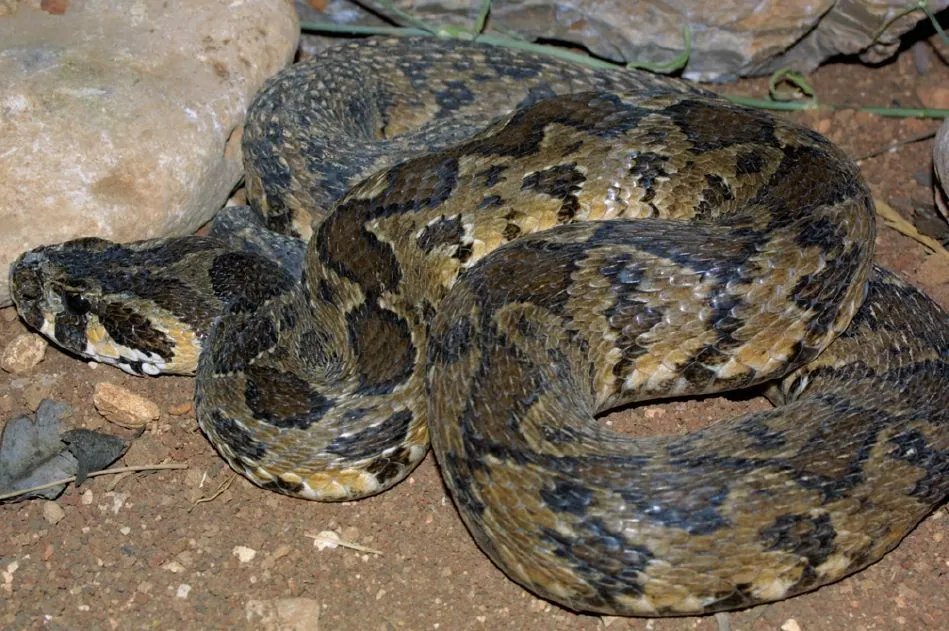
 Ho e tseba jwang
- The head is triangular and clearly separate from the neck, covered in small scales.1
- The upper body has large dark, diamond-shaped (rhomboid) blotches, sometimes forming a zig-zag pattern.1
- It usually measures 70 to 90 cm in total length (body plus tail), and can reach 130 cm.1
Hangata e ferekanngwa le: The harmless coin-marked snake lives in the same areas and is similar in length, colouring and defensive behaviour, so people often confuse the two. This resemblance is probably a case of Batesian mimicry, where a harmless animal copies a dangerous one.1
Matla a chefo
Chefo e tswa ka meno a yona a chefo (fangs) kapa ka meno a mang ha e loma.
Chefo ya yona (eo e e kenyang ka ho loma kapa ho hlaba) e etsang?
Its venom contains several groups of active compounds, including neurotoxins (which attack the nerves) and hemorrhagins (which damage blood vessels and cause bleeding). Other compounds include angioneurin growth factors and integrin inhibitors. Its LD50, a standard measure of how toxic a venom is, is 0.34 mg/kg.1
E kotsi hakae ho batho?
Kotsi ho batho: E kotsi haholoE ka bolaya motho ya sa fumaneng kalafo.It is considered a leading cause of snakebite within its range. About 0.5% to 2% of people who are bitten die. At least 7 people are reported to have died from its bite in Israel in the 21st century so far.1
 Ditaba tse monate: dingaka di na le moriana (antivenom) kapa kalafo bakeng sa sena.1
 Haeba e loma
- Boloka motho a sa sisinyehe ebile a kgutsitse, boloka setho se lomilweng se lekana le bophahamo ba pelo, tlosa mesale le dintho tse tiileng, mme o mo ise sepetlele kapele.
Kamehla letsetsa nomoro ya tshohanyetso pele (112, 000, 911). Ena ke tataiso e akaretsang ya thuso ya pele, hase keletso ya bongaka. Metheo ya thuso ya pele
 Dula o bolokehile
- O se ke wa ama, wa tshwara kapa wa tena phoofolo ya naheng, leha e le e nyenyane, le leha e shebahala e robetse kapa e shwele.
- E fe sebaka. Ha o kopana le yona, dula o kgutsitse, kgutlela morao butle mme o e tlohele e tsamaye ka tsela ya yona.
- Haeba e nngwe e o loma: dula o kgutsitse, o se ke wa sisinyeha, letsetsa nomoro ya tshohanyetso (112, 000, 911) kapa o ye sepetlele kapele. Hopola hore e ne e shebahala jwang, foto e a thusa.
Ha e o batle. E sebedisa chefo ya yona ho tshwara dijo kapa ho itshireletsa, mme e kgetha ho ipata. Ho eketsehileng ka ho dula o bolokehile
Hokae lefatsheng?
E kgolo hakae?
E telele hakae?
 e telele jwaloka dikatse tsa lapeng tse 2,5 ho tloha nkong ho isa mohatleng
 e telele jwaloka dibanana tse 7 tse latellanang
 e ka matha metara e 100 ka metsotswana e 100 (motho ya potlakang ka ho fetisisa o hloka 9,6)
Palestine viper e kgolo hakae ha e bapiswa le WENA?
Ke dipalo feela ka hara sebatli sa hao. Ha ho letho le bolokwang kapa le romelwang kae kapa kae.
E potlaka hakae?


Dintlha
In the 1991 Gulf War, the code phrase "Nahash Tsefa" (Viper Snake) was broadcast on radio and TV to tell Israelis to put on their gas masks during missile attacks from Iraq.1
In 2018 it was chosen as the national snake of Israel, after a public campaign.1
The Israeli Air Force named its Bell AH-1 Cobra helicopter Tzefa, and the IDF's paratroopers battalion #202 is called the Tzefa Battalion.1
Some modern scholars think the tsefa snake mentioned in the Hebrew Bible is this species.1
A list of venomous snakes in the Brooklyn Papyrus, from the first millennium BC in ancient Egypt, probably includes it.1
Bakeng sa ditsebi tsa chefo
- Lebitso la saense
- Daboia palaestinae
- Sehlopha
- Di-viper le di-adder
- Lelapa
- Viperidae2
- Tatelano
- Squamata
- Dikontinente
- Asia
- Masea
- Unlike most vipers, which give birth to live young, it lays eggs around August. The eggs hatch 1.5 to 2 months later, and the young can already bite and kill prey.1
- Boemo ba yona naheng
- Least Concern1
- Kotsi ho batho
- 4 / 5: E kotsi haholo3
Moo dintlha di tswang teng
- Daboia palaestinae (Wikipedia (CC BY-SA 4.0))
- Daboia palaestinae (iNaturalist): mabitso le tlhophiso.
- Venom Wiki: boemo ba kotsi, boholo bo tlwaelehileng le kakanyo ya lebelo ke tsa rona. Bona kamoo re di balang ka teng: Kamoo re lekanyang kotsi ka teng.
Taba e nngwe le e nngwe leqepheng lena e na le nomoro e bontshang mohlodi wa yona. Haeba re entse phoso, re kopa tshwarelo, re barati ba diphoofolo, hase makasine wa saense. Re bolelle ho [email protected] mme re tla e lokisa.
 Phepheng e lapile! Venom Wiki ke projeke ya motho a le mong: ke mahala, ha e na dipapatso ebile ha e na di-tracker. Thuso e nyenyane ya tjhelete e e boloka e ntse e le inthaneteng.Fepa phepheng
Tse ding tsa sehlopha se le seng: Di-viper le di-adder
 Indian saw-scaled viperDi-viper le di-adderE a bolaya
 Puff adderDi-viper le di-adderE a bolaya
 Noha ea RussellDi-viper le di-adderE a bolaya
 Common European adderDi-viper le di-adderE hloka ngaka
 Eastern Russell's viperDi-viper le di-adderE a bolaya
 Northeast African carpet viperDi-viper le di-adderE a bolaya
E boetse e phela: Asia
 DeathstalkerDiphephengE a bolaya
 Indian cobraDi-cobra, di-mamba le di-kraitE a bolaya
 King cobraDi-cobra, di-mamba le di-kraitE a bolaya
 Asian giant hornetDinotshi, di-wasp le di-hornetE ka bolaya
 Komodo dragonMekgodutswane e nang le chefoE ka bolaya
 Spanish flyDiphoofolo tse ding tse chefangE hloka ngakaO se ke wa ama