
 Afrika
 Asia
Asia Yuropa
 Amerika Borwa
 Australia le Oceania
 Antarctica
 Lewatle la Pacific
 Lewatle la Atlantic
 Lewatle la India
 Lewatle la Arctic
 Lewatle la Mediterranean
 Lewatle le Lefubedu
 Lewatle la Caribbean
 Lewatle la Coral
 Lewatle la China Borwa
 Lewatle la Philippine
 Lewatle la Andaman
 Lewatle la Leboya
 Lewatle la Timor le Arafura
 Kgwohlo ya Bengal
 Kgwohlo ya California
Red-necked keelback
 Ho loma
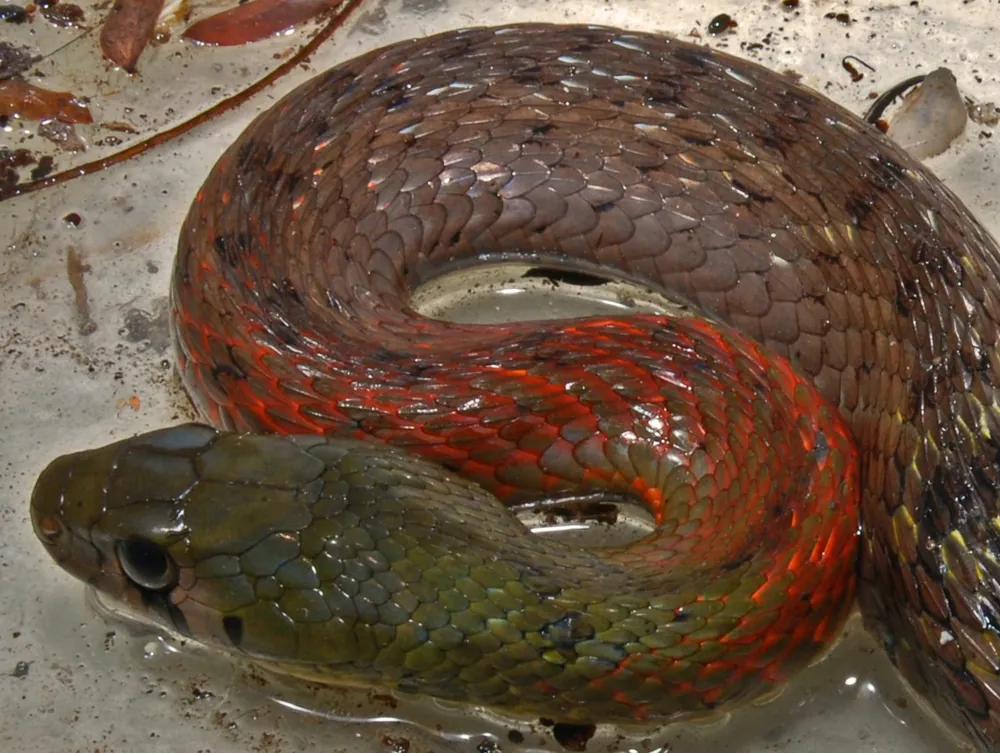
The red-necked keelback is a snake from the Indonesian islands of Java and Sumatra. It is unusual because it is venomous, which is rare for snakes in its family, and it was only recently reclassified as dangerous to people.1



 Ho e tseba jwang
Matla a chefo
Chefo e tswa ka meno a yona a chefo (fangs) kapa ka meno a mang ha e loma.
Chefo ya yona (eo e e kenyang ka ho loma kapa ho hlaba) e etsang?
This snake is rear-fanged, so its venom is delivered through grooved teeth at the back of the upper jaw rather than through hollow front fangs. Its venom can cause internal bleeding, including bleeding in the brain, nausea, and blood clotting problems such as disseminated intravascular coagulation. In animal tests, the venom caused kidney failure.1
E kotsi hakae ho batho?
Kotsi ho batho: E tebilengHo longwa ho hloka ngaka. Lefu le etsahala ka seoelo haholo.After one fatal and several near-fatal envenomations, the snake was reclassified as dangerous. Most bites to people involve the front teeth and cause no harmful effects, but rare bites from the rear fangs can be lethal. Recent reports describe severe envenomation and organ failure, affecting the kidneys and liver, after even brief bites.1
E etsang ha e tshohile?
When threatened, for example by being touched, it can burst its nuchal glands in the red neck, releasing stored toad toxins (bufotoxins) that cause fast heartbeat, drooling, convulsions and paralysis.1
 Haeba e loma
- Care is needed when treating a bitten person. Injections should be avoided, as they may cause excessive bleeding.1
- Hlatswa moo e lomileng teng, boloka motho a kgutsitse mme o fumane thuso ya bongaka. Mefuta e meng (jwaloka boomslang) e ka bolaya dihora hamorao.
Kamehla letsetsa nomoro ya tshohanyetso pele (112, 000, 911). Ena ke tataiso e akaretsang ya thuso ya pele, hase keletso ya bongaka. Metheo ya thuso ya pele
 Dula o bolokehile
- O se ke wa ama, wa tshwara kapa wa tena phoofolo ya naheng, leha e le e nyenyane, le leha e shebahala e robetse kapa e shwele.
- E fe sebaka. Ha o kopana le yona, dula o kgutsitse, kgutlela morao butle mme o e tlohele e tsamaye ka tsela ya yona.
- Haeba e nngwe e o loma: dula o kgutsitse, o se ke wa sisinyeha, letsetsa nomoro ya tshohanyetso (112, 000, 911) kapa o ye sepetlele kapele. Hopola hore e ne e shebahala jwang, foto e a thusa.
Ha e o batle. E sebedisa chefo ya yona ho tshwara dijo kapa ho itshireletsa, mme e kgetha ho ipata. Ho eketsehileng ka ho dula o bolokehile
Hokae lefatsheng?
E kgolo hakae?
E telele hakae?
 e telele jwaloka dikatse tsa lapeng tse 2 ho tloha nkong ho isa mohatleng
 e telele jwaloka dibanana tse 5 tse latellanang
 e ka matha metara e 100 ka metsotswana e 71 (motho ya potlakang ka ho fetisisa o hloka 9,6)
Red-necked keelback e kgolo hakae ha e bapiswa le WENA?
Ke dipalo feela ka hara sebatli sa hao. Ha ho letho le bolokwang kapa le romelwang kae kapa kae.
E potlaka hakae?


Dintlha
It stores toxins from the toads it eats in glands in its neck, which it can release when threatened.1
Unusually for a member of the colubrid family, which is a large snake family, this species is venomous.1
Its venom ducts open onto grooved fangs at the back of the mouth, and chewing helps the venom enter a bite.1
During mating, several males may swarm around a single female.1
Ho senya ditshomo
Tshomo: The red-necked keelback is harmless because it was once thought to be.
Nnete: It is venomous. It was previously thought harmless, but after serious bites it was reclassified as dangerous.1
Moo dintlha di tswang teng
- Rhabdophis subminiatus (Wikipedia (CC BY-SA 4.0))
- Rhabdophis subminiatus (iNaturalist): mabitso le tlhophiso.
- Venom Wiki: boemo ba kotsi, boholo bo tlwaelehileng le kakanyo ya lebelo ke tsa rona. Bona kamoo re di balang ka teng: Kamoo re lekanyang kotsi ka teng.
Taba e nngwe le e nngwe leqepheng lena e na le nomoro e bontshang mohlodi wa yona. Haeba re entse phoso, re kopa tshwarelo, re barati ba diphoofolo, hase makasine wa saense. Re bolelle ho [email protected] mme re tla e lokisa.
 Phepheng e lapile! Venom Wiki ke projeke ya motho a le mong: ke mahala, ha e na dipapatso ebile ha e na di-tracker. Thuso e nyenyane ya tjhelete e e boloka e ntse e le inthaneteng.Fepa phepheng
Tse ding tsa sehlopha se le seng: Dinoha tse meno a ka morao
 Brown tree snakeDinoha tse meno a ka moraoE utlwisa bohloko feela
 Tiger keelbackDinoha tse meno a ka moraoE ka bolaya
 Green cat snakeDinoha tse meno a ka moraoE utlwisa bohloko feela
 Mangrove snakeDinoha tse meno a ka moraoE utlwisa bohloko feela
 Asian vine snakeDinoha tse meno a ka moraoHa e na kotsi
 Golden tree snakeDinoha tse meno a ka moraoHa e na kotsi
 Deathstalker
 Indian cobra
 Indian saw-scaled viper
 King cobra
 Puff adder
 Noha ea Russell