
 Afrika
 Asia
Asia Yuropa
 Amerika Borwa
 Australia le Oceania
 Antarctica
 Lewatle la Pacific
 Lewatle la Atlantic
 Lewatle la India
 Lewatle la Arctic
 Lewatle la Mediterranean
 Lewatle le Lefubedu
 Lewatle la Caribbean
 Lewatle la Coral
 Lewatle la China Borwa
 Lewatle la Philippine
 Lewatle la Andaman
 Lewatle la Leboya
 Lewatle la Timor le Arafura
 Kgwohlo ya Bengal
 Kgwohlo ya California
Red Sea fire urchin
 Meutlwa e nang le chefo
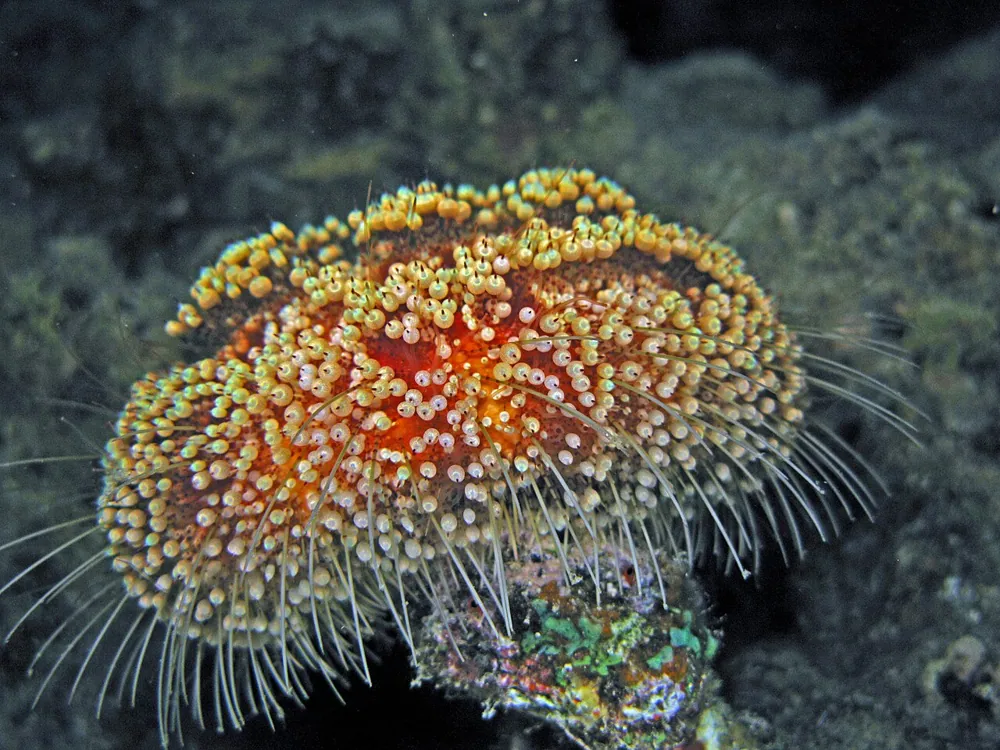
The Red Sea fire urchin is a spiny sea creature that lives on the seabed. It is a fairly common sea urchin across much of the Indo-Pacific. Its spines can cause extreme pain, so it is important to know it when you are in the water.1


 Ho e tseba jwang
- Its spines regularly cover the whole aboral (back) side of its body.1
- Its body plates are articulated, which makes the test (shell) quite flexible.1
- It is most active at night.1
Hangata e ferekanngwa le: It was once considered a colour variant of Asthenosoma varium. In the Red Sea fire urchin, the spines cover the whole back side evenly. In A. varium, the spines are grouped in rectangular patches separated by bare areas.1
Matla a chefo
Meutlwa e bohale e nka chefo. Ho e hata kapa ho e tshwara ho bohloko.
Chefo ya yona (eo e e kenyang ka ho loma kapa ho hlaba) e etsang?
Its spines inflict extreme pain on anyone who is pricked by them. The pain is the main effect described for this urchin.1
E kotsi hakae ho batho?
Kotsi ho batho: E tebilengHaeba meutlwa ya yona e o hlaba, eya ho ngaka. Lefu le etsahala ka seoelo haholo.Its spines cause extreme pain, which is the main danger to people who touch it or come into contact with its spines.1
 Haeba meutlwa ya yona e o hlaba
- Kenya leqeba metsing a tjhesang, a tjhesang hoo motho a ka a mamellang ntle le ho tjha, mme o fumane thuso ya bongaka ho ntsha meutlwa. O se ke wa e cheka ka bowena.
Kamehla letsetsa nomoro ya tshohanyetso pele (112, 000, 911). Ena ke tataiso e akaretsang ya thuso ya pele, hase keletso ya bongaka. Metheo ya thuso ya pele
 Dula o bolokehile
- O se ke wa ama, wa tshwara kapa wa tena phoofolo ya naheng, leha e le e nyenyane, le leha e shebahala e robetse kapa e shwele.
- E fe sebaka. Ha o kopana le yona, dula o kgutsitse, kgutlela morao butle mme o e tlohele e tsamaye ka tsela ya yona.
- Haeba meutlwa ya yona e o hlaba: dula o kgutsitse, o se ke wa sisinyeha, letsetsa nomoro ya tshohanyetso (112, 000, 911) kapa o ye sepetlele kapele. Hopola hore e ne e shebahala jwang, foto e a thusa.
Ha e o batle. E sebedisa chefo ya yona ho tshwara dijo kapa ho itshireletsa, mme e kgetha ho ipata. Ho eketsehileng ka ho dula o bolokehile
E kgolo hakae?
E telele hakae?
 e telele jwaloka diboloko tsa ho bapala tse 8 moleng
 e dieha ho feta kgofu ya serapeng
Red Sea fire urchin e kgolo hakae ha e bapiswa le WENA?
Ke dipalo feela ka hara sebatli sa hao. Ha ho letho le bolokwang kapa le romelwang kae kapa kae.
E potlaka hakae?


Dintlha
It often shelters commensal shrimps, including Allopontonia iaini and Periclimenes colemani, and the parasitic gastropod Leutzenia asthenosomae.1
Until 1998 it was considered a colour variant of Asthenosoma varium.1
Sea urchins are close relatives of starfish, crinoids, brittle stars and sea cucumbers. Together these are called echinoderms, meaning 'spiny skins'.1
Moo dintlha di tswang teng
- Asthenosoma marisrubri (Wikipedia (CC BY-SA 4.0))
- Asthenosoma marisrubri (iNaturalist): mabitso le tlhophiso.
- Venom Wiki: boemo ba kotsi, boholo bo tlwaelehileng le kakanyo ya lebelo ke tsa rona. Bona kamoo re di balang ka teng: Kamoo re lekanyang kotsi ka teng.
Taba e nngwe le e nngwe leqepheng lena e na le nomoro e bontshang mohlodi wa yona. Haeba re entse phoso, re kopa tshwarelo, re barati ba diphoofolo, hase makasine wa saense. Re bolelle ho [email protected] mme re tla e lokisa.
 Phepheng e lapile! Venom Wiki ke projeke ya motho a le mong: ke mahala, ha e na dipapatso ebile ha e na di-tracker. Thuso e nyenyane ya tjhelete e e boloka e ntse e le inthaneteng.Fepa phepheng
Tse ding tsa sehlopha se le seng: Di-sea urchin, dinaledi tsa lewatle le diboko
 Crown-of-thorns starfishDi-sea urchin, dinaledi tsa lewatle le dibokoE hloka ngakaO se ke wa ama
 Flower urchinDi-sea urchin, dinaledi tsa lewatle le dibokoE ka bolaya
 Fire urchinDi-sea urchin, dinaledi tsa lewatle le dibokoE hloka ngakaO se ke wa ama
 Bearded firewormDi-sea urchin, dinaledi tsa lewatle le dibokoE utlwisa bohloko feelaO se ke wa ama
 Black long-spined urchinDi-sea urchin, dinaledi tsa lewatle le dibokoE utlwisa bohloko feelaO se ke wa ama
 BloodwormDi-sea urchin, dinaledi tsa lewatle le dibokoE utlwisa bohloko feela
E boetse e phela: Lewatle le Lefubedu
 Hawksbill sea turtleDiphoofolo tse ding tse chefangE ka bolaya
 Reef stonefishDitlhapi tse nang le chefoE ka bolayaO se ke wa ama
 Red lionfishDitlhapi tse nang le chefoE hloka ngakaO se ke wa ama
 Common octopusDikgofu tsa cone le di-octopusHa e na kotsi
 Moon jellyfishDi-jellyfish le diphoofolo tsa lewatle tse hlabangHa e na kotsi
 Silver-cheeked toadfishDiphoofolo tse ding tse chefangE a bolaya