
 Afrika
 Asia
Asia Yuropa
 Amerika Borwa
 Australia le Oceania
 Antarctica
 Lewatle la Pacific
 Lewatle la Atlantic
 Lewatle la India
 Lewatle la Arctic
 Lewatle la Mediterranean
 Lewatle le Lefubedu
 Lewatle la Caribbean
 Lewatle la Coral
 Lewatle la China Borwa
 Lewatle la Philippine
 Lewatle la Andaman
 Lewatle la Leboya
 Lewatle la Timor le Arafura
 Kgwohlo ya Bengal
 Kgwohlo ya California
Red spitting cobra
 E a fafatsa kapa e a tshwela
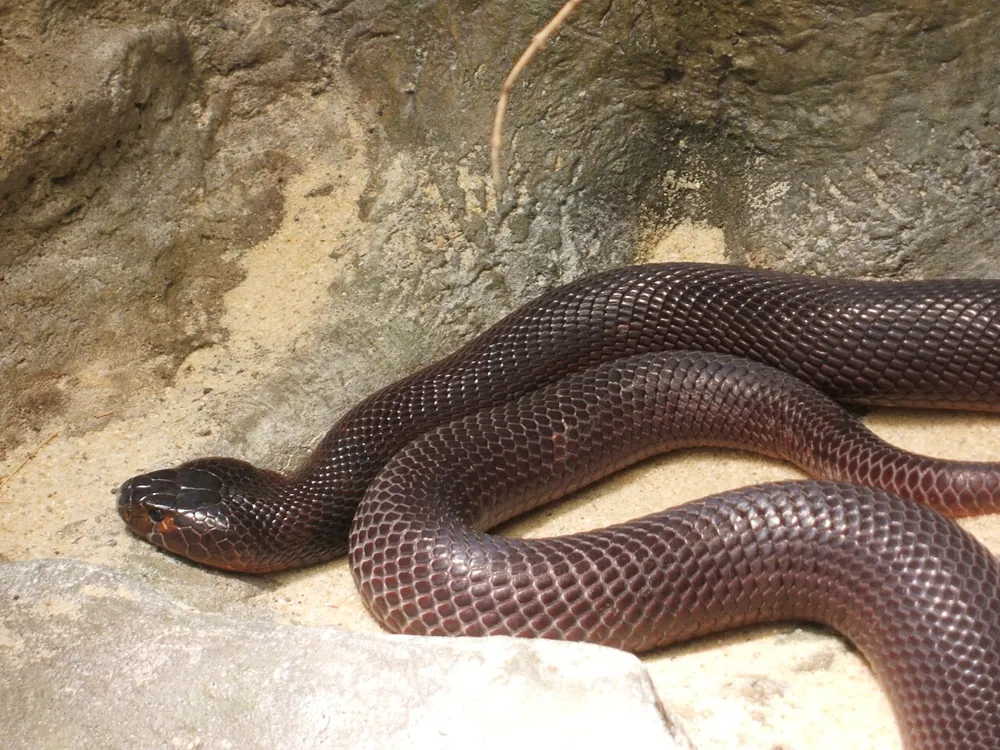
The red spitting cobra is a medium-sized cobra found in East Africa. When threatened, it can spray venom into an attacker's face, which can cause burning pain and blindness. It is often considered an attractive snake, usually bright salmon-red with a black throat band.1



 Ho e tseba jwang
- Usually bright salmon-red, with a broad black throat band and teardrop markings below the eyes1
- Colour varies by region: specimens from southern Kenya and northern Tanzania are orange-red with a dark blue or black throat band1
- The throat band often fades or disappears in larger adults, and true red specimens turn reddish-brown with age1
- Adults typically measure 0.7 to 1.2 metres1
- When threatened, it rears up, shows a cobra hood and hisses loudly1
Matla a chefo
E fafatsa kapa e tshwela mokedikedi o hlabang ho ba e hlaselang.
Chefo ya yona (eo e e kenyang ka ho loma kapa ho hlaba) e etsang?
Its venom contains a mixture of neurotoxins, which attack the nerves, and cytotoxins, which damage cells. A bite causes slight pain around the wound and numbness of the lips, fingers and tongue. Venom sprayed into the eyes causes burning pain and can cause blindness.1
E kotsi hakae ho batho?
Kotsi ho batho: E kotsi haholoE ka bolaya motho ya sa fumaneng kalafo.It seldom causes human deaths, but survivors of its bites are usually left disfigured. In September 2011, a snake keeper from South Africa died shortly after venom was sprayed into his face while he was photographing the snake. The venom is thought to have entered his nasal passages and caused anaphylactic shock, a severe allergic reaction, and his asthma may have contributed.1
E etsang ha e tshohile?
When threatened, it rears up, displays its hood and hisses loudly, and if the intruder does not retreat, it may spray venom at the face. In very rare cases it sprays without first rearing up.1
 Haeba e loma kapa e tshwela
- Boloka motho a sa sisinyehe ebile a kgutsitse, tlosa mesale le dintho tse tiileng, mme o mo ise sepetlele kapele: antivenom ke yona kalafo.
- Haeba chefo e tshwetswe mahlong, a hlatswe ka metsi a mangata a hlwekileng hang-hang.
Kamehla letsetsa nomoro ya tshohanyetso pele (112, 000, 911). Ena ke tataiso e akaretsang ya thuso ya pele, hase keletso ya bongaka. Metheo ya thuso ya pele
 Dula o bolokehile
- O se ke wa ama, wa tshwara kapa wa tena phoofolo ya naheng, leha e le e nyenyane, le leha e shebahala e robetse kapa e shwele.
- E fe sebaka. Ha o kopana le yona, dula o kgutsitse, kgutlela morao butle mme o e tlohele e tsamaye ka tsela ya yona.
- Haeba e nngwe e o loma kapa e o tshwela chefo mahlong: dula o kgutsitse, o se ke wa sisinyeha, letsetsa nomoro ya tshohanyetso (112, 000, 911) kapa o ye sepetlele kapele. Hopola hore e ne e shebahala jwang, foto e a thusa.
Ha e o batle. E sebedisa chefo ya yona ho tshwara dijo kapa ho itshireletsa, mme e kgetha ho ipata. Ho eketsehileng ka ho dula o bolokehile
Hokae lefatsheng?
E kgolo hakae?
E telele hakae?
 e telele jwaloka dikatse tsa lapeng tse 2,5 ho tloha nkong ho isa mohatleng
 e telele jwaloka dibanana tse 7 tse latellanang
 e ka matha metara e 100 ka metsotswana e 53 (motho ya potlakang ka ho fetisisa o hloka 9,6)
Red spitting cobra e kgolo hakae ha e bapiswa le WENA?
Ke dipalo feela ka hara sebatli sa hao. Ha ho letho le bolokwang kapa le romelwang kae kapa kae.
E potlaka hakae?


Dintlha
Moo dintlha di tswang teng
- Red spitting cobra (Wikipedia (CC BY-SA 4.0))
- Naja pallida (iNaturalist): mabitso le tlhophiso.
- Venom Wiki: boemo ba kotsi, boholo bo tlwaelehileng le kakanyo ya lebelo ke tsa rona. Bona kamoo re di balang ka teng: Kamoo re lekanyang kotsi ka teng.
Taba e nngwe le e nngwe leqepheng lena e na le nomoro e bontshang mohlodi wa yona. Haeba re entse phoso, re kopa tshwarelo, re barati ba diphoofolo, hase makasine wa saense. Re bolelle ho [email protected] mme re tla e lokisa.
 Phepheng e lapile! Venom Wiki ke projeke ya motho a le mong: ke mahala, ha e na dipapatso ebile ha e na di-tracker. Thuso e nyenyane ya tjhelete e e boloka e ntse e le inthaneteng.Fepa phepheng
Tse ding tsa sehlopha se le seng: Di-cobra, di-mamba le di-krait
 Black mambaDi-cobra, di-mamba le di-kraitE a bolaya
 Egyptian cobraDi-cobra, di-mamba le di-kraitE a bolaya
 Cape cobraDi-cobra, di-mamba le di-kraitE a bolaya
 Eastern green mambaDi-cobra, di-mamba le di-kraitE a bolaya
 Jameson's mambaDi-cobra, di-mamba le di-kraitE a bolaya
 Western green mambaDi-cobra, di-mamba le di-kraitE a bolaya
 Deathstalker
 Puff adder
 Boomslang
 Fat-tailed scorpion
 Gaboon viper
 Western honey bee