
 Afrika
 Asia
Asia Yuropa
 Amerika Borwa
 Australia le Oceania
 Antarctica
 Lewatle la Pacific
 Lewatle la Atlantic
 Lewatle la India
 Lewatle la Arctic
 Lewatle la Mediterranean
 Lewatle le Lefubedu
 Lewatle la Caribbean
 Lewatle la Coral
 Lewatle la China Borwa
 Lewatle la Philippine
 Lewatle la Andaman
 Lewatle la Leboya
 Lewatle la Timor le Arafura
 Kgwohlo ya Bengal
 Kgwohlo ya California
Spotted jelly
 Di-tentacle tse hlabang
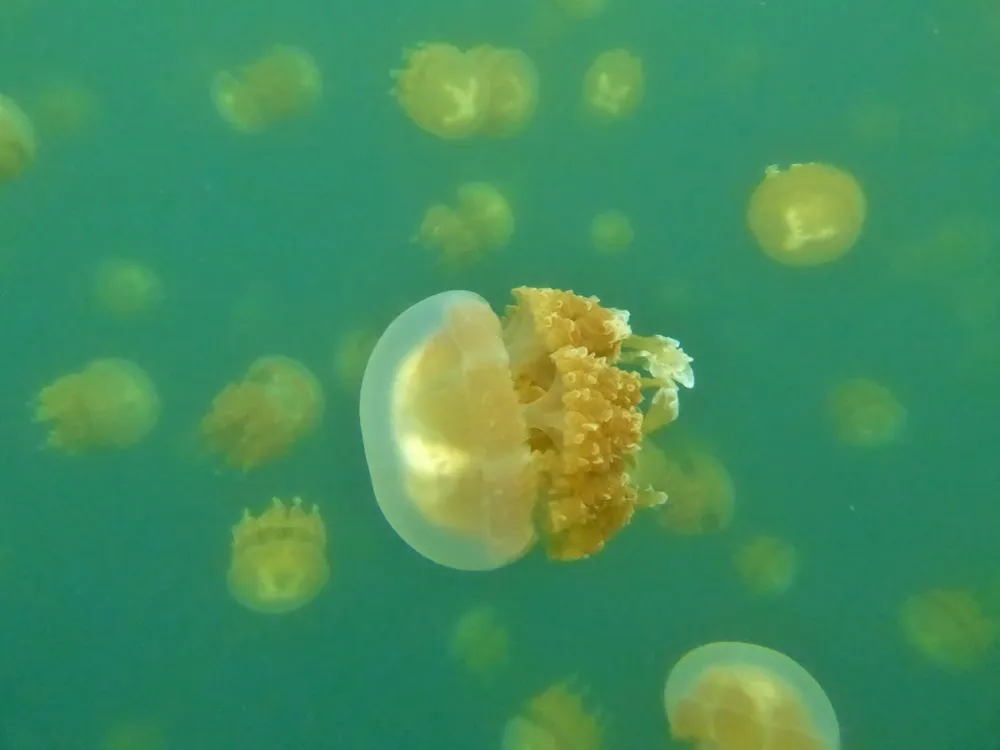
The spotted jelly is a jellyfish with spots on the top of its bell, the rounded body. It lives in the warm Indo-Pacific oceans, and in some saltwater lakes in Palau and Indonesia. Its lake populations are famous because they have lost most of their sting.1


 Ho e tseba jwang
- Distinctive spots on the top of the bell1
- Colour ranges from greenish blue to olive green, from the algae living in its tissues1
- Eight rhopalia (sensory organs) along the edge of the bell1
- Eight frilled oral arms, each ending in a club-like appendage1
- Numerous small mouths along the bottom of the oral arms, unlike many other jellies1
Matla a chefo
Dikete tsa disele tse nyenyane tse hlabang di thunya ha ho na le se di amang.
Chefo ya yona (eo e e kenyang ka ho loma kapa ho hlaba) e etsang?
The venom is protein-based and is delivered by stinging cells called nematocytes (cnidocytes) on the upper surfaces of the oral arms. In jellyfish living in marine lakes, conditions in the lake are thought to break down this venom, so those populations do not sting humans.1
E kotsi hakae ho batho?
Kotsi ho batho: E bobebeJwaloka ho hlajwa ke notshi kapa ho fetang moo. Ha e na kotsi ho batho.Jellyfish in the open ocean have stinging cells on their oral arms. Populations in marine lakes, such as Jellyfish Lake in Palau, do not sting humans.1
 Haeba e hlaba
- Tswa metsing mme o tlose di-tentacle tsohle (ka ditlelafo kapa ka lesela).
- Bakeng sa box jellyfish tsa tropike: tshela asene (vinegar) moo e hlabileng teng bonyane metsotswana e 30, bitsa thuso mme o itokisetse ho etsa CPR. Bakeng sa di-bluebottle le tse ding tse ngata: hlatswa ka metsi a lewatle, ebe ka metsi a tjhesang bakeng sa bohloko.
Kamehla letsetsa nomoro ya tshohanyetso pele (112, 000, 911). Ena ke tataiso e akaretsang ya thuso ya pele, hase keletso ya bongaka. Metheo ya thuso ya pele
 Dula o bolokehile
- O se ke wa ama, wa tshwara kapa wa tena phoofolo ya naheng, leha e le e nyenyane, le leha e shebahala e robetse kapa e shwele.
- E fe sebaka. Ha o kopana le yona, dula o kgutsitse, kgutlela morao butle mme o e tlohele e tsamaye ka tsela ya yona.
- Haeba e nngwe e o hlaba: dula o kgutsitse, o se ke wa sisinyeha, letsetsa nomoro ya tshohanyetso (112, 000, 911) kapa o ye sepetlele kapele. Hopola hore e ne e shebahala jwang, foto e a thusa.
Ha e o batle. E sebedisa chefo ya yona ho tshwara dijo kapa ho itshireletsa, mme e kgetha ho ipata. Ho eketsehileng ka ho dula o bolokehile
Hokae lefatsheng?
E kgolo hakae?
E telele hakae?
 e telele jwaloka diboloko tsa ho bapala tse 9 moleng
Spotted jelly e kgolo hakae ha e bapiswa le WENA?
Ke dipalo feela ka hara sebatli sa hao. Ha ho letho le bolokwang kapa le romelwang kae kapa kae.
E potlaka hakae?


Dintlha
Lake populations of spotted jellies have lost most of their ability to sting, probably after being cut off in marine lakes long ago.1
Each day, spotted jellies rise to the surface and follow the sun from east to west, so their algae can photosynthesise.1
Lake jellyfish are over three times wider than ocean ones, yet their tentacles are about the same length.1
Unlike many jellies, spotted jellies have several small mouths along their oral arms.1
A sea anemone called Entacmaea medusivora preys on spotted jellies, catching them in its tentacles.1
At night they stay lower in the water column.1
Ho senya ditshomo
Tshomo: All spotted jellies sting people.
Nnete: Ocean populations have stinging cells, but the jellyfish in marine lakes such as Jellyfish Lake in Palau do not sting humans.1
Bakeng sa ditsebi tsa chefo
Moo dintlha di tswang teng
- Spotted jelly (Wikipedia (CC BY-SA 4.0))
- Mastigias papua (iNaturalist): mabitso le tlhophiso.
- Venom Wiki: boemo ba kotsi, boholo bo tlwaelehileng le kakanyo ya lebelo ke tsa rona. Bona kamoo re di balang ka teng: Kamoo re lekanyang kotsi ka teng.
Taba e nngwe le e nngwe leqepheng lena e na le nomoro e bontshang mohlodi wa yona. Haeba re entse phoso, re kopa tshwarelo, re barati ba diphoofolo, hase makasine wa saense. Re bolelle ho [email protected] mme re tla e lokisa.
 Phepheng e lapile! Venom Wiki ke projeke ya motho a le mong: ke mahala, ha e na dipapatso ebile ha e na di-tracker. Thuso e nyenyane ya tjhelete e e boloka e ntse e le inthaneteng.Fepa phepheng
Tse ding tsa sehlopha se le seng: Di-jellyfish le diphoofolo tsa lewatle tse hlabang
 Australian box jellyfishDi-jellyfish le diphoofolo tsa lewatle tse hlabangE a bolayaO se ke wa ama
 Irukandji jellyfishDi-jellyfish le diphoofolo tsa lewatle tse hlabangE ka bolayaO se ke wa ama
 Portuguese man o' warDi-jellyfish le diphoofolo tsa lewatle tse hlabangE hloka ngakaO se ke wa ama
 Lion's mane jellyfishDi-jellyfish le diphoofolo tsa lewatle tse hlabangE utlwisa bohloko feelaO se ke wa ama
 Moon jellyfishDi-jellyfish le diphoofolo tsa lewatle tse hlabangHa e na kotsi
 Common kingslayerDi-jellyfish le diphoofolo tsa lewatle tse hlabangE ka bolayaO se ke wa ama
E boetse e phela: Lewatle la Pacific
 Geography coneDikgofu tsa cone le di-octopusE a bolaya
 Greater blue-ringed octopusDikgofu tsa cone le di-octopusE a bolaya
 Japanese pufferfishDiphoofolo tse ding tse chefangE a bolaya
 Southern blue-ringed octopusDikgofu tsa cone le di-octopusE a bolaya
 Hawksbill sea turtleDiphoofolo tse ding tse chefangE ka bolaya
 Reef stonefishDitlhapi tse nang le chefoE ka bolayaO se ke wa ama