
 Afrika
 Asia
Asia Yuropa
 Amerika Borwa
 Australia le Oceania
 Antarctica
 Lewatle la Pacific
 Lewatle la Atlantic
 Lewatle la India
 Lewatle la Arctic
 Lewatle la Mediterranean
 Lewatle le Lefubedu
 Lewatle la Caribbean
 Lewatle la Coral
 Lewatle la China Borwa
 Lewatle la Philippine
 Lewatle la Andaman
 Lewatle la Leboya
 Lewatle la Timor le Arafura
 Kgwohlo ya Bengal
 Kgwohlo ya California
Tomato frog
 Chefo letlalong la yonaE ja: DikokoanyanaE chefang, eseng e nang le chefo
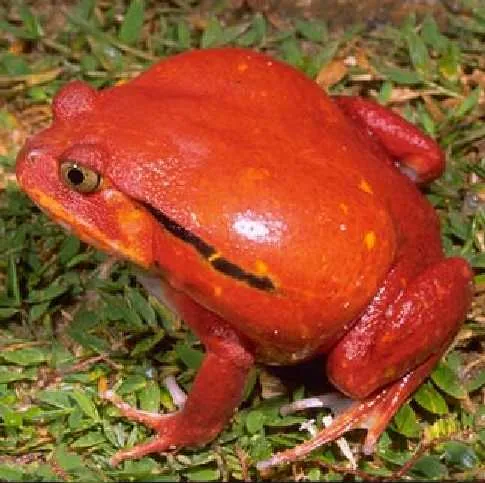
The tomato frog is a bright orange-red frog that lives only on the island of Madagascar. Its colour is a warning: its skin produces a sticky white substance that can cause an allergic reaction in people. It is also a species of conservation concern, because many have been taken for the pet trade.1
 Ho e tseba jwang
- Vibrant orange-red colour on the back1
- Females have brighter red or orange tones and a pale underside1
- Some individuals have black spots on the throat1
- Females are much larger than males1
Hangata e ferekanngwa le: The tomato frog is closely related to D. guineti, and the two are often confused. It is not yet clear how far the tomato frog's range extends, or whether it is a separate species or a variant of D. guineti.1
Matla a chefo
Letlalo la yona le a chefa. Ho kotsi ho e ama, ho e nyeka kapa ho e ja.
Chefo ya yona (e chefang ha o e ama kapa o e ja) e etsang?
The tomato frog is poisonous to touch rather than venomous, as it does not inject venom. A white substance secreted from its skin acts as a glue and can produce an allergic reaction in humans.1
E kotsi hakae ho batho?
Kotsi ho batho: E bobebeJwaloka ho hlajwa ke notshi kapa ho fetang moo. Ha e na kotsi ho batho.The skin secretion can cause an allergic reaction in people.1
E etsang ha e tshohile?
When threatened, it inflates its body to look larger, and its skin secretion acts as a sticky glue to deter predators.1
 Haeba motho a e amme kapa a e jele
- Haeba motho a amme e nngwe: hlatswa matsoho hantle mme o se ke wa ama mahlo kapa molomo. Haeba ngwana kapa phoofolo ya lapeng e e nyeditse kapa e e jele: letsetsa setsi sa chefo (poison centre) kapa nomoro ya tshohanyetso.
Kamehla letsetsa nomoro ya tshohanyetso pele (112, 000, 911). Ena ke tataiso e akaretsang ya thuso ya pele, hase keletso ya bongaka. Metheo ya thuso ya pele
 Dula o bolokehile
- O se ke wa ama, wa tshwara kapa wa tena phoofolo ya naheng, leha e le e nyenyane, le leha e shebahala e robetse kapa e shwele.
- E fe sebaka. Ha o kopana le yona, dula o kgutsitse, kgutlela morao butle mme o e tlohele e tsamaye ka tsela ya yona.
- Haeba o e amme kapa o e jele: o se ke wa hohla mahlo kapa molomo, hlatswa matsoho mme o fumane thuso ya bongaka.
Ha e o batle. Chefo ya yona e teng feela hore ho se be le letho le e jang. Ho eketsehileng ka ho dula o bolokehile
Hokae lefatsheng?
E kgolo hakae?
E telele hakae?
E boima hakae?

 e telele jwaloka diboloko tsa ho bapala tse 3 moleng
 e ka matha metara e 100 ka metsotswana e 78 (motho ya potlakang ka ho fetisisa o hloka 9,6)
Tomato frog e kgolo hakae ha e bapiswa le WENA?
Ke dipalo feela ka hara sebatli sa hao. Ha ho letho le bolokwang kapa le romelwang kae kapa kae.
E potlaka hakae?


Dintlha
Females are much larger than males, reaching up to 230 g, while males reach only about 41 g.1
Each female can lay between 1,000 and 1,500 eggs at once, on the surface of the water.1
Tadpoles are only about 6 mm long when they hatch and feed by filter-feeding.1
Tadpoles turn into yellow juveniles about 45 days after the eggs were laid.1
Bakeng sa ditsebi tsa chefo
- Lebitso la saense
- Dyscophus antongilii
- Sehlopha
- Dihoho tse chefang, mampotsana le di-newt
- Lelapa
- Microhylidae2
- Tatelano
- Anura
- Dikontinente
- Afrika
- Masea
- Females lay a clutch of 1,000 to 1,500 eggs on the water surface. The tadpoles hatch about 36 hours later.1
- Boemo ba yona naheng
- Near Threatened (IUCN Red List)1
- Kotsi ho batho
- 1 / 5: E bobebe3
Moo dintlha di tswang teng
- Dyscophus antongilii (Wikipedia (CC BY-SA 4.0))
- Dyscophus antongilii (iNaturalist): mabitso le tlhophiso.
- Venom Wiki: boemo ba kotsi, boholo bo tlwaelehileng le kakanyo ya lebelo ke tsa rona. Bona kamoo re di balang ka teng: Kamoo re lekanyang kotsi ka teng.
Taba e nngwe le e nngwe leqepheng lena e na le nomoro e bontshang mohlodi wa yona. Haeba re entse phoso, re kopa tshwarelo, re barati ba diphoofolo, hase makasine wa saense. Re bolelle ho [email protected] mme re tla e lokisa.
 Phepheng e lapile! Venom Wiki ke projeke ya motho a le mong: ke mahala, ha e na dipapatso ebile ha e na di-tracker. Thuso e nyenyane ya tjhelete e e boloka e ntse e le inthaneteng.Fepa phepheng
Tse ding tsa sehlopha se le seng: Dihoho tse chefang, mampotsana le di-newt
 Golden mantellaDihoho tse chefang, mampotsana le di-newtHa e na kotsi
 Iberian ribbed newtDihoho tse chefang, mampotsana le di-newtHa e na kotsi
 African common toadDihoho tse chefang, mampotsana le di-newtE utlwisa bohloko feelaO se ke wa ama
 Baron's mantellaDihoho tse chefang, mampotsana le di-newtHa e na kotsi
 Blue-legged mantellaDihoho tse chefang, mampotsana le di-newtHa e na kotsi
 Climbing mantellaDihoho tse chefang, mampotsana le di-newtHa e na kotsi
 Black mamba
 Deathstalker
 Egyptian cobra
 Puff adder
 Boomslang
 Fat-tailed scorpion