
 Afrika
 Asia
Asia Yuropa
 Amerika Borwa
 Australia le Oceania
 Antarctica
 Lewatle la Pacific
 Lewatle la Atlantic
 Lewatle la India
 Lewatle la Arctic
 Lewatle la Mediterranean
 Lewatle le Lefubedu
 Lewatle la Caribbean
 Lewatle la Coral
 Lewatle la China Borwa
 Lewatle la Philippine
 Lewatle la Andaman
 Lewatle la Leboya
 Lewatle la Timor le Arafura
 Kgwohlo ya Bengal
 Kgwohlo ya California
Walser viper
 Ho loma
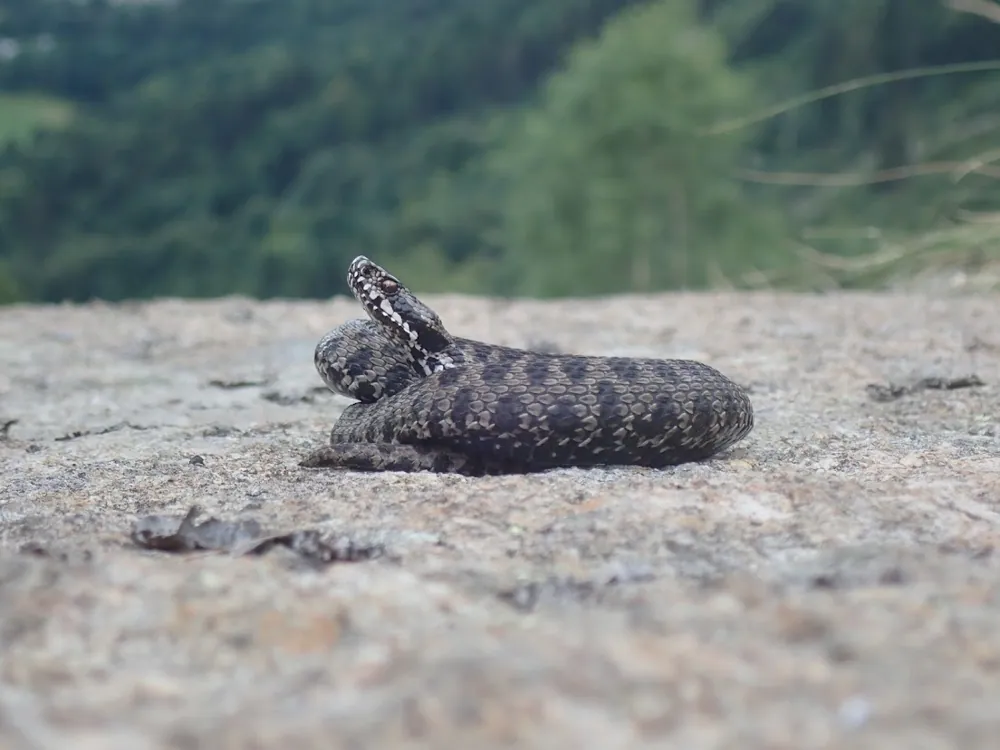
The Walser viper is a venomous snake found only in a small area of the western Italian Alps. Scientists only recognised it as its own species after genetic studies, because it looks very much like the common adder. Its tiny range makes it one of the more unusual vipers in Europe.1
 Ho e tseba jwang
- Colour varies a great deal between individuals.1
- Many have a zigzag pattern along the back, while others have a reduced pattern of horizontal bars.1
- Some individuals are melanistic, meaning they are very dark or black.1
- Most have 1.5 to 2 rows of scales below the eye on each side of the head.1
Hangata e ferekanngwa le: It closely resembles the common adder (Vipera berus), which is far more widespread. The Walser viper has more scales on the top of the head, these head shields are more often broken up, and it usually has 1.5 to 2 rows of scales below each eye, where the common adder usually has only one.1
Matla a chefo
Chefo e tswa ka meno a yona a chefo (fangs) kapa ka meno a mang ha e loma.
E kotsi hakae ho batho?
Kotsi ho batho: E tebilengHo longwa ho hloka ngaka. Lefu le etsahala ka seoelo haholo. Haeba e loma
- Boloka motho a sa sisinyehe ebile a kgutsitse, boloka setho se lomilweng se lekana le bophahamo ba pelo, tlosa mesale le dintho tse tiileng, mme o mo ise sepetlele kapele.
Kamehla letsetsa nomoro ya tshohanyetso pele (112, 000, 911). Ena ke tataiso e akaretsang ya thuso ya pele, hase keletso ya bongaka. Metheo ya thuso ya pele
 Dula o bolokehile
- O se ke wa ama, wa tshwara kapa wa tena phoofolo ya naheng, leha e le e nyenyane, le leha e shebahala e robetse kapa e shwele.
- E fe sebaka. Ha o kopana le yona, dula o kgutsitse, kgutlela morao butle mme o e tlohele e tsamaye ka tsela ya yona.
- Haeba e nngwe e o loma: dula o kgutsitse, o se ke wa sisinyeha, letsetsa nomoro ya tshohanyetso (112, 000, 911) kapa o ye sepetlele kapele. Hopola hore e ne e shebahala jwang, foto e a thusa.
Ha e o batle. E sebedisa chefo ya yona ho tshwara dijo kapa ho itshireletsa, mme e kgetha ho ipata. Ho eketsehileng ka ho dula o bolokehile
Hokae lefatsheng?
E kgolo hakae?
E telele hakae?
 e telele jwaloka dibanana tse 3 tse latellanang
 e telele jwaloka diboloko tsa ho bapala tse 17 moleng
 e ka matha metara e 100 ka metsotswana e 110 (motho ya potlakang ka ho fetisisa o hloka 9,6)
Walser viper e kgolo hakae ha e bapiswa le WENA?
Ke dipalo feela ka hara sebatli sa hao. Ha ho letho le bolokwang kapa le romelwang kae kapa kae.
E potlaka hakae?


Dintlha
For a long time it was thought to be an isolated group of the common adder, until genetic analysis showed it is a separate species related to the Vipera ursinii group.1
Its genetic variety is low, which may make it more vulnerable to disturbance.1
Its range is split into two separate populations: a southern one of about 225 km² and a northern one of about 45 km².1
It lives at high altitude, between 1300 and 2300 metres.1
Ho senya ditshomo
Tshomo: The Walser viper is just an isolated population of the common adder (Vipera berus).
Nnete: Molecular analyses have shown it is a distinct species, related to the Vipera ursinii group.1
Bakeng sa ditsebi tsa chefo
- Lebitso la saense
- Vipera walser
- Sehlopha
- Di-viper le di-adder
- Lelapa
- Viperidae2
- Tatelano
- Squamata
- Dikontinente
- Yuropa
- Boemo ba yona naheng
- Not yet evaluated by the IUCN. The original species description argues for a classification of Endangered, because its range is under 1000 km².1
- Kotsi ho batho
- 3 / 5: E tebileng3
Moo dintlha di tswang teng
- Vipera walser (Wikipedia (CC BY-SA 4.0))
- Vipera walser (iNaturalist): mabitso le tlhophiso.
- Venom Wiki: boemo ba kotsi, boholo bo tlwaelehileng le kakanyo ya lebelo ke tsa rona. Bona kamoo re di balang ka teng: Kamoo re lekanyang kotsi ka teng.
Taba e nngwe le e nngwe leqepheng lena e na le nomoro e bontshang mohlodi wa yona. Haeba re entse phoso, re kopa tshwarelo, re barati ba diphoofolo, hase makasine wa saense. Re bolelle ho [email protected] mme re tla e lokisa.
 Phepheng e lapile! Venom Wiki ke projeke ya motho a le mong: ke mahala, ha e na dipapatso ebile ha e na di-tracker. Thuso e nyenyane ya tjhelete e e boloka e ntse e le inthaneteng.Fepa phepheng
Tse ding tsa sehlopha se le seng: Di-viper le di-adder
 Common European adder
 Blunt-nosed viper
 Nose-horned viper
 Ottoman viper
 Asp viper
 Lataste's viper
E boetse e phela: Yuropa
 Spanish flyDiphoofolo tse ding tse chefangE hloka ngakaO se ke wa ama
 Common waspDinotshi, di-wasp le di-hornetE utlwisa bohloko feela
 European hornetDinotshi, di-wasp le di-hornetE utlwisa bohloko feela
 Fire salamanderDihoho tse chefang, mampotsana le di-newtE utlwisa bohloko feelaO se ke wa ama
 Western honey beeDinotshi, di-wasp le di-hornetE utlwisa bohloko feela
 Mediterranean black widowDikgoE hloka ngaka