
 Afrika
 Asia
Asia Ulaya
Ulaya Amerika Kusini
 Australia na Oceania
 Antaktika
 Bahari ya Pasifiki
 Bahari ya Atlantiki
 Bahari ya Hindi
 Bahari ya Aktiki
 Bahari ya Mediterania
 Bahari ya Shamu
 Bahari ya Karibi
 Bahari ya Matumbawe
 Bahari ya Kusini ya China
 Bahari ya Ufilipino
 Bahari ya Andaman
 Bahari ya Kaskazini
 Bahari ya Timor na Arafura
 Ghuba ya Bengal
 Ghuba ya California
Cane toad
 Sumu ndani ya ngoziHula: Kidogo cha kila kituSumu ya kugusa au kula, hadungi sumu
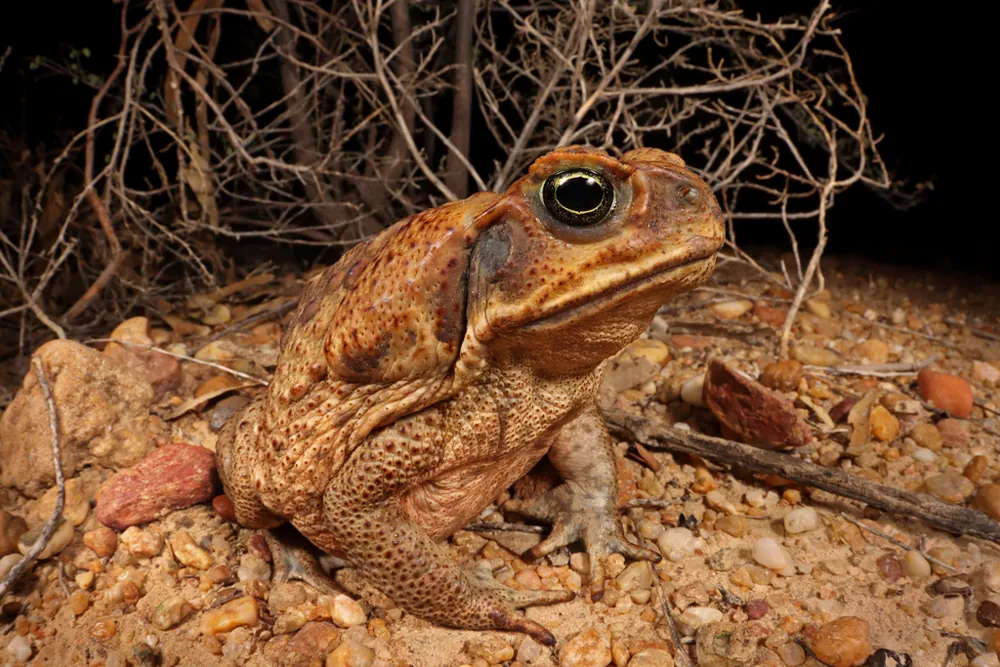
The cane toad is a large toad that is very poisonous to many animals. It is native to South and mainland Central America, but people have moved it to islands in Oceania and the Caribbean and to northern Australia. It matters because it spreads quickly and harms native wildlife and pets.1
 Jinsi ya kumtambua
- Very large, with adults usually 10 to 15 cm long1
- Dry, warty skin with distinct ridges above the eyes that run down the snout1
- A large parotoid gland (a swollen gland) behind each eye1
- Grey, yellowish, red-brown or olive-brown skin, often with patterns1
- Horizontal pupils and golden irises1
Mara nyingi huchanganywa na: In Australia, adults can be confused with large native frogs, but these lack the large parotoid glands and the ridge between the nostril and eye. The giant burrowing frog has vertical pupils and silver-grey irises, while the cane toad has horizontal pupils and golden irises. In the United States, the southern toad has two bulbs in front of the parotoid glands.1
Nguvu ya sumu
Ngozi yake ina sumu. Ni hatari kumgusa, kumramba au kumla.
Sumu yake hufanya nini?
The toad's glands secrete a milky-white fluid called bufotoxin when it is threatened. Components of bufotoxin are toxic to many animals. In dogs, signs of poisoning include excessive drooling, extremely red gums, head-shaking, crying and loss of coordination.1
Ana hatari gani kwa watu?
Hatari kwa watu: MbayaMtu akimgusa au kumla, aende kwa daktari. Vifo ni nadra sana.The toxic skin can kill many wild and domestic animals. Dogs are especially at risk from licking or biting the toad. Human deaths have also been recorded after people ate cane toads.1
Hufanya nini akiogopa?
When threatened, it releases bufotoxin from its glands.1
 Mtu akimgusa au kumla
- Mtu akimgusa: nawa mikono vizuri na usiguse macho wala mdomo. Mtoto au mnyama kipenzi akimramba au kumla: piga kituo cha taarifa za sumu au namba ya dharura.
Daima piga namba ya dharura kwanza (112, 000, 911). Huu ni mwongozo wa jumla wa huduma ya kwanza, si ushauri wa kitabibu. Misingi ya huduma ya kwanza
 Kaa salama
- Kamwe usimguse, kumkamata wala kumchokoza mnyama wa porini, hata akiwa mdogo, na hata akionekana amelala au amekufa.
- Mpe nafasi. Ukikutana naye, tulia, rudi nyuma polepole na umwache aende zake.
- Ukimgusa au kumla: usisugue macho wala mdomo, nawa mikono na utafute msaada wa kitabibu.
Hakuwindi wewe. Sumu yake ipo tu ili asiliwe na yeyote. Zaidi kuhusu kukaa salama
Ana ukubwa gani?
Ana urefu gani?
 urefu sawa na matofali 8 ya kuchezea yaliyopangwa mstari
 angeweza kukimbia mita 100 kwa sekunde 180 (binadamu mwenye kasi zaidi anahitaji 9.6)
Cane toad ana ukubwa gani ukilinganisha na WEWE?
Ni hesabu tu kwenye kivinjari chako. Hakuna kinachohifadhiwa wala kutumwa popote.
Ana kasi gani?


Ukweli
Young toads lose the toxicity they had as eggs and tadpoles, and they only develop their poison glands later. Only an estimated 0.5% of cane toads reach adulthood.1
In Australia, tadpoles have evolved to be more likely to eat their siblings than tadpoles in South America.1
A female can lay thousands of eggs in one spawn, in strings up to 20 metres long.1
In the wild, cane toads can live 10 to 15 years, and one captive toad was reported to have lived 35 years.1
The cane toad is considered the largest species in the Bufonidae, the toad family.1
Cane toads eat both living and dead matter, which is unusual among frogs and toads.1
Kuvunja dhana potofu
Dhana potofu: The name 'marine toad' suggests that cane toads live in the sea.
Ukweli: Cane toads do not live in the sea. The name came from a mistaken belief by an early naturalist.1
Kwa wataalamu wa sumu
- Jina la kisayansi
- Rhinella marina
- Kundi
- Vyura wa sumu, chura na mijusi-maji
- Familia
- Bufonidae2
- Mpangilio
- Anura
- Mabara
- Amerika Kaskazini, Amerika Kusini
- Watoto
- A female lays 8,000 to 25,000 eggs at once, in long jelly strings that can stretch up to 20 metres.1
- Muda wa maisha
- takriban miaka 151
- Hatari kwa watu
- 3 / 5: Mbaya3
Ukweli unatoka wapi
- Cane toad (Wikipedia (CC BY-SA 4.0))
- Rhinella marina (iNaturalist): majina na uainishaji.
- Venom Wiki: kiwango cha hatari, ukubwa wa kawaida na makadirio ya kasi ni yetu wenyewe. Ona jinsi tunavyovipata: Jinsi tunavyopima hatari.
Kila ukweli kwenye ukurasa huu una namba inayoonyesha chanzo chake. Kama tumekosea kitu, samahani, sisi ni wapenzi wa wanyama, si jarida la kisayansi. Tuambie kupitia [email protected] nasi tutarekebisha.
 Nge ana njaa! Venom Wiki ni mradi wa mtu mmoja: bure, bila matangazo na bila vifuatiliaji. Mchango mdogo husaidia kuiweka hewani.Mlishe nge
Zaidi kutoka kundi hilohilo: Vyura wa sumu, chura na mijusi-maji
 Golden poison frogVyura wa sumu, chura na mijusi-majiAnauaUsiguse
 Dyeing poison dart frogVyura wa sumu, chura na mijusi-majiInauma tuUsiguse
 Strawberry poison-dart frogVyura wa sumu, chura na mijusi-majiInauma tuUsiguse
 Black-legged poison frogVyura wa sumu, chura na mijusi-majiAnaweza kuuaUsiguse
 California newtVyura wa sumu, chura na mijusi-majiAnaweza kuuaUsiguse
 Rough-skinned newtVyura wa sumu, chura na mijusi-majiAnaweza kuuaUsiguse
 Terciopelo
 Eastern coral snake
 Eastern diamondback rattlesnake
 Eyelash viper
 Timber rattlesnake
 Western diamondback rattlesnake