
 Aprika
 Asya
Asya Europa
 Timog Amerika
 Australia at Oceania
 Antarctica
 Karagatang Pasipiko
 Karagatang Atlantiko
 Karagatang Indiyano
 Karagatang Artiko
 Dagat Mediteraneo
 Dagat Pula
 Dagat Caribe
 Dagat Coral
 Dagat Timog Tsina
 Dagat Pilipinas
 Dagat Andaman
 Dagat Hilaga
 Dagat Timor at Arafura
 Look ng Bengal
 Golpo ng California
Brown-tail moth
 Nanunusok na balahibo
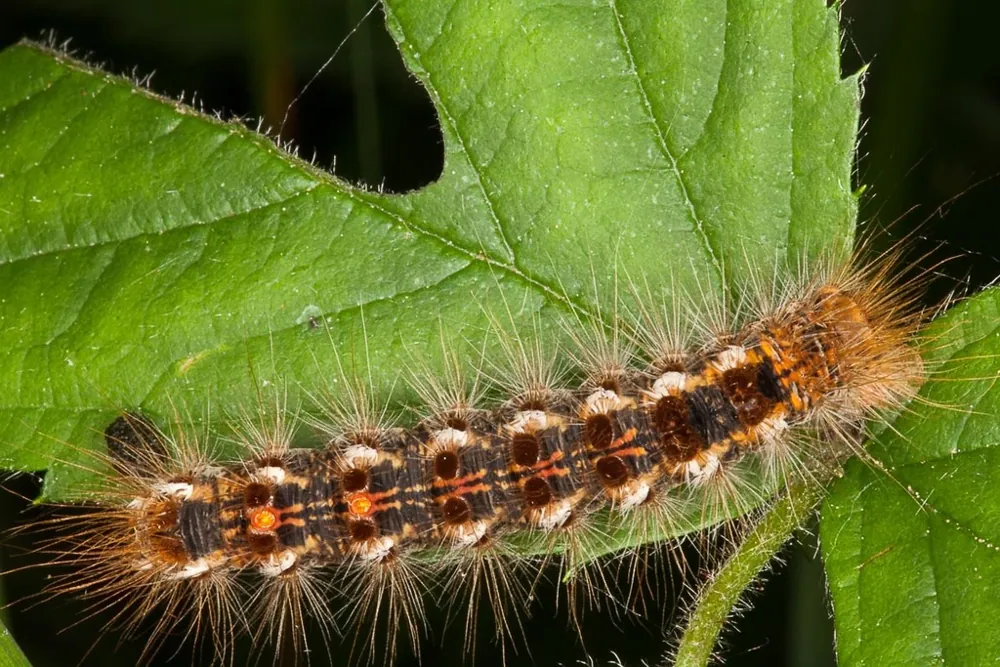
The brown-tail moth is a moth whose caterpillars are covered in tiny irritating hairs. It is native to Europe, neighbouring parts of Asia and the north coast of Africa. Its hairs can cause a very itchy rash, so it matters to anyone who works or plays near trees it feeds on.1

 Paano ito makikilala
- Adults have pure white upper wings and a hairy white body with a tuft of brown hair at the tip of the tail end.1
- Adults have a wingspan of 36 to 42 millimetres.1
- Caterpillars are very hairy, brown with white markings, and have two prominent red spots toward the tail end.1
- In late autumn and winter, silken tents hang on branch tips, which are a sign that the caterpillars are present.1
Madalas mapagkamalang: Euproctis similis, also native to Europe, is similar as an adult but the female has a yellow tail tuft. Hyphantria cunea, native to North America, is similar too, but it lacks the coloured tail tuft.1
Lakas ng kamandag
Maliliit na balahibo o buhok ang nababali sa balat at nanunusok.
Ano ang epekto ng kamandag nito?
The hairs are not venom injected by a bite or sting. They are toxic and irritating to skin. Barbed hairs lodge in the skin and cause physical irritation, and chemicals in the hairs also irritate it. If inhaled, the hairs can cause breathing difficulties similar to asthma. The toxins stay active for up to three years after the hairs are shed.1
Gaano ito kapanganib sa tao?
Panganib sa tao: MasakitTalagang masakit, pero halos hindi kailanman malala.Contact with the hairs causes a very itchy rash that can last for weeks. Doctors reported rashes worse than poison ivy rash in the early 1900s. Breathing difficulties can occur if the hairs are inhaled.1
Ano ang ginagawa nito kapag natatakot?
Its hairs protect the caterpillars from predators, and the caterpillars use some hairs in their cocoons.1
 Kung mahawakan mo ang mga balahibo nito
- Para sa nanunusok na balahibo ng higad: alisin ang mga ito gamit ang sticky tape, pagkatapos ay hugasan ang balat. Huwag kuskusin.
- Para sa kagat: hugasan at palamigin. Kumuha ng tulong medikal kung masama ang pakiramdam ng tao o madali siyang dumugo.
Laging tawagan muna ang numero pang-emergency (112, 000, 911). Ito ay pangkalahatang gabay sa pangunang lunas, hindi payong medikal. Mga batayan ng pangunang lunas
 Mag-ingat
- Huwag kailanman hawakan, hulihin o asarin ang ligaw na hayop, kahit maliit, at kahit mukha itong tulog o patay.
- Bigyan ito ng espasyo. Kung makasalubong ka ng isa, manatiling kalmado, dahan-dahang umatras at hayaan itong umalis.
- Kung mahawakan mo ang mga balahibo nito: manatiling kalmado, huwag gumalaw, tawagan ang numero pang-emergency (112, 000, 911) o pumunta agad sa ospital. Tandaan ang itsura nito, makakatulong ang litrato.
Hindi ka nito hinahabol. Ginagamit nito ang kamandag para manghuli ng pagkain o ipagtanggol ang sarili, at mas gusto pa nitong magtago. Higit pa tungkol sa pag-iingat
Gaano ito kalaki?
Gaano ito kahaba?
 mas maikli kaysa sa hinliliit mo
 mas mabagal kaysa sa suso sa hardin
Gaano kalaki si Brown-tail moth kumpara sa IYO?
Math lang sa browser mo. Walang sine-save o ipinapadala kahit saan.
Gaano ito kabilis?

Mga fact
The hairs of the caterpillars can cause a rash even when no one touches a caterpillar, because shed hairs can blow in the wind.1
Brown-tail moths were described in outbreaks in Paris, London and Berlin as far back as the 1500s, when they stripped trees of leaves.1
The species spends about nine months of its year as caterpillars, which is unusually long for a moth.1
Caterpillars spend the winter together in silken tents built at branch tips, rather than spreading out.1
A parasitic fly introduced to North America in 1906 to control spongy moths also strongly affected brown-tail moths.1
Myth buster
Mito: You can only get the rash by touching the caterpillars.
Totoo: Hairs are shed and can become windblown, and they can be carried indoors on clothing and shoes, so a rash can occur without direct contact with the caterpillars.1
Saan galing ang mga fact
- Brown-tail moth (Wikipedia (CC BY-SA 4.0))
- Euproctis chrysorrhoea (iNaturalist): mga pangalan at klasipikasyon.
- Venom Wiki: sarili naming tantiya ang antas ng panganib, karaniwang laki at hula sa bilis. Tingnan kung paano namin ito kinukuwenta: Paano namin sinusukat ang panganib.
Bawat fact sa pahinang ito ay may numerong tumuturo sa pinagmulan nito. Kung may mali kami, pasensya na, mahilig lang kami sa hayop, hindi kami science journal. Sabihin sa amin sa [email protected] at aayusin namin.
 Gutom ang alakdan! Ang Venom Wiki ay proyekto ng iisang tao: libre, walang ads at walang trackers. Nakatutulong ang maliit na tip para manatili itong online.Pakainin ang alakdan
Higit pa mula sa parehong grupo: Mga higad at insekto
 Oak processionaryMga higad at insektoMasakit langHuwag hawakan
 Pine processionaryMga higad at insektoMasakit langHuwag hawakan
 Common bombardier beetleMga higad at insektoHindi nakapipinsala
 Asian giant water bugMga higad at insektoMasakit lang
 Blue-striped nettle grubMga higad at insektoMasakit langHuwag hawakan
 Masked hunterMga higad at insektoMasakit lang
Nakatira rin sa: Europa
 Common European adderMga viper at adderKailangan ng doktor
 Spanish flyIba pang nakalalasong hayopKailangan ng doktorHuwag hawakan
 Common waspMga bubuyog, putakti at hornetMasakit lang
 European hornetMga bubuyog, putakti at hornetMasakit lang
 Fire salamanderMga poison frog, palaka at newtMasakit langHuwag hawakan
 Western honey beeMga bubuyog, putakti at hornetMasakit lang