
 Aforika
 Asia
Asia Yuropa
 Amerika Borwa
 Australia le Oceania
 Antarctica
 Lewatle la Pacific
 Lewatle la Atlantic
 Lewatle la India
 Lewatle la Arctic
 Lewatle la Mediterranean
 Lewatle le Lehibidu
 Lewatle la Caribbean
 Lewatle la Coral
 Lewatle la China Borwa
 Lewatle la Philippines
 Lewatle la Andaman
 Lewatle la Bokone
 Lewatle la Timor le la Arafura
 Kou ya Bengal
 Gulf ya California
Australian hornet
 Go tlhaba
The Australian hornet is a large orange wasp, about 3 cm long, that lives across much of Australia. It lives alone rather than in a colony, and it builds small mud nests against buildings and other structures. It is a venomous sting insect, so it is worth knowing what it looks like.1


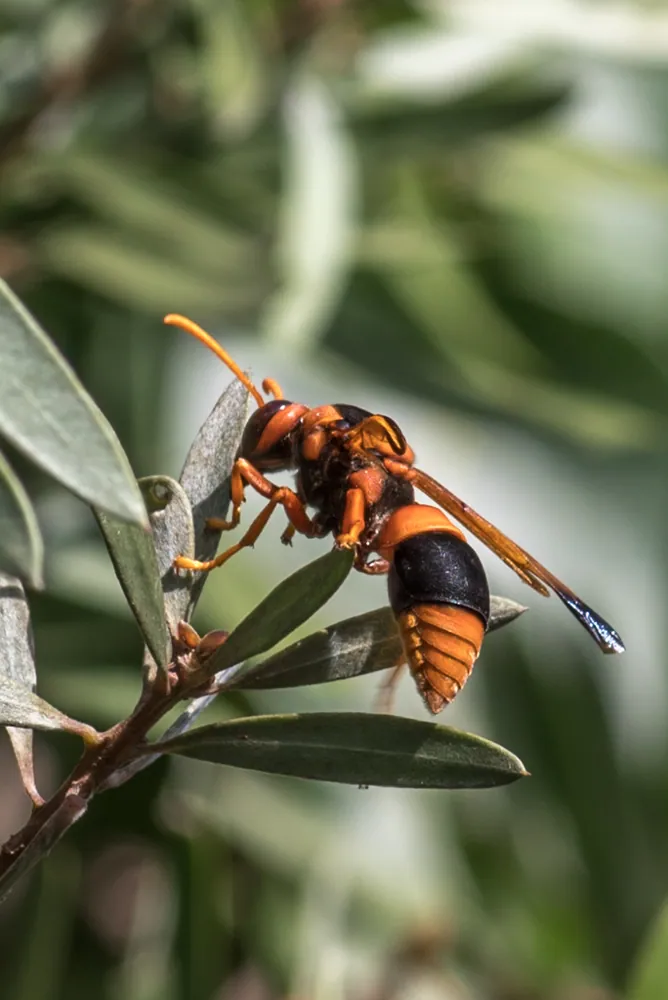
 Tsela ya go e lemoga
Maatla a botlhole
Botlhole bo tswa ka lemao le le tlhabang.
E kotsi go le kae go batho?
Kotsi go batho: E botlhokoE ka utlwisa botlhoko tota, mme go seoka thata gore e nne masisi. Fa e tlhaba
- Ntsha lemao la notshe ka go le kgwaratla, mme o tsidifatse lefelo leo.
- Fa motho a hema ka bothata, sefatlhego kgotsa mometso o ruruga, kgotsa a ikutlwa a tla idibala, ke tshoganyetso ya aletshi: leletsa nomoro ya gago ya tshoganyetso mme o dirise pene ya gagwe ya adrenaline fa a na le yone.
Ka gale leletsa nomoro ya gago ya tshoganyetso pele (112, 000, 911). Se ke kaelo e e akaretsang ya thuso ya ntlha, ga se kgakololo ya bongaka. Motheo wa thuso ya ntlha
 Nna o babalesegile
- O se ka wa ama, wa tshwara kgotsa wa tshwenya phologolo ya naga, le fa e le e nnye, le fa e lebega e robetse kgotsa e sule.
- E fe sebaka. Fa o kopana le yone, ritibala, boela morago ka bonya mme o e tlogele e tsamaye ka tsela ya yone.
- Fa e nngwe e go tlhaba: ritibala, o se ka wa tshikinyega, leletsa nomoro ya gago ya tshoganyetso (112, 000, 911) kgotsa o ye bookelong ka bonako. Gopola gore e ne e lebega jang, setshwantsho se a thusa.
Ga e go batle. E dirisa botlhole jwa yone go tshwara dijo kgotsa go itshireletsa, mme e rata go iphitlha go feta. Go le gontsi ka go nna o babalesegile
Kae mo lefatsheng?
E kgolo go le kae?
E telele go le kae?
 e ka nna boleele jo bo lekanang le jwa kelipi ya pampiri
 e ka fofa go kgabaganya lebala lotlhe la kgwele ya dinao ka metsotswana e le 11
Australian hornet e kgolo go le kae fa e bapisiwa le WENA?
Ke dipalo fela mo sefetleng sa gago (browser). Ga go sepe se se bolokwang kgotsa se se romelwang gope.
E bonako go le kae?


Dintlha
The female builds her nest from mud in sheltered places, then seals captured prey inside the cells.1
Each female is a solitary insect, so she builds and looks after her own nest alone.1
Females hunt spiders and caterpillars around trees and shrubs to provide food for their young.1
The nest grows throughout the summer, and new queens and males are produced towards the end of the season.1
Mosenyi wa ditlhamane
Tlhamane: It is a hornet.
Nnete: Despite its common name, it is not a true hornet. It is a potter or mason wasp.1
Ya baitseanape ba botlhole
Kwa dintlha di tswang teng
- Australian hornet (Wikipedia (CC BY-SA 4.0))
- Abispa ephippium (iNaturalist): maina le thulaganyo ya mefuta.
- Venom Wiki: seelo sa kotsi, bogolo jo bo tlwaelegileng le kakanyo ya lebelo ke tsa rona. Bona kafa re di balang ka teng: Kafa re lekanyang kotsi ka teng.
Ntlha nngwe le nngwe mo tsebeng e e na le nomoro e e supang motswedi wa yone. Fa re dirile phoso, maitshwarelo, re barati ba diphologolo, e seng kgatiso ya saense. Re bolelele kwa [email protected] mme re tla e baakanya.
 Phepheng e tshwerwe ke tlala! Venom Wiki ke porojeke ya motho a le mongwe: ke mahala, ga e na dipapatso le ditraka. Mpho e nnye e thusa go e tshegetsa mo inthaneteng.Fepa phepheng
Tse dingwe tsa setlhopha se se tshwanang: Dinotshe, diwasepe le dihonete
 Blue antDinotshe, diwasepe le dihoneteE utlwisa botlhoko fela
 Orange spider waspDinotshe, diwasepe le dihoneteE utlwisa botlhoko fela
 Asian giant hornetDinotshe, diwasepe le dihoneteE ka bolaya
 Common waspDinotshe, diwasepe le dihoneteE utlwisa botlhoko fela
 European hornetDinotshe, diwasepe le dihoneteE utlwisa botlhoko fela
 Tarantula hawkDinotshe, diwasepe le dihoneteE utlwisa botlhoko fela
E tshela gape kwa: Australia le Oceania
 Coastal taipanDinoga tsa AustraliaE a bolaya
 Common death adderDinoga tsa AustraliaE a bolaya
 Eastern brown snakeDinoga tsa AustraliaE a bolaya
 Taipan ya kwa teng ga nagaDinoga tsa AustraliaE a bolaya
 Sydney funnel-web spiderDitarantula le di-funnel-webE a bolaya
 Noga ya tigerDinoga tsa AustraliaE a bolaya