
 Aforika
 Asia
Asia Yuropa
 Amerika Borwa
 Australia le Oceania
 Antarctica
 Lewatle la Pacific
 Lewatle la Atlantic
 Lewatle la India
 Lewatle la Arctic
 Lewatle la Mediterranean
 Lewatle le Lehibidu
 Lewatle la Caribbean
 Lewatle la Coral
 Lewatle la China Borwa
 Lewatle la Philippines
 Lewatle la Andaman
 Lewatle la Bokone
 Lewatle la Timor le la Arafura
 Kou ya Bengal
 Gulf ya California
Australian spotted jellyfish
 Mesela e e tlhabangE ja: Dijo tse dinnye tsa lewatle
The Australian spotted jellyfish is a jellyfish with a bell up to 50 cm wide. It is native to the western Pacific, from Australia to Japan, but has spread to many other seas. Its sting is mild and it is not considered a threat to people, but large groups can cause problems for fishing and local sea life.1

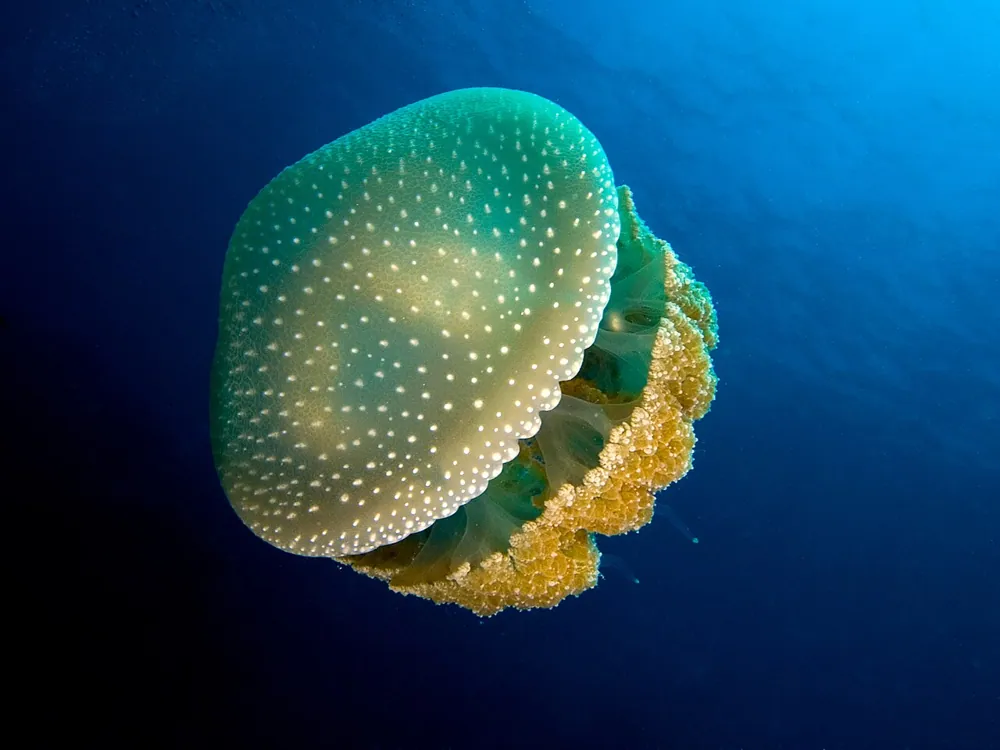
 Tsela ya go e lemoga
Maatla a botlhole
Dikete tsa disele tse dinnye tse di tlhabang di a thuntsha fa sengwe se di ama.
Botlhole jo e bo tsenyang bo dira eng?
It has only a mild venom. The venom is not strong enough to kill its prey, which is why it catches food by filtering rather than by stunning it.1
E kotsi go le kae go batho?
Kotsi go batho: Kotsi e nnyeJaaka go tlhabiwa ke notshe kgotsa go le kwa tlase. Ga e na kotsi go batho.It is not considered a threat to humans, and its sting is mild or hard to notice. It does cause harm to fishing industries, where it eats fish, crab and shrimp eggs and larvae and clogs nets.1
 Fa e tlhaba
- The sting can be treated with a dilute acid, usually white or cider vinegar.1
- Tswa mo metsing mme o tlose mesela (tentacles) epe fela e e setseng (ka ditlelafo kgotsa ka lesela).
- Ya dijelifishi tsa lebokoso tsa tropiki: tshela asene mo mafelong a a tlhabilweng bonnye metsotswana e le 30, bitsa thuso mme o ipaakanyetse go dira CPR. Ya dibluebottle le tse dingwe tse dintsi: tlhatswa ka metsi a lewatle, morago ka metsi a a mogote go fokotsa botlhoko.
Ka gale leletsa nomoro ya gago ya tshoganyetso pele (112, 000, 911). Se ke kaelo e e akaretsang ya thuso ya ntlha, ga se kgakololo ya bongaka. Motheo wa thuso ya ntlha
 Nna o babalesegile
- O se ka wa ama, wa tshwara kgotsa wa tshwenya phologolo ya naga, le fa e le e nnye, le fa e lebega e robetse kgotsa e sule.
- E fe sebaka. Fa o kopana le yone, ritibala, boela morago ka bonya mme o e tlogele e tsamaye ka tsela ya yone.
- Fa e nngwe e go tlhaba: ritibala, o se ka wa tshikinyega, leletsa nomoro ya gago ya tshoganyetso (112, 000, 911) kgotsa o ye bookelong ka bonako. Gopola gore e ne e lebega jang, setshwantsho se a thusa.
Ga e go batle. E dirisa botlhole jwa yone go tshwara dijo kgotsa go itshireletsa, mme e rata go iphitlha go feta. Go le gontsi ka go nna o babalesegile
Kae mo lefatsheng?
E kgolo go le kae?
E telele go le kae?
 boleele jo bo lekanang le dipanana di le 3 di latelana
 boleele jo bo lekanang le diboloko tsa go aga tsa ditshamekisi di le 16 mo moleng
 e ka thuma boleele jwa bodiba jo bogolo jwa go thuma (50 m) ka metsotswana e le 150
Australian spotted jellyfish e kgolo go le kae fa e bapisiwa le WENA?
Ke dipalo fela mo sefetleng sa gago (browser). Ga go sepe se se bolokwang kgotsa se se romelwang gope.
E bonako go le kae?

_edit.jpg)
Dintlha
Each jellyfish can filter as much as 50,000 litres of seawater per day.1
One individual found on Sunset Beach, North Carolina, in October 2007 measured 74 cm wide, perhaps the largest ever recorded.1
Large swarms can clog fishing nets, damage boat intakes and sometimes force fishing areas to close.1
Its polyps can multiply by dividing into other polyps, which makes a larger group than the one the mother started with.1
Its polyp stage can last up to five years, and its adult stage up to two years.1
In the Gulf of Mexico, medusae grow unusually large, reaching more than 60 cm across.1
Mosenyi wa ditlhamane
Tlhamane: It is a dangerous jellyfish that is a serious threat to people.
Nnete: It has only a mild venom and is not considered a threat to humans. Its main harm is to fishing and the local ecosystem, where it eats large amounts of zooplankton.1
Ya baitseanape ba botlhole
- Leina la saense
- Phyllorhiza punctata
- Setlhopha
- Dijelifishi le dibopiwa tsa lewatle tse di tlhabang
- Lelapa
- Mastigiidae2
- Lekoko
- Rhizostomeae
- Dikontinente
- Lewatle la Pacific, Lewatle la India, Lewatle la Coral, Lewatle la Atlantic, Lewatle la Caribbean, Gulf ya Mexico, Lewatle la Timor le la Arafura, Mawatle
- Masea
- Males release sperm into the water, and the female gathers it into her mouth, where she holds the fertilised eggs. The larvae settle on the seabed and grow into polyps, which reproduce by cloning themselves.1
- Kotsi go batho
- 1 / 5: Kotsi e nnye3
Kwa dintlha di tswang teng
- Phyllorhiza punctata (Wikipedia (CC BY-SA 4.0))
- Phyllorhiza punctata (iNaturalist): maina le thulaganyo ya mefuta.
- Venom Wiki: seelo sa kotsi, bogolo jo bo tlwaelegileng le kakanyo ya lebelo ke tsa rona. Bona kafa re di balang ka teng: Kafa re lekanyang kotsi ka teng.
Ntlha nngwe le nngwe mo tsebeng e e na le nomoro e e supang motswedi wa yone. Fa re dirile phoso, maitshwarelo, re barati ba diphologolo, e seng kgatiso ya saense. Re bolelele kwa [email protected] mme re tla e baakanya.
 Phepheng e tshwerwe ke tlala! Venom Wiki ke porojeke ya motho a le mongwe: ke mahala, ga e na dipapatso le ditraka. Mpho e nnye e thusa go e tshegetsa mo inthaneteng.Fepa phepheng
Tse dingwe tsa setlhopha se se tshwanang: Dijelifishi le dibopiwa tsa lewatle tse di tlhabang
 Australian box jellyfishDijelifishi le dibopiwa tsa lewatle tse di tlhabangE a bolayaO se ka wa ama
 Irukandji jellyfishDijelifishi le dibopiwa tsa lewatle tse di tlhabangE ka bolayaO se ka wa ama
 Portuguese man o' warDijelifishi le dibopiwa tsa lewatle tse di tlhabangE tlhoka ngakaO se ka wa ama
 Lion's mane jellyfishDijelifishi le dibopiwa tsa lewatle tse di tlhabangE utlwisa botlhoko felaO se ka wa ama
 Moon jellyfishDijelifishi le dibopiwa tsa lewatle tse di tlhabangGa e na kotsi
 Common kingslayerDijelifishi le dibopiwa tsa lewatle tse di tlhabangE ka bolayaO se ka wa ama
E tshela gape kwa: Lewatle la Pacific
 Geography coneDikgopa tsa khouno le diokotopaseE a bolaya
 Greater blue-ringed octopusDikgopa tsa khouno le diokotopaseE a bolaya
 Japanese pufferfishDiphologolo tse dingwe tse di botlhole go di ama kgotsa go di jaE a bolaya
 Southern blue-ringed octopusDikgopa tsa khouno le diokotopaseE a bolaya
 Hawksbill sea turtleDiphologolo tse dingwe tse di botlhole go di ama kgotsa go di jaE ka bolaya
 Reef stonefishDitlhapi tse di tsenyang botlholeE ka bolayaO se ka wa ama