
 Aforika
 Asia
Asia Yuropa
 Amerika Borwa
 Australia le Oceania
 Antarctica
 Lewatle la Pacific
 Lewatle la Atlantic
 Lewatle la India
 Lewatle la Arctic
 Lewatle la Mediterranean
 Lewatle le Lehibidu
 Lewatle la Caribbean
 Lewatle la Coral
 Lewatle la China Borwa
 Lewatle la Philippines
 Lewatle la Andaman
 Lewatle la Bokone
 Lewatle la Timor le la Arafura
 Kou ya Bengal
 Gulf ya California
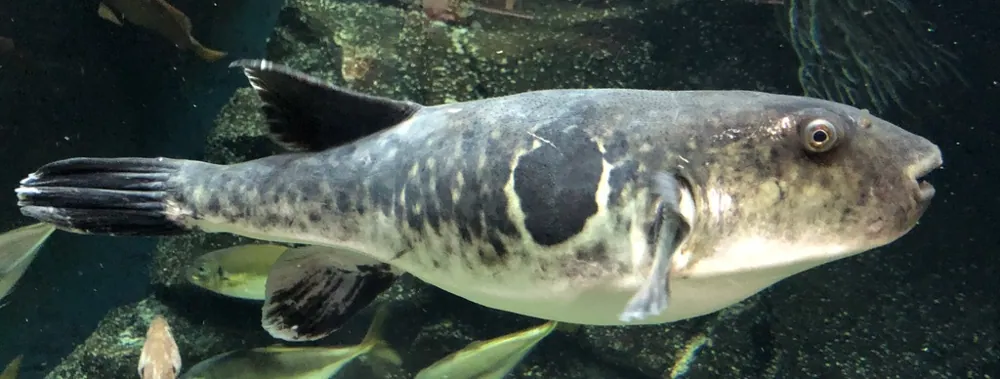
Japanese pufferfish
 E botlhole go e jaE botlhole go e ama kgotsa go e ja, ga e tsenye botlhole
The Japanese pufferfish, also called the tiger puffer or torafugu, is a fish that lives in cold, shallow seas off East Asia. It is famous as a food in Japan, but its liver and ovaries contain a strong toxin, so it must be prepared with great care. It is also a key animal in genetics research.1
Maatla a botlhole
E kotsi fela fa sengwe se e ja.
Botlhole jwa yone (jwa go e ama kgotsa go e ja) bo dira eng?
This pufferfish is poisonous rather than venomous. Some of its organs contain tetrodotoxin, a highly toxic substance, which is concentrated in the liver and ovaries, slightly present in the intestines and flesh, and absent from the skin and testes.1
E kotsi go le kae go batho?
Kotsi go batho: E a bolayaNngwe ya diphologolo tse di kotsi go gaisa mo lefatsheng.Its organs are highly toxic, so the liver and ovaries are the dangerous parts to eat. Only the flesh and skin are the parts that are safe to eat in regulated preparation.1
 Fa mongwe a e amile kgotsa a e jele
- Fa mongwe a e jele kgotsa a na le matshwao morago ga go e ja: leletsa nomoro ya gago ya tshoganyetso kgotsa senthara ya botlhole ka yone nako eo.
Ka gale leletsa nomoro ya gago ya tshoganyetso pele (112, 000, 911). Se ke kaelo e e akaretsang ya thuso ya ntlha, ga se kgakololo ya bongaka. Motheo wa thuso ya ntlha
 Nna o babalesegile
- O se ka wa ama, wa tshwara kgotsa wa tshwenya phologolo ya naga, le fa e le e nnye, le fa e lebega e robetse kgotsa e sule.
- E fe sebaka. Fa o kopana le yone, ritibala, boela morago ka bonya mme o e tlogele e tsamaye ka tsela ya yone.
- Fa o e amile kgotsa o e jele: o se ka wa gotlha matlho kgotsa molomo wa gago, tlhatswa diatla mme o batle thuso ya bongaka.
Ga e go batle. Botlhole jwa yone bo teng fela gore sepe se se ka se e je. Go le gontsi ka go nna o babalesegile
Kae mo lefatsheng?
E kgolo go le kae?
E telele go le kae?
 boleele jo bo lekanang le dipanana di le 2 di latelana
 boleele jo bo lekanang le diboloko tsa go aga tsa ditshamekisi di le 12 mo moleng
 e ka thuma boleele jwa bodiba jo bogolo jwa go thuma (50 m) ka metsotswana e le 45
Japanese pufferfish e kgolo go le kae fa e bapisiwa le WENA?
Ke dipalo fela mo sefetleng sa gago (browser). Ga go sepe se se bolokwang kgotsa se se romelwang gope.
E bonako go le kae?
Dintlha
A genetically modified type called 22-seiki fugu, meaning 22nd-century fugu, has had four leptin receptor genes removed, which increases appetite. It grows on average 1.9 times faster than normal torafugu and is sold as food.1
Its genome is one of the smallest known among vertebrates, and it was the first vertebrate genome after the human genome to be made publicly available.1
Its genome has about 6% of the base pairs of the human genome, yet it has 22 chromosomes, close to the 23 in humans.1
It is one of the most valuable commercial fishes in Japan.1
It is used as a reference genome to help identify genes in human and other vertebrate genomes.1
Ya baitseanape ba botlhole
- Leina la saense
- Takifugu rubripes
- Setlhopha
- Diphologolo tse dingwe tse di botlhole go di ama kgotsa go di ja
- Lelapa
- Tetraodontidae2
- Lekoko
- Tetraodontiformes
- Dikontinente
- Lewatle la Pacific, Mawatle
- Masea
- Spawning takes place in estuaries. Young fish stay in river mouths and lagoons for about one year before migrating permanently to the open ocean.1
- Seemo sa yone kwa nageng
- Near Threatened1
- Kotsi go batho
- 5 / 5: E a bolaya3
Kwa dintlha di tswang teng
- Takifugu rubripes (Wikipedia (CC BY-SA 4.0))
- Takifugu rubripes (iNaturalist): maina le thulaganyo ya mefuta.
- Venom Wiki: seelo sa kotsi, bogolo jo bo tlwaelegileng le kakanyo ya lebelo ke tsa rona. Bona kafa re di balang ka teng: Kafa re lekanyang kotsi ka teng.
Ntlha nngwe le nngwe mo tsebeng e e na le nomoro e e supang motswedi wa yone. Fa re dirile phoso, maitshwarelo, re barati ba diphologolo, e seng kgatiso ya saense. Re bolelele kwa [email protected] mme re tla e baakanya.
 Phepheng e tshwerwe ke tlala! Venom Wiki ke porojeke ya motho a le mongwe: ke mahala, ga e na dipapatso le ditraka. Mpho e nnye e thusa go e tshegetsa mo inthaneteng.Fepa phepheng
Tse dingwe tsa setlhopha se se tshwanang: Diphologolo tse dingwe tse di botlhole go di ama kgotsa go di ja
 Hawksbill sea turtleDiphologolo tse dingwe tse di botlhole go di ama kgotsa go di jaE ka bolaya
 Greenland sharkDiphologolo tse dingwe tse di botlhole go di ama kgotsa go di jaE utlwisa botlhoko fela
 Silver-cheeked toadfishDiphologolo tse dingwe tse di botlhole go di ama kgotsa go di jaE a bolaya
 Blackspotted pufferDiphologolo tse dingwe tse di botlhole go di ama kgotsa go di jaE ka bolaya
 White-spotted pufferDiphologolo tse dingwe tse di botlhole go di ama kgotsa go di jaE ka bolaya
 Long-spine porcupinefishDiphologolo tse dingwe tse di botlhole go di ama kgotsa go di jaE tlhoka ngaka
E tshela gape kwa: Lewatle la Pacific
 Australian box jellyfishDijelifishi le dibopiwa tsa lewatle tse di tlhabangE a bolayaO se ka wa ama
 Geography coneDikgopa tsa khouno le diokotopaseE a bolaya
 Greater blue-ringed octopusDikgopa tsa khouno le diokotopaseE a bolaya
 Southern blue-ringed octopusDikgopa tsa khouno le diokotopaseE a bolaya
 Irukandji jellyfishDijelifishi le dibopiwa tsa lewatle tse di tlhabangE ka bolayaO se ka wa ama
 Reef stonefishDitlhapi tse di tsenyang botlholeE ka bolayaO se ka wa ama