
 Aforika
 Asia
Asia Yuropa
 Amerika Borwa
 Australia le Oceania
 Antarctica
 Lewatle la Pacific
 Lewatle la Atlantic
 Lewatle la India
 Lewatle la Arctic
 Lewatle la Mediterranean
 Lewatle le Lehibidu
 Lewatle la Caribbean
 Lewatle la Coral
 Lewatle la China Borwa
 Lewatle la Philippines
 Lewatle la Andaman
 Lewatle la Bokone
 Lewatle la Timor le la Arafura
 Kou ya Bengal
 Gulf ya California
Black house spider
 Go loma
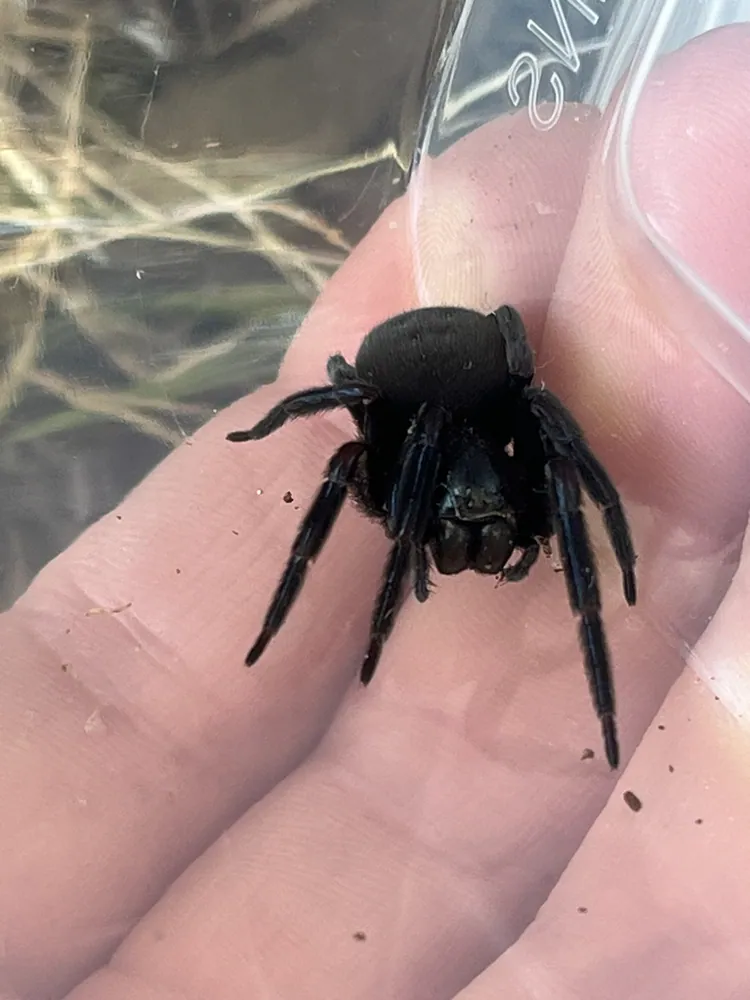
The black house spider is a dark, sturdy spider that lives across Australia. It was carried to New Zealand and Japan, and it often lives in homes, where it sits in a messy web in corners and near windows. It is venomous, but its bite is rarely a serious danger to people.1

 Tsela ya go e lemoga
- A dark, robust spider. Females have a body up to 18 mm long and a leg span of 30 mm.1
- Males are smaller, about 10 mm long, with longer legs in proportion to their body.1
- The body and legs are dark brown to black. The abdomen (rear part) is charcoal grey, with light markings that are sometimes faint, and it is covered in fine, velvety hair.1
- The web looks messy, with irregular sail-like sheets of silk and a funnel-shaped retreat, usually in the middle or corner of the web.1
Gantsi e tlhakanngwa le: The grey house spider (Badumna longinqua) is similar and has a similar range. It is slightly smaller, at about 14 mm, has a greyish top section (carapace) and black-brown legs. It is more often found outdoors.1
Maatla a botlhole
Botlhole bo tswa ka meno a yone fa e loma.
Botlhole jo e bo tsenyang bo dira eng?
The bite is venomous. It may be excruciatingly painful and cause local swelling. Nausea, vomiting, sweating and dizziness are occasionally recorded. In a few cases, skin lesions (arachnogenic necrosis, damage to the skin and tissue) have developed after several bites.1
E kotsi go le kae go batho?
Kotsi go batho: E botlhokoE ka utlwisa botlhoko tota, mme go seoka thata gore e nne masisi.Black house spiders are venomous but are not considered dangerous. They are timid, and bites from them are infrequent.1
 Fa e loma
- Tlhatswa fa go lomilweng mme o tsenye pakana ya aese mo go gone go fokotsa botlhoko. Batla thuso ya bongaka fa botlhoko bo le bogolo, bo anama kgotsa motho a ikutlwa a sa siama.
Ka gale leletsa nomoro ya gago ya tshoganyetso pele (112, 000, 911). Se ke kaelo e e akaretsang ya thuso ya ntlha, ga se kgakololo ya bongaka. Motheo wa thuso ya ntlha
 Nna o babalesegile
- O se ka wa ama, wa tshwara kgotsa wa tshwenya phologolo ya naga, le fa e le e nnye, le fa e lebega e robetse kgotsa e sule.
- E fe sebaka. Fa o kopana le yone, ritibala, boela morago ka bonya mme o e tlogele e tsamaye ka tsela ya yone.
- Fa e nngwe e go loma: ritibala, o se ka wa tshikinyega, leletsa nomoro ya gago ya tshoganyetso (112, 000, 911) kgotsa o ye bookelong ka bonako. Gopola gore e ne e lebega jang, setshwantsho se a thusa.
Ga e go batle. E dirisa botlhole jwa yone go tshwara dijo kgotsa go itshireletsa, mme e rata go iphitlha go feta. Go le gontsi ka go nna o babalesegile
Kae mo lefatsheng?
E kgolo go le kae?
E telele go le kae?
 khutshwane go feta monwana wa gago o monnye
Black house spider e kgolo go le kae fa e bapisiwa le WENA?
Ke dipalo fela mo sefetleng sa gago (browser). Ga go sepe se se bolokwang kgotsa se se romelwang gope.
E bonako go le kae?


Dintlha
A male plucks the female's web to attract her attention before he approaches to mate. They may stay together for several days and mate several times.1
The spider rarely moves its web, so old webs become messy, with dust and small objects stuck in them.1
At night, the spider repairs and adds to its web, often by laying new silk over the old.1
The female almost never leaves her web unless she is forced to.1
Predators include the white-tailed spider, as well as parasitic wasps and flies.1
Mosenyi wa ditlhamane
Tlhamane: Black house spiders are dangerous spiders.
Nnete: They are venomous, but they are not considered dangerous. They are timid, and their bites are infrequent.1
Ya baitseanape ba botlhole
- Leina la saense
- Badumna insignis
- Setlhopha
- Digokgo
- Lelapa
- Desidae2
- Lekoko
- Araneae
- Dikontinente
- Australia le Oceania
- Masea
- The female builds several white silk egg sacs inside the web retreat and stays with the eggs until they hatch. The young may leave or stay in the mother's web for some time.1
- Kotsi go batho
- 2 / 5: E botlhoko3
Kwa dintlha di tswang teng
- Black house spider (Wikipedia (CC BY-SA 4.0))
- Badumna insignis (iNaturalist): maina le thulaganyo ya mefuta.
- Venom Wiki: seelo sa kotsi, bogolo jo bo tlwaelegileng le kakanyo ya lebelo ke tsa rona. Bona kafa re di balang ka teng: Kafa re lekanyang kotsi ka teng.
Ntlha nngwe le nngwe mo tsebeng e e na le nomoro e e supang motswedi wa yone. Fa re dirile phoso, maitshwarelo, re barati ba diphologolo, e seng kgatiso ya saense. Re bolelele kwa [email protected] mme re tla e baakanya.
 Phepheng e tshwerwe ke tlala! Venom Wiki ke porojeke ya motho a le mongwe: ke mahala, ga e na dipapatso le ditraka. Mpho e nnye e thusa go e tshegetsa mo inthaneteng.Fepa phepheng
Tse dingwe tsa setlhopha se se tshwanang: Digokgo
 Redback spider
 Katipo
 White-tailed spider
 Peacock spider
 Badge huntsman spider
 Eastern white-tailed spider
E tshela gape kwa: Australia le Oceania
 Coastal taipanDinoga tsa AustraliaE a bolaya
 Common death adderDinoga tsa AustraliaE a bolaya
 Eastern brown snakeDinoga tsa AustraliaE a bolaya
 Taipan ya kwa teng ga nagaDinoga tsa AustraliaE a bolaya
 Sydney funnel-web spiderDitarantula le di-funnel-webE a bolaya
 Noga ya tigerDinoga tsa AustraliaE a bolaya